Previously on Monday Mysteries
**This week we'll be taking a look at religions that are outside the mainstream. Generally people know the main ones - Buddhism, Christianity, Islam, Judaism, etc. However, what about cults and more "niche" methods of worship? What did they worship? How did they do it? Why did it never expand or become more popular than it was? This question is relatively broad, so feel free to define "cult" however you wish. So long as it involves worship, it'll be cool to hear about! Just remember - as per always on AskHistorians, just a name will not do. Go in depth :)
Remember, moderation in these threads will be light - however, please remember that politeness, as always, is mandatory. Also, if you're looking to get flair, these threads are great to use for those purposes :)
Cool, this is my time in the spotlight! Let me avoid (most of) the complicated details of the cult and instead tell you about why you all should know about the Roman Imperial Cult.
What was the Roman Imperial Cult?
Well, first of all, throw everything you know about separating religion and politics from each other out of the window. The Roman Imperial Cult is one of the most ingenious ways in global world history of keeping order in an empire. It was a mix of religion, politics and propaganda that is hard to grasp the extent of fully.
Who did they worship?
They worshipped the numen and the genius of the Emperor, but also the genii of the entire imperial family. A loose modern translation would be the life spirit and the soul of the living Emperor. The genius is something that everyone in the empire had, and you could certainly pray to your mother's genius if you wanted to. The numen was unique to the living Emperor. It was thanks to the numen that the Roman Empire was such a great place. The reason for which they could hold back the barbarians on the borders, enjoy gladiatorial games, walk safely on the streets, and so on.
How did it work?
To keep this immense structure in a constant and working condition it required a mass of different priesthoods and priests, as well as governors who were determined to make sure that everyone followed suit. Very few decisions about they cult emerged from the city of Rome itself. Instead most of the decisions regarding the cult were decided on a local level, either regionally or within a municipality. Thanks to this we have altars showing Gaius and Lucius Caesar, despite them never actually becoming Emperors.
What about the deification?
Only certain Emperors did in fact get deified. Although all Emperors up to and including Diocletian were divus <name>, but only a few of them got the title divi <name> when they died. The case of divi is a complicated matter which has to do with the priesthood flamines. Flamines were priests that belonged to temples, and temples were only allowed to be erected for gods. Certainly not for living Emperors.
They exception to the rule is Tiberius, who refused to have himself treated as a potential god. A refusal that was only acknowledged in the West; the East had a different history of ruler worship and did not play by the same rules as the West. Emperors that were in fact deified were divus Augustus, divus Claudius and divus Vespasianus, among others.
Did any women get deified?
Yes! Most importantly Livia, the wife of Augustus, who died 13 years after her husband. When she died in 27 AD her son Tiberius was Emperor and it has been speculated that it played part in the defification. Nonetheless, Livia Augusta became diva Augusta when she died, one of few women to hold that title.
What did the propaganda look like?
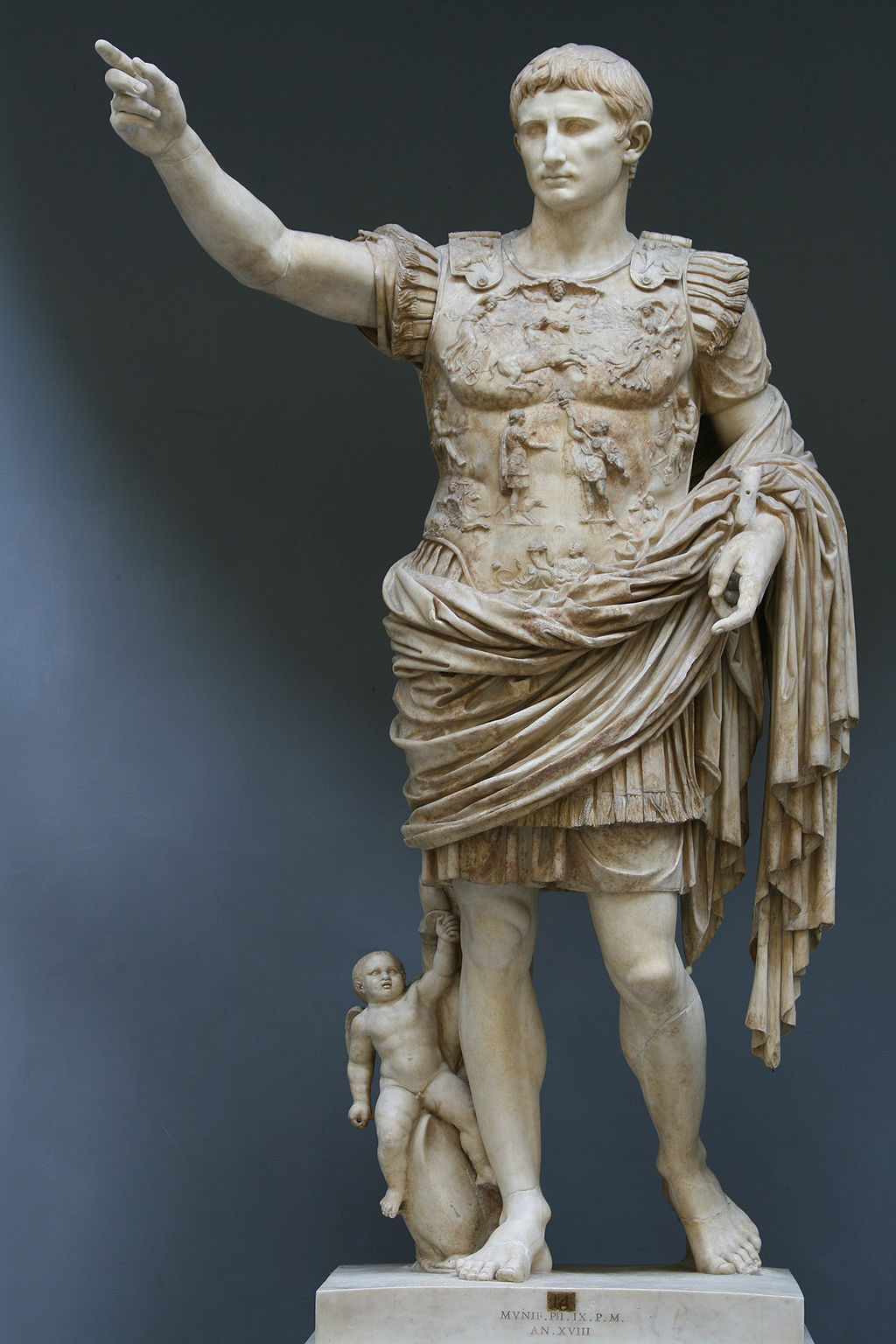
My personal favorite is this statue, called Augustus of Prima Porta. Notice they artwork on the breastplate, the stout facial features, the prominent stance and the combination of a breastplate and a toga. Now imagine that it was painted as well.
Most people in the Roman Empire would never have met or even seen the Emperor. Instead this, and images like this one, is what they would be seeing. On coins, statues or similar. What they see is the pater patriae, the father of the fatherland. The man that keeps peace and prosperity in the empire through his wisdom and intelligence.
So, what can we learn from this cult today?
The Roman Imperial Cult is a prime example of how a politician can use various ways to get the people on his or her side. It is also a great example of how religion can be used to strengthen the power structure in a state. More than anything it shows us the power of something else, something that distances itself somewhat from both politics and religion - the sense of belonging.
Many peoples today have trouble finding their true identity. So were the case also when Augustus came to power in the Roman Empire. The Imperial Cult joined together (almost) everyone in a mutual cult worship that both meant that you were Roman and at the same time that the people across the borders were not Romans.
There are lots of things to learn from this cult, a cult that kept the Roman Empire prosperous for 250 years, before the importance of the cult started to decline in favor of Christianity. If you have a hard time imagining it working in modern times, I suggest you take a look at Vladimir Putin.
^I ^should ^point ^out ^that ^I ^have ^left ^out ^a ^lot ^of ^other ^information ^regarding ^Roman ^religion ^to ^keep ^it ^short.
Often times in history we confront extremely challenging and provoking question, none more so than whether Mithraism was the most metal religion.
The Mithraic mysteries are a fascinating little cult because it was extremely prevalent, yet we know almost nothing about it. There are a handful of literary mentions of it, but the lionshare of information on it comes from its iconography, which places Classical archaeologists in the same place most archaeologists are all the time in reconstructing religious belief from imagery. Because of this, its importance has been exaggerated somewhat in the modern world, and it is not uncommon to see it appropriated by assorted kooks and new agey people today. There is also a persistent story going around that it is the basis for Christianity and Jesus is a redressed Mithras: what the justification for this claim is I will never know. Within the Roman Empire it was of profound importance within the army and within the networks of freedmen and others who made up the Imperial household bureaucracy. That being said, it was never given official sanction, and no Mithraic site has ever been found within the confines of a military camp.
Its origins are a little vague: it was once widely accepted that it was an Eastern import from the Persian Empire, a rather reasonable conclusion given that Mithras was an Iranian deity of great antiquity. However, more research on the Persians has shown that the Mithraic cult was really quite unlike anything that actually existed within Persia itself, rather, the Eastern elements were borrowed to make the imagery more exotic and antique-seeming. Interestingly, Mithraic sanctuaries closer to Persia show a greater prevalence of imagery that was 'accurate" to Iranian belief, so it seems that those with familiarity with Iran purposefully shifted the imagery to be more authentic.
Even without witches and Jesuses, however, it is a fascinating example of the sort of religious diversity within the Early Imperial period of the Roman Empire.
I'm surprised there isn't anything yet on the cargo cults of the South Pacific.
These cults began popping up in Melanesia after WWII when "stone age" civilizations came into contact with American soldiers. The islanders believed that foreigners were going to bring them a huge cargo of many long-denied material possessions. After the war ended and the soldiers left, the islanders built wooden planes on the abandoned runways hoping for the "cargo gods" to return.
One cult believes an American named John Frum is going to deliver this cargo. As recently as 2009, thousands of people still honor John Frum on the island of Tanna. They believe he lives inside a volcano on the island. Every February 15th, they celebrate John Frum day, holding marches with fake rifles and calling for their messiah to return.
Source: Hobbs, Joseph J. Fundamentals of World Regional Geography. Belmont, Ca: Brooks/cole Cengage Learning, 2013. Print.
Wiki link: http://en.wikipedia.org/wiki/Cargo_cult
how accurate was dan carlin's narration of the Münster Rebellion?
Can you tell me more about the Manichaens in China (specifically modern western china) and how pervasive the religion was among commoners?
I want to know more about the syncretic religions of the Caribbean and Gulf. Are they really as common and unconventional as Hollywood likes to portray?
Did Egypt or India ever have mystery cults similar to the Greco-Roman mysteries? What about New World cultures?
The Ancient Egyptians - they had a star cult based on the worship of Ra, is this an accurate way of describing it?
Was Ra's the most prevalent religion in the area, or did this compete with other cults like Isis? (Or did they complement each other)
And last question - what happened to any of these cults, did they morph into different religions elsewhere?