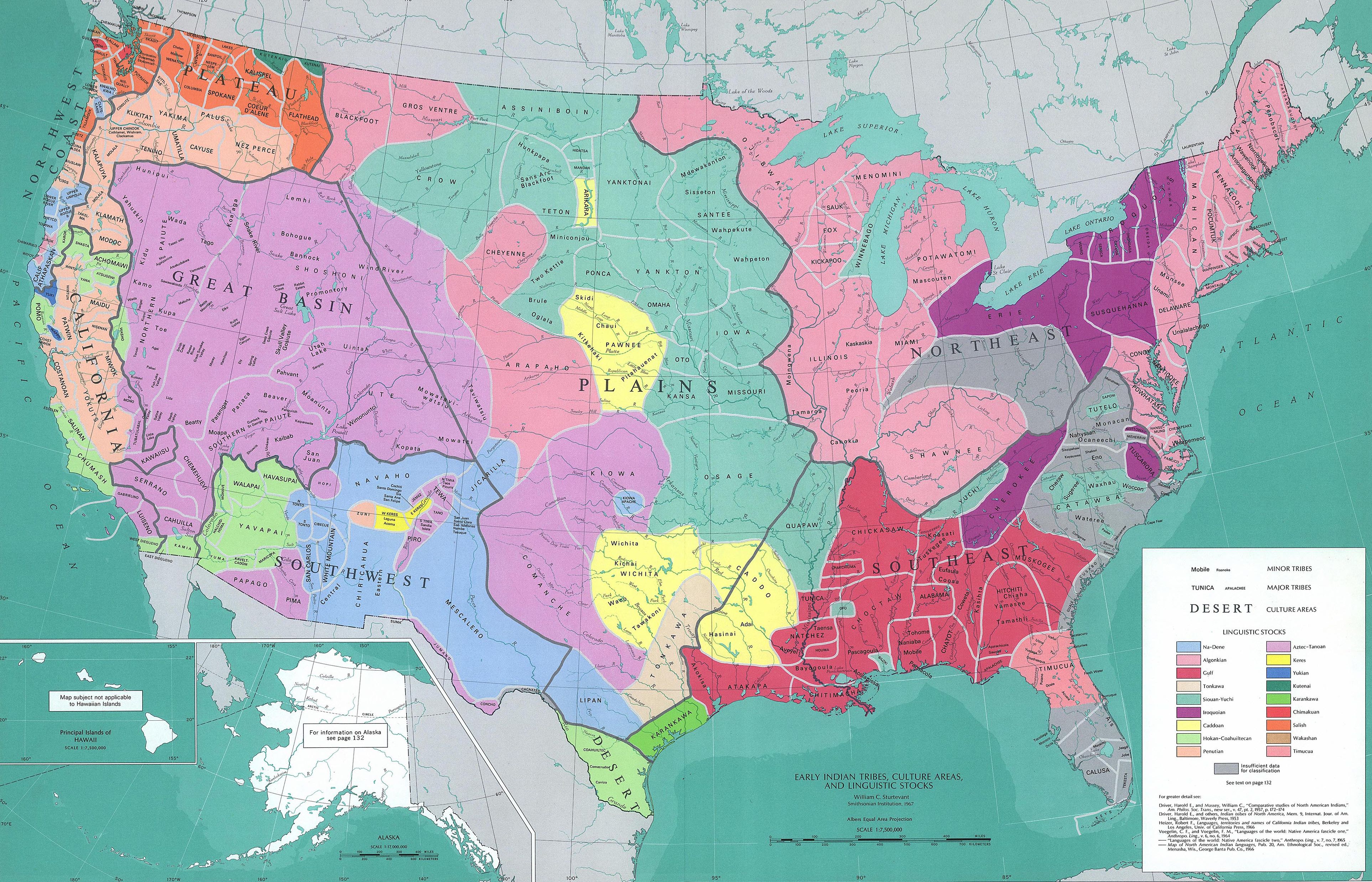
This question comes after viewing this map of Native American linguistic distribution (in what I assume must have been the post-Columbian period). Looking at the map it seemed to me like the Shoshone as a single tribe had the most territory, but is there a more definitive answer as to which Native American tribe, as a single culture, was spread over the greatest land area in the post-Columbian period?
And can there even be a definitive answer for this question? Or is the definition of a tribe as a cohesive unit too vague, such as the division or lack thereof between the Shoshone and Paiute or the Santee/Yankton-Yantkonai/Lakota? And for that matter, how permanent were these tribes really in the context of their formation after the deaths from diseases introduced by Europeans?
Any answer would be greatly appreciated!
When you actually get into looking at ethnographic studies of "tribal" or "segmentary" societies, what you find is that it is extremely difficult to draw a line determining who is in the tribe and who is not. It's even hard to establish that such a thing as "the tribe" in the sense we conceive of it exists.
For instance, a particular field ethnography of the Kurdish people from around the 1970s that I just read describes how in nearly the same sentence, a old man describes his neighbors as kurds, and then as foreigners. With constant migration, marriage, warfare, globalization and trade, who is and isn't a "Kurd" varies wildly on the time of year, social status of the person in question, and relationship of the person to whomever is doing the classifying. A man might be considered a kurd if he moved to a non-Kurdish area, but in his homeland he might consider himself something completely different.
This ultimately gets to the question of how ethnicity is defined anthropologically-- while earlier anthropologists defined it based on cultural forms and features such as material culture, pretty much all credible anthropologists today will state that ethnicity (and therefore which "tribe" you are in) is completely based on self-ascription and the ascription as such by others.
So, getting back to your question, since it's even very difficult to establish where a tribe begins and ends even in modern populations where we have bountiful data and a population that is capable of ascribing ethnicity, it becomes nearly impossible to establish these boundaries based on the archaeological and historical record.
The short answer is, no one really knows the extent of the Shoshone, because no one actually can tell who was a Shoshone and who wasn't, or if the Shoshone even existed at all as a concrete unit.