I've watched Band of Brothers through a half dozen times, because I think it's great entertainment. I've "learned" a bit about WWII from watching it, but I want to know how accurate it is. There are a few dimensions of this:
Band of Brothers, in my opinion, is a very entertaining and well produced series, and a great way to give a general audience a basic understanding of the experiences faced by a typical American combat unit operating in the ETO during WWII. It does however, have its issues with both accuracy and how some things are portrayed. So one does have to keep in mind that the shows primary goal is to entertain, not educate. This doesn't make it a bad show or anything, just not something I would cite academically. Rather than tackle the entire series in a single post, I'll focus on just a couple of points for now.
First off, the show and the book in which it is based on, is primarily sourced on first hand accounts and interviews. Most of which were taken from the men of Easy Company several decades after their experiences in the war occurred. If you haven't read it before, /u/American_Graffit's post here gives a good explanation about why first hand accounts while great in combination with other sources, are not necessarily great sources all by themselves.
Anyways, one major point made by the show that is heavily criticized is the deception of the Troop Carrier Pilots during the Normandy drop. Now in both the show and the book, the pilots flying the 101st to their Normandy drop zones are not really shown in the best of light. We see pilots flying too fast, too low, deviating from their designated flight paths, panicking in the face of fire, etc. The problem with these portrayals in the show and the book is that they are based upon interviews Ambrose conducted with 101st Veterans only, not pilots or other crew members of the C-47's that took part in the airborne drops at Normandy. So obviously, we are getting only one side of the story that night, and not necessarily a well informed one (I can respect the amount of training one undergoes to become a member of an airborne infantry unit, but that training doesn't necessarily make one an expert in flight operations, especially during combat). Flying an aircraft in 1944, especially at night and in combat, is not a mindless task, and it still took a lot of skill and effort to get the majority of Airborne Forces over Normandy in one piece, regardless if they hit the correct drop zones or not.
It also doesn't help that members of the 82nd Airborne, who had previously dropped into combat before Normandy (remember this was the 101st's first combat drop), weren't nearly as critical of the pilots. In fact, the pilots were officially commended by the commanding officer of the 82nd, Gen. Matthew Ridgway, for their actions that night. Now this isn't to say missed drop zones didn't happen and that mistakes weren't made by the troop carrier pilots, but their portrayal as seen in Band of Brothers isn't necessarily fair nor accurate in regards to how things really unfolded during the Normandy Operation. In fairness to Ambrose and the show, this misrepresentation has shown up in other history books and has been touted by other historians, though Band of Brothers seems to be the most grievous offender of perpetuating this misrepresentation. You can read some of the pilots accounts in the sources bellow, and you can quickly see how the events that unfolded that night look completely different depending on the perspective of the person recalling that particular event.
Other inaccuracies appear throughout the show as well. The story of Pvt. Albert Blithe, for example, is shown where Blithe is wounded in the neck during the Normandy campaign and then later dying of his wounds in a hospital four years later. This was based again, primarily upon the recollections of surviving members of Easy Company, and Ambrose did not consult primary sources that would have confirmed or clarified this event. In fact, Blithe lived on after recovering from his wounds, and stayed in the army eventually reaching the rank of Master Sergeant before dying suddenly in 1967. Despite his family's efforts, this correction has still not made it into the book, nor has HBO removed the title card at the end of that particular episode stating this error.
Now as far as weapons, tactics, uniforms, etc. The show did a fantastic job in accuracy as far as these parts were concerned. There are issues here and there, but for the most part, the show seems to have stayed closer to historical accuracy, primarily due to the efforts of Dale Dye and his company, Warrior's Inc.
Sources:
The Troop Carrier D-Day Flight
The show closely follows Band of Brothers by Steven Ambrose. Ambrose wrote the book off of oral histories from the men of Easy company. It's definitely worth checking out if you're a fan of the show.
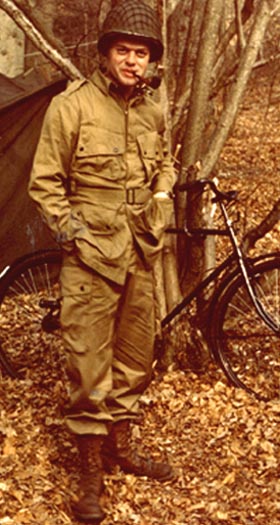
In general, Band of Brothers did a very good job with getting the uniforms and equipment correct.
The 506th PIR would have landed in Normandy with the M42 Jumpsuit, brown Corcoran jump boots, and the M2 Helmet. For Market Garden, the 101st was re-equipped with the M43 field uniform with trousers modified to have large pockets. Replacements would be issued "double buckle boots", so it's common to see soldiers wearing a mix of jump boots and the double buckles from September 1944 to the end of the war. Riflemen would have been equipped with the M1 Garand(this is mine restored to a 1943 time frame), cartridge belt, and possibly bandoleers that would hold 6 enblocs for the rifle.
I know that Band of Brothers gets those major details right. I would have to give the show a re-watch to give any more specifics than that.
One of the parts in the series that stands out in my mind is the rumours of Lt. Speirs executing POWs. There is some controversy over whether this situation really occurred, but another one that is mentioned once is that he allegedly executed a Sergeant who was drunk on guard.
In reality he didn't execute a Sergeant who was drunk on guard, he executed him for endangering his men. An artillery barrage was called in near the american lines and his men were ordered to take cover, the disoriented soldier failed to respond to the order and was shot in the head by Speirs.
Lt. Speirs reported to his CO explaining that he had given the order and then shot the man for disobeying it, the CO was killed the next day and the whole affair was never brought up again.
Out of curiosity and for the sake of history, I decided to re-watch the episode “Day of Days” so I can comment on Band of Brothers recreations of the equipment and uniforms.
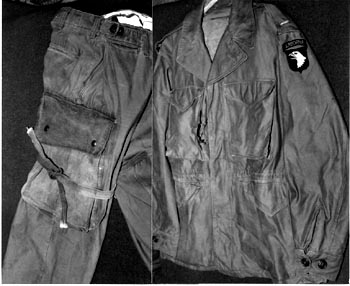
As I stated in a previous post, the basic uniform which consists of the M1942 Jump suit is correct. Getting a little more specific, there were two particular versions of this uniform, one version with reinforced knees and elbows, and one without. The reinforced uniform starts appearing in photographs around the time of Normandy. Much of the issuing is dependent on particular division and regiment. For Easy Company, the show depicts the men in a combination of both types of uniforms, which is consistent with the photographic evidence. On top of the paratrooper’s head sat the M2 helmet. It differs slightly from the standard M1 infantry helmet as it had to accommodate jumping out of an airplane. These helmets are easily distinguishable from the M1 helmets by the distinctive semi-circles on which the chin straps attached. The majority of E. Co is seen wearing helmet nets with scrim (the little pieces of fabric). This is consistent with photographs of 101st units pre-jump on D-Day. As time goes on, helmet nets appear less frequently in photographs in Normandy.
Paratroopers would often jump with several knives on them. For Normandy, the M3 knife was issued to men carrying the M1 Carbine, as there was not a bayonet for the gun until post-war. The other issued knife was the M2 switchblade. The paratrooper would keep it in easy reach in case the he dropped into a tree. This is where the white let down rope would come in handy.
Upon landing, the paratrooper would ditch his main parachute and reserve, ditch the daisy-may inflatable life preserver, prepare his weapon, and then “roll up the stick”—find other members from his plane.
One of the best features of the M1942 jumpsuit is the utility. There are 4 large pockets on the jacket and 2 large cargo-style pockets on the trousers. Unfortunately, this particular uniform was only issued to the paratroopers and not normal infantry. The jumpsuit was designed this way as paratroopers carried more equipment, as their primary purpose was to be dropped into an area outside of immediate supply. They had to carry several days worth of supplies. As such, the photographs we see of paratroopers (and infantrymen) typically have pockets full to bursting. In order to aid the stuffing of the pockets, the trousers actually have ties that go around the cargo pockets in order to keep contents in while jumping. My first gripe with this episode is Lt. Winter's pockets look empty.
The 82nd Airborne consisted of several Parachute Infantry Regiments and Gliders. Despite having the same job as 101st there are a fair number of small uniform differences. For example, the men of E. Co did not jump in with US Flags on the right sleeve, where regiments in the 82nd did. Furthermore, the PIR in the 82nd did not use scrim. Both of these details show up in this episode.
When looking at photos of the modern army more often than not the soldier has his muzzle pointed to the ground. This is not the case for WWII. Soldiers were taught to point their muzzles skyward. The paratroopers walking their rifles with the buttstock in the shoulder with the muzzle pointing down is modern firearm training leaching into the show.
There are a number of other differences in paratrooper’s gear that are not found in the normal infantry. Like I said above, paratroopers were equipped to jump behind enemy lines. The little packs carried on the paratroopers suspenders are the parachutist’s first aid pouch. These pouches contained morphine in addition to extra bandages. There were a number of small differences made to the issued weapons. Notably, a version of the M1 Carbine was produced with a collapsible stock (called the M1A1 Carbine). I’ve heard modern accounts that the stock will sometimes collapse when firing. In any case, when the M1A1s were refitted, they were done so with normal stocks. Lastly, the Army produced the M191A6. The .30 Cal machine gun was refitted with a buttstock and bipod. It was made to be more mobile. For whatever reason, these do not appear in very many photos. Later in the war, they’re practically non-existent.
There is a minor slip up in regards to the chin straps. Soldiers in Normandy wore their chin straps in several different ways. Band of Brothers goes for the “cool look” with the "all down" rather than a mix and primarily fixed behind the helmet.
Lastly, I want to discuss the main infantry rifle, the M1 Garand. In the show they are sporting the milled trigger guard (noted by the ring at the rear of the trigger assembly) and the M1907 sling. The M1907 was a leather sling that was one of the few items in a WWII paratrooper’s gear that is a holdover from WWI. It would be later replaced by the cheaper “olive drab #7” web sling.
There are many minuscule details in the episode in regards to the equipment and uniforms. For the most part the show does a very good job of recreating these details.
Sources:
Edit: Grammar
Also, how often would there be someone like 1st Lt Norman Dike who had little to no experience but still made it to a high ranking position who actually 'fought' in combat?
For that matter, how accurate was the Crossroads battle depicted in the show? I've seen a lot of people criticize that scene because it portrayed the SS as getting absolutely slaughtered by Easy Company with very little retaliation.
At the end of the miniseries the unit is depicted at the Eagle's Nest. I've heard this is mostly fantasy and the unit was never actually there. Was this soldiers exaggerating thier role or were they at a different but similar location and misunderstood?
The producers did their absolute best to render a faithful oral history, as reported to Ambrose. As others have already discussed some of the troubles of oral history, I won't elaborate on that issue further.
The producers and actors met with the surviving men of Easy Company. Rick Gomez spoke with George Luz, I believe twice, to hear information not included in the book, as well as to get his character as accurate as possible. The Actors all went through a fairly intensive boot camp. The infamous spaghetti scene--totally real. They did it to help generate the total hate of Ross' character, and to also replicate what being a drafted solider entailed.
Ultimately, it's entertainment--all movies, no matter how faithful they are to primary source materials, are movies, not history. They are created to make money, just as popular histories are--not to further scholarship. Some, like the Pianist, follow their source very closely--the only change was giving Wladislaw a 'love interest' of sorts. Historians don't consider Ambrose a real historian--his works are not assigned in a history class (and if they are, you need to drop that class immediately). However, it doesn't mean there isn't value in what he is bringing to the table either. I happen to love using movies and assign a paper from a list of WWII based movies to offer up different perspectives in my classes. If they get people interested and engaged, awesome!
I am thinking the detailing of the uniforms, weapons, etc is more of a credit to HBO and Hank's production than to anything else. They invested heavily in this series, and HBO really doesn't pinch pennies when it comes to their programming, and rendering things accurately (look at all the locations GoT is filmed). HBO spent around 120 million on production of the series.
Reading We Who Are Alive And Remain there's a chapter where Michael Sobel, 2nd son of Captain Sobel wrote about his father, and depicted him as a fall guy needed to make a successful BoB series.
I called my mom back, told her what I had seen, and asked her what she thought. She said, “I got the book and started to read it but couldn’t get beyond the first chapter—what they said about your father was just so much garbage.”
R.I.P Captain Sobel.