After hearing some comments from a Brazilian student of mine, it got me researching this particular point of aviation history. Many regard the Wright Brothers as being the inventors of the airplane. However, according to Brazilians, Alberto Santos-Dumont was the first.
Many Brazilians claim (somewhat ironically) that Americans push a false view of history due to vanity and national pride. Obviously, the distortion of history for nationalistic purposes is well-possible of any country, so I didn't want to discount anything. While the true answer seems to be "no one person invented it," it would be nice to have some clear facts regarding this debate if it ever came up again.
Here are my specific questions:
What is the definition of airplane when someone says the "first airplane was invented by..." Conversely, what is the definition of a glider.
One of the factors that Santos-Dumont supporters often cite is that the Wright Brothers used a "catapult" system to launch the plane from the ground. It is therefore, not a plane, but a glider. Depending on whose opinion you read, this system seems to range from "nothing but a rail" to some kind of massive trebuchet-like system that propelled it into the air allowing it to glide for extended periods. What are the technical details of this device?
Another factor is that the French FAI officially awarded Santos-Dumont for his achievements at the time. What is their stance on the Wright Brothers flights, being documented, but not publicly shown. Also, How authoritative is the FAI in matters of aviation history?
Articles and comments on the net seem to be rife with bias without clear definitions and technical details, so any clarity on these points would be appreciated.
As a pilot and amateur aviation historian, this question always annoys the crap out of me. Let's be clear, Alberto Santos-Dumont has absolutely zero claim to the title of "inventor of the airplane".
That's actually a tricky thing to define, which is why there is so much controversy over this. The Wrights invented the first system of 3 axis control and the first aviation propeller, which meant they were able to build the first aircraft able to turn and climb after leaving the ground.
The Wright's 1903 flyer used a launching rail to hold it steady during takeoff. After several close calls with their gliders, the Wrights were worried that their aircraft might fly off course and hit something. The launching rail was nothing more than a couple of planks keeping the airplane from accidentally turning off course. Even the FAI considers this the "the first controlled, powered, sustained (from takeoff to landing) flight involving a heavier-than-air vehicle, using mechanically unassisted takeoff (thrust/lift created chiefly by onboard propulsion)"
Take off performance was still a bit of a sticking point though. In 1904 the Wrights started using a crude catapult picture of replica. It was an optional feature, as Wilbur Wright showed during a 1908 demonstration. During an attempt to set an FAI time to altitude record, the officials disqualified him on account of his "assisted takeoff". Wilbur promptly redid the attempt without the catapult and promptly set a new record.
In the end though, it's not about the Wright brothers. It's about Brazil, and its relationship with the west. Maybe this will make more sense:
"As a result of this indoctrination, the aeronautical primacy of Santos Dumont has become part of a belief system among many Brazilians. When a North American expresses his opinion that the Wright brothers flew a fixed-wing airplane several years before Santos Dumont, he is attacking an article of cultural faith in Brazil. The Brazilian often reacts with emotion, and if the North American counters with evidence, he is an arrogant Yankee." (http://www.wright-brothers.org/History_Wing/History_of_the_Airplane/Who_Was_First/Santos_Dumont/Santos_Dumont.htm)
Sources: http://www.wright-house.com/wright-brothers/wrights/1903.html
http://www.daytonhistorybooks.com/the_wright_brothers_11.html
- What is the definition of airplane when someone says the "first airplane was invented by..." Conversely, what is the definition of a glider.
I can't provide a complete answer but controlled gliders flights were performed as early as 1891 by Otto Lilienthal in Germany. We even have pictures of it. He was able to stay stationary in updrafts and glide for about 250m. He is credited for a lot of advances in early aerodynamics.
As for the term airplanes it is kind of fuzzy since the terminology was still getting defined at the time. The FAI rule for the Archdeacon Cup and the Aero Club of France prize was an unassisted powered flight more than a 100m long by an heavier than air (ie not relying on buoyancy like dirigible). The flight had to be performed in front of the officials.
Santos-Dumont was fairly famous in France after his multiple dirigible flights over Paris between 1900 and 1904(?) with is models number 4, 5 and 6. He was also a regular of the Aero-Club, won several international prizes and was even made "Chevalier de la Legion d'honneur" in 1905 for his aeronautic adventures. That's probably why he got a lot more attention at the time than 2 relatively unknown Americans.
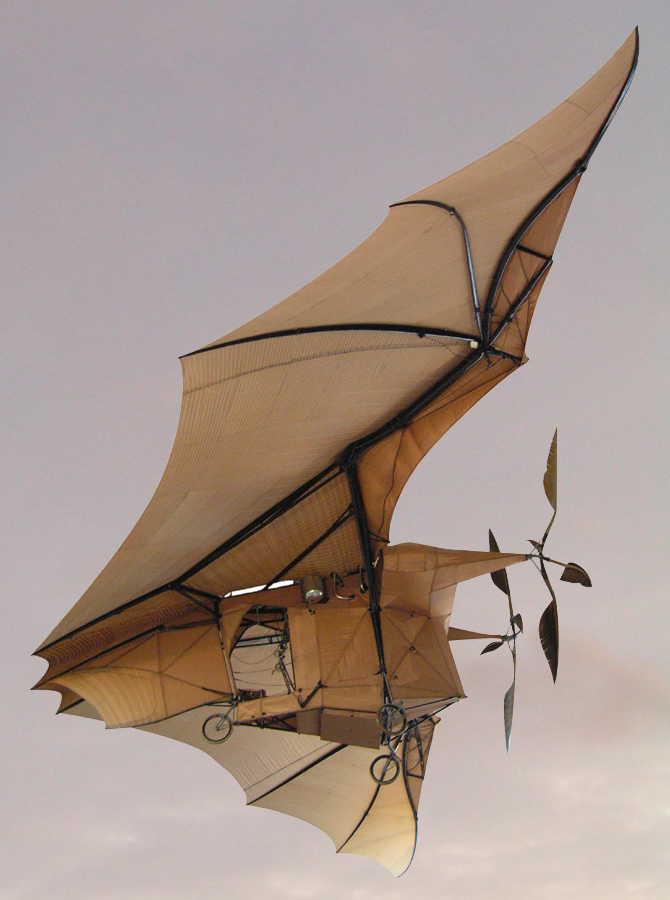
Edit: also as /u/JanitorJasper said there was at some point some claims that Clement Ader was the first make and fly an airplane. His demonstration in front of some French officers was not very conclusive. The testimonies are contradictory on whether is was just a series of bounces or a real controlled flight and IIRC some of the witnesses changed their story several year after the attempt. There is no doubt that his machine was in nearly every aspect but the style, inferior to the Flyer or the 14-bis.
Many regard the Wright Brothers as being the inventors of the airplane.
The Wright Brothers didn't invent, and never claimed to have invented, the airplane. What they invented was means for controlling an airplane in flight (roll, pitch and yaw). I know you may have just been writing loosely, and that this may seem like a pedantic point, but it's a common misunderstanding about what the Wrights accomplished, and parallels many other misunderstandings about the history of technology.
The Wrights did an impressive job of developing their own wing shapes, propellor and motor, especially considering their lack of formal education and their shoestring budget, but none of these things, or their use on an airplane, or the idea of an airplane, was anything new. Here is a list of the Wright Bros. patents. Five of the seven are clearly about ways of controling an airplane, one is for a toy, and the brief description of the first one is deceptive - it's also primarily about controlling an airplane. From the patent:
The objects of our invention are to provide means for maintaining or restoring the equilibrium or lateral balance of the apparatus, to provide means for guiding the machine both vertically and horizontally ...
Since wings, motors and propellors had already been developed, the important thing the Wright Bros. did was to add the last piece of the puzzle for building a workable airplane.
As for the question of who had the first successful heavier-than-air flight, as you noted, much of the controversy revolves around things like whether the Wrights were cheating by using a launch rail, strong headwinds, etc. There were no previously defined criteria for winning a prize or anything, and the FAI was only founded two years after the Wrights' 1903 flight, so the debate may continue forever. I think it's somewhat arbitrary and is only about bragging rights. It has little to do with the development of aircraft technology.
The catapult system was used, but was optional. In 1908, the FAI disqualified the Wright Brothers from a height record because it was deemed that the flight was made by "assisted take-off". The Wright brothers promptly set another record without the catapult.
The Wright Brothers made many public flights in America before 1905, the year the FAI was formed --and before Santos-Dumont's first flight in 1906 -- and were by no means working in absolute secret. Furthermore, the first flight in Kitty Hawk in 1903 was viewed by witnesses, however no members of the press were asked to attend so that the brothers themselves could break the news in their home town of Dayton, Ohio. The Wright Brothers were simply unimpressed by the FAI which was created after, and possibly as a result of their flights prior to 1905.
Furthermore, the argument that Santos-Dumont made the first controlled heavier than air flight is likely to be a consequence the propaganda of the Vargas dictatorship of Brazil. School books and other media were made to glorify Brazil; this made the story of Santos-Dumont a part of the popular "belief system". While the dictatorship ended in 1945, many of the books and ideas created live on to this day.
Source: WrightBrothers.org