Dinosaur bones had been found for ages, but no one really knew what to make of them. You have to remember that the vast majority of all fossils are just fragmentary bits of skeleton....you pretty much never get the full skeleton in life articulation. Unless you know a lot about bones, you won't have a clue what sort of animal they come from. Anyway, up until the early 1800's people generally thought these bones were the bones of pre-flood giants.
Anyway, by the early 1800's enough work had been done on vertebrate bone structure that people were starting to recognize dinosaur bones as reptilian in nature. Rev. Gideon Buckland named Megalosaurus and Gideon Mantell named Iguanadon. Both their reconstructions were pretty far off the mark, but represent the very beginning of a real understanding of dinosaurs. In the 1840's Owen coined the word "dinosaur" as people started to realize that these species were the same "type" of animal.
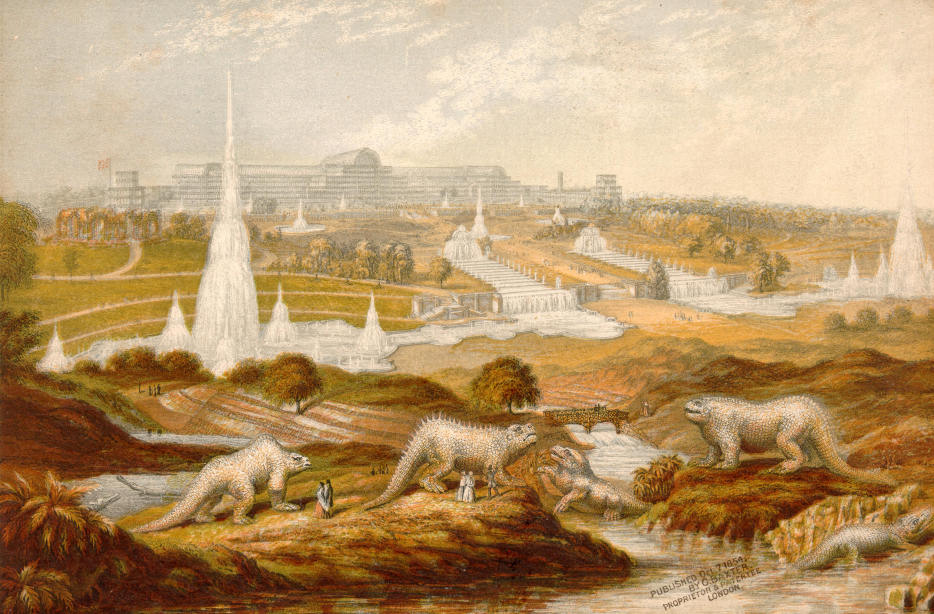
The Crystal Palace Park had (still has, actually) a famous set of statues of dinosaurs and other extinct creatures which opened in the 1850's. My understanding is that they were a rather popular attraction and even got their own merchandising in the form of miniatures for sale. Note that this is all a few years prior to The Origin of Species.
A bit later (1870-90ish) and in America, some big dinosaur discoveries were made thanks to intense competition between Edward Drinker Cope and Othniel Charles Marsh. Both led numerous digs in the American West, and the rivalry between them was so intense that its often called "The Bone Wars". The whole story is a really fascinating mix of science, drama, and wild west action. They described some of the most famous dinosaurs in the public imagination, including Stegosaurus and Triceratops.
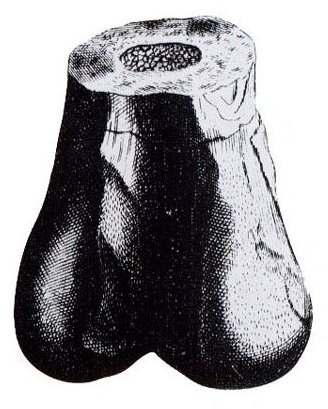
There are a few possible answers to this question. The first dinosaur fossil was described in a scholarly fashion in late 17th century, and more would follow, describing fragments such as teeth. They did not however recognize these fossils as all coming from one group of extinct animals, let alone giant reptiles— they didn't even know about the mechanisms of fossilization at the time, or that extinction was even possible. Robert Plott concluded that the first fossil was actually from a giant human. I'm gonna quote myself from a comment in a related thread with the source:
In 1676, Robert Plot published the first scientific illustration of a dinosaur fossil, in his book, Natural History of Oxfordshire. It's online here, the part discussing the fossil starts around page 132 and goes on for many pages.
"And that indeed there are stones thus naturally fashioned, must by no means be doubted... [but] none of them, as the judicious Charles Marquess of Ventimiglia well observed, [have] any signs of hollowness for the place of the marrow, much less of the marrow itself. Which has fully convinced me that this stone of ours was not so produced, it having those signs exquisitly expressed; but must have been a real bone, now petrified...
But against this opinion of its having been once a real bone, there lies a considerable objection, viz. that it will be hard to find an Animal proportionable to it, both horses and oxen falling much short of it... If so in probability it must have been the bone of some Elephant brought hither during the Government of the Romans in Britain.
But... there happily came to Oxford while I was writing of this, a living Elephant to be shewn publickly... with whose bones and teeth I compared ours; and found those of the Elephant not only of a different shape, but also incomparably bigger than ours, though the Beast were very young and not half grown. If then they are neither the bones of Horses, Oxen, nor Elephants, as I am strongly perswaded they are not, upon comparison, and from their like found it Churches: it remains, that (notwithstanding their extravagant magnitude) they must have been the bones of Men or Women." (pg 136)
And then he goes on for many more pages discussing various historical and biblical accounts of giants, and concludes that yes, since it wasn't an elephant bone, it must have been from a giant human. The fossil in question was only the end of a femur, so you can understand why he didn't jump immediately to 'giant lizard.'
Dinosaur knowledge wouldn't really ramp up until the 19th century. By the early 1800s, 3 dinosaurs would be known from enough remains to be described reasonably well— the first, Megalosaurus, the second, Iguanodon, and the third, Hylaeosaurus. In 1842, Sir Richard Owen coined the term dinosauria as an order containing these 3 extinct animals, in his "Report on British Fossil Reptiles, part II," which you can read online here. He established a museum of natural history exhibiting dinosaur fossils in London, and in 1852 would commission life-sized sculptures of his dinosaurs, along with other extinct giant reptiles to be put on display in Crystal Palace Park. (On New Years' 1853 they hosted a banquet inside one of the Iguanodons, to demonstrate how large it was!) These statues were incredibly popular, there are tons of contemporary images of them, and you can still visit them today. Keep in mind this is all before Dawin's Origin of Species.
In 1858, the first dinosaur would be discovered in the United States, and this lead to a an enormous interest and competition that lasted through the rest of the century to unearth as many fossils as possible, leading to hundreds of new discoveries. During this time the perception of dinosaurs shifted away from just giant lizards to something more, with discoveries like Deinonychus— Here is an illustration of Deinonychus in 1869, from John Ostrom's article about its osteology. As you can see, it's rather modern, and it was at this time that some scientists began to advocate that dinosaurs might have been warm-blooded and active. In 1877, Othniel Charles Marsh even proposed that birds were descended from dinosaurs, but this was not accepted at the time. The public's perception would be rooted in a slower, duller, tail-dragging style of dinosaur well into the 1900s, but dinosaurs would continue to be very popular. (If you want a humorous insight into dinosaur perception from 100 years ago, you can watch one of the first animated movies, 1914's Gertie the Dinosaur, right now (it's great))
Ask away if you're interested in elaboration.
If I may play Youtube for a moment: You may also like "What did Pre-modern era people think of Dinosaurs and Fossils? " from a few days ago.