In the beginning of the movie Gladiator, the Roman armies catapult some sort of burning cannonballs or other objects toward the Germanic armies in the forest. They hit the ground or trees and explode in a flash of fire, setting the tree or forest floor ablaze. What were these? Was that historically accurate? What were some of the other awesome weapons available to the Romans?
What you were looking at was in essence clay pots filled with pitch, meant to shatter on impact and spread fire. As is the case with most films (particularly Gladiator), take into consideration that they were significantly amped up to make the scene look more dramatic. While it could be visually impressive on the battlefield, they won't "explode" per se, any more than the classic video of the kid on Youtube trying to kick a burning soccer ball.
But the Romans always had something I personally found pretty impressive. Their usage of scorpions and ballista have always piqued my interest as early attempts to leverage the battlefield and the sheer power of the pilum were all something to behold in a time period that was more about the summoning of men to fight.
The scorpion was noted for its accuracy and range. It was not a large piece of equipment by any stretch of the imagination, standing roughly waist to chest high. It was almost the ancient equivalent of an MG-42, distributed to legions with the expectation of being placed on a high hill and sniping or "suppressing" (as much as a single fire long range bolt thrower could) by raining down death at up to 400 meters. It softened specific enemy units up on their way to try to fight the legion. Caesar described them as terrifically accurate.
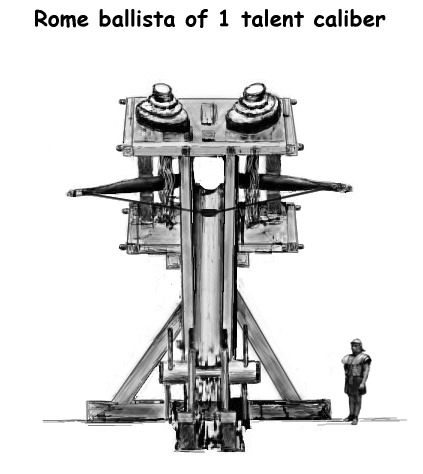
The ballista was significantly larger and was meant to throw a bolt, stone, or art at a significant range. Don't be confused by depictions you see in fantasy or movies, ballistae were not giant crossbows, but complex, sophisticated torsion systems that were well engineered and crafted to take advantage of torque to send extremely heavy objects extremely long distances to do extreme amounts of damage. They could be used both defensively, as they were at Alesia, or offensively.
As impressive as these were however, I am constantly amazed, instead, by the Romans' abilities to remain cohesive, disciplined, and inventive under stress and fire. For example, the seemingly impregnable fortress of Masada (just looking at it is incredibly intimidating) was threatened, according to Josephus, because the Romans simply endured their rain of harassing projectiles and built a ramp all the way up to their wall, which they planned to crush with a battering ram.
Although some debate exists today as to precisely how the Jewish zealots inside reacted, according to Josephus (and the most common narrative) the sight of the imminent sacking was enough to drive them all to quasi suicide. (quasi because they drew lots to kill one another, with the last man, allegedly, killing himself).