Okay, that's a terrible pun, I know. I think it's kind of becoming my trademark, though.
This question is actually part of a much larger topic I'm curious about, but I was hoping to provide a springboard into the broader field.
I really want to know how warfare itself evolved throughout the First World War. I know that Kitchener was hugely influential in the development of a different kind of British Army, although I don't quite know how.
Let's keep the question focused. What was the British Army like in 1914? How had it changed by 1916? And how had it changed (from 1916) by 1918? How did tanks change during these times?
Well, the first British tanks (the Mk I, II, and IIIs) were designed in 1915 and entered service in 1916. These gigantic monstrosities were largely unsuccessful beyond proof of concept. Most of the time they broke down in the muddy terrain, the crew passed out in the extreme heat of the engine compartment or from the fumes due to the fact that the engine compartment and crew compartment were one in the same.
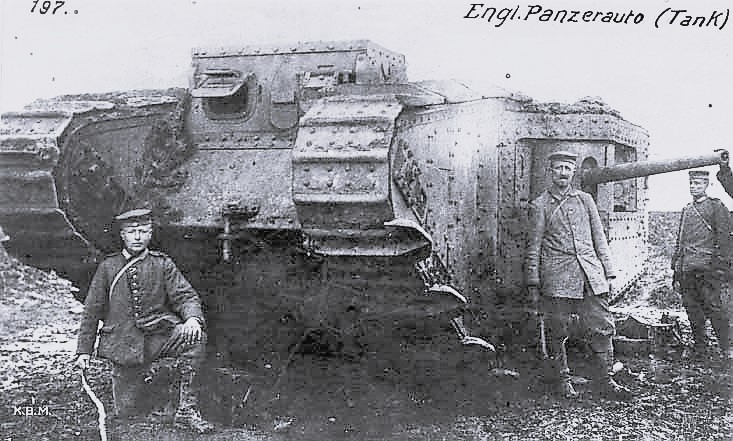
Once/if the tank did get to combat it had numerous design flaws. The armor was thick enough in most places to prevent small arms fire from penetrating, but the top armor might as well have been tin foil. Not only that, the tank used rivets instead of welds, meaning that if a round from any common Mauser rifle were to strike one of the rivets, shards of metal would fly off into the crew compartment, ricocheting around until it struck a crew member. All in all this adds up to what you would think to be a terrible machine, but it had a tremendous psychological effect on enemy soldiers. I mean, just imagine that you are sitting in a cold, damp trench, surrounded by the decay of dead bodies, and the cries of the soon to be dead bodies, and then suddenly - this thing comes over the trench - http://upload.wikimedia.org/wikipedia/commons/a/a7/German_photo_with_English_Tank.jpg now keep in mind that the only piece of machinery you've seen in your early 20th century life is a premitive tractor that your more successful neighbor bought for his farm. How fast would you give up the will to fight? That was the real effect of the Mk I-IIIs, but they weren't produced in enough numbers to effect the tide of the war that much.
This post is getting quite long so let me start a new one to talk about the Mk IV.
Sources -