Watching a documentary called Filthy Cities, I saw an episode on Revolutionary Paris. It demonstrated how appallingly disgusting Paris was at the time, and how the retched unsanitary conditions helped spark revolt. Later on the episode it talked about the famous Palace of Versailles, and said that the famous palace had very few toilets, and as a result most of the guests had to relieve themselves behind pillars and curtains, making the entire palace was reeking open sewer.
Why would a place of such prominence and power as Versailles be built with such a critical flaw? Surely the designers knew it would house a large number of people, why didn't they build sufficient sewage systems to accommodate them? All the fancy sculptures and gold in the world seem like they'd be let down by piles of reeking shit in all the corners. Why would Versailles be allowed to be so filthy?
Versailles was built on and off from around 1664-1710, in a time when efficient sewage systems weren't really a common thing, and Versailles was built in a small, rural village, so it wasn't like there was an already established sewer system that the builders could have easily tapped into. Therefore, it can't be called a critical flaw. What they did have in abundance were buckets/chamber pots/ fancy chairs with a whole in the seat and a bucket below it, as well as copious amounts of servants who would regularly clean up. Most people weren't doing their business right on the floor, but it could have happened.
To answer your questions more directly, it would have been filthy by today's standards, yes. Aside from the previously mentioned bodily wastes which weren't whisked away with modern flush toilets, the remodeling of the palace over the years meant that the chimneys didn't work particularly well, so it got quite smokey/sooty inside. And of course, people bathed less frequently than they do now, so in general people didn't smell as nice. As to why it was allowed to be so filthy? Well, standards of hygiene and cleanliness have changed in the last 300+ years, and what you consider filthy people hundreds of years ago would have called clean.
All that being said, there's a lot of assumptions on French hygiene floating around that are rather prejudiced. In researching the answers to your questions, I've found a lot of repeated rumors about the lack of toilet facilities and the "piles of shit" in the corners. This seems to go along with countless stereotypes about the French people and their supposed lack of hygiene. After the French Revolution and the monarchy was dissolved, anything pertaining to that era was seen as negative, backwards, disgusting even. Fashions changed in order to avoid associations with the ostentatious lifestyle at Versailles, and nasty rumors started about the monarchs and their lives. These rumors included the myth that these fancy, wealthy nobles were just shitting all over the floor of their fancy palaces. In actuality, through all the regular renovations of Versailles, it was modernized with the required facilities.
tl;dr While hygiene has drastically improved since the French Revolution, Versailles wasn't nearly as disgusting as you think.
Indoor sanitation wasn't a huge priority for the 17th-18th century court. Public urination in particular was rather common throughout Western Europe (Source). That's not to say that it was entirely accepted by everyone: when Frederick the Great built the Sans Souci palace, he had to post a sign forbidding his courtiers from urinating in the Grand Portico. And at Versailles in 1762, the comte de Compans complained about the kitchen boys "attending to their needs" outside his bedroom; the kitchen boys responded in time by "breaking his windows." (Source)
Simply adding bathrooms was not the solution, as the latrines at Versailles stank as well. In 1785 one privy in particular got so bad that seven people with rooms in the vicinity filed a complaint, saying that "The smell penetrates the lodgings...and infects furnishing, clothes, and linen" and that it attracted "certain riffraff who use it as a meeting place."
The vast correspondance of the "Princess Palatine", the Duke of Orléans' (younger brother of Louis XIV) wife, provides a detailed account of the personalities and activities at the court of her brother-in-law.
In a letter dated back to the 9th october 1694 she tells her aunt Sophie, Duchess of Hanover, what a pain it can be to "shit" (she actually uses the word "chier") at the Fontainebleau Palace.
Excerpt (courtesy translation): "I esteem you to be happy to shit whenever it pleases you ; [...]. It's not the same over here, I'm obliged to keep my pile of fecal matter until the night ; [... she explains that she lives in one of the houses attending the forest, that are not equipped with any lavatory facility], consequently I am chagrined to shit outside and that annoys me because I like to shit conveniently and I do not shit conveniently when my ass is not rested anywhere."
Source (in french): Here.
Edit: Some minor changes in my references had to be made.
Just going to elaborate on /u/GuineaGuyanaGhana's informative post. :)
Firstly, the French were not the only ones who relieved themselves in the corners of rooms.
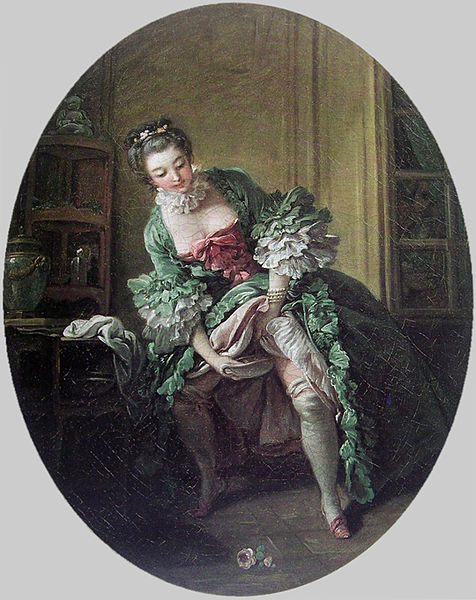
While I'm sure some people did relieve themselves in hallways and corners by necessity, it was much more common in the times/areas where construction was happening in the palace. Chamber pots existed and most private rooms would have contained one that would be emptied by servants. If you were a woman and needed to relieve yourself while wearing a dress, a lady of means would use a bourdaloue (a fancy chamber pot) under her dress, usually behind a curtain if she were in public.
Now, on to why the palace had sewage problems to begin with and why they weren't addressed effectively. Versailles was originally a hunting lodge used by Louis XIII. Louis XIV had fond memories of the area as a child, so when he wanted a new country retreat, he decided to build his palace around his father's old hunting lodge. (The original structure is still there and enveloped by the current palace.)
This is the reasoning for the palace being in a very specific place. The sewage problem was a symptom of the location; there were no large reservoirs of water nearby to sustain the populace or drain sewage from the palace. This lack of water was a problem for Louis XIV and subsequent French kings using the palace; it's been estimated that a third of the money spent on Versailles by Louis XIV was used in an attempt to solve the water issue.
TL;DR If you're going to build a huge palace, do it near a decent water source.
Artwork referenced:
Aaron Martinet (publisher), L'après Dinée des Anglais, c. 1814
François Boucher, La Toilette intime (Une Femme qui pisse), c. 1760's
Jacques Gomboust, Vignette from the 1652 Paris map by Gomboust, showing the Château de Versailles as constructed, c. 1630–1640
Speaking of "relieving oneself on the floor," my humanities professor told me that the large skirts/dresses that women wore in that time were as such so women could relieve and not indecently expose themselves. Is this true?