We have a rich legacy of ancient academic and creative writing and artwork but hear comparatively little of the music of the time. Did any Greek compositions survive and can they be played by modern musicians?
One of the most well known examples of Ancient Greek music would be the Sekilos epitaph, which is the oldest example we have of musical notation that accompanies lyrics. It dates back to the first century CE and is written in the Phrygian mode, a specific type of scale which can be played today as the D-D octave on the piano. Other Greek scales which still see use include the Mixolydian (G-G B-B) and the Dorian (D-D), all of which still play an important part in musical theory.
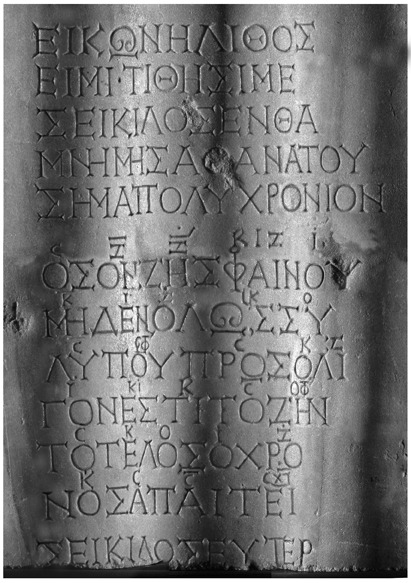
The epitaph is recorded on a steele on which there is this inscription. If you read Greek, you'll notice the very strange capital Omega (Ω) as well as the almost triangular Phi (Φ) which lends a clue to its age. The inscription begins with a poem:
"Εἰκὼν ἡ λίθος εἰμί.Τίθησί με Σείκιλος ἔνθα μνήμης ἀθανάτου σῆμα πολυχρόνιον"
Which reads:
"I am a tombstone, an image. Seikilos placed me here as an everlasting sign of deathless remembrance"
And then is followed by a song:
Ὅσον ζῇς φαίνου
μηδὲν ὅλως σὺ λυποῦ
πρὸς ὀλίγον ἐστὶ τὸ ζῆν
τὸ τέλος ὁ xρόνος ἀπαιτεῖ.
Which translates to:
While you live, shine
Have no grief at all
Life exists only for a short while
And time demands its toll
On the inscription, you'll see, above the lyrics, letters such as Zeta, Kappa, Iota and others, some with lines and dots to indicate value of note. These are the notation marks that can be used to play this piece today. This piece was rather wonderfully covered by Hank Green at the Vlogbrothers, and was also used by Firaxis as the theme for Alexander the Great in Civilisation V.
Beyond Greece, there exist a set of even older Mesopotamian songs inscribed in cuneiform called the Hurrian songs, of which number 6 is complete. Hurrian hymn no. 6 is therefore arguably the oldest complete work of notated music extant, but because Hurrian is so poorly understood as a language (compared to Ancient Greek) and because of the comparatively poor condition of the Hurrian songs, the Epitaph of Seikilos is far better known as the "oldest song".
EDIT: I just realised that the Mixolydian mode is only G-G in the modern use. The Greeks would have had it closer to B-B.
Don't forget to check out /r/earlymusicalnotation if you're interested in this kind of stuff :)