The general impression I have is that feudal societies were vastly more unequal than modern industrial democracies. Is this characterization correct? And does it hold for all aspects of inequality? (For ex. inequality in education might have be much larger compared to today but was inequality of income or general quality of life much larger than the more unequal industrial democracies of today?). And how much does the difference in inequality between the feudal past and the democratic present vary by region? (i.e. in Europe, Middle East, South Asia, East Asia etc.)
Has there been any attempt to put numbers on, say, the gini coefficients on distribution of some measurable aspect of medieval life?
Here's a pretty involved overview of economic inequality in premodern societies. They don't examine feudal England or France, but they examine some fairly similiar societies. For the most part the Gini coefficient of these societies isn't hugely different from today. Rome in 14CE and Byzantium in 1000CE both at a Gini coefficient of around 40, which is actually better than the United States' Gini coefficient of 45 today.
But, as the authors point out, the Gini coefficient doesn't tell the whole story. Even though by that measure these ancient societies were more equal, this doesn't mean everyone was necessarily better off. A significant percentage of the population were living at or below subsistence levels, meaning they could barely obtain enough food to survive. Today the surplus wealth of the rich is higher, but both the poor and the rich can at least afford to eat.
One area in which it certainly does not hold is nutrition and fitness.
On the one hand, advances in dietetics naturally mean that the best-nourished people today are better nourished than the best-nourished people then (not that they necessarily eat more, but we know more of what nutrients are essential).
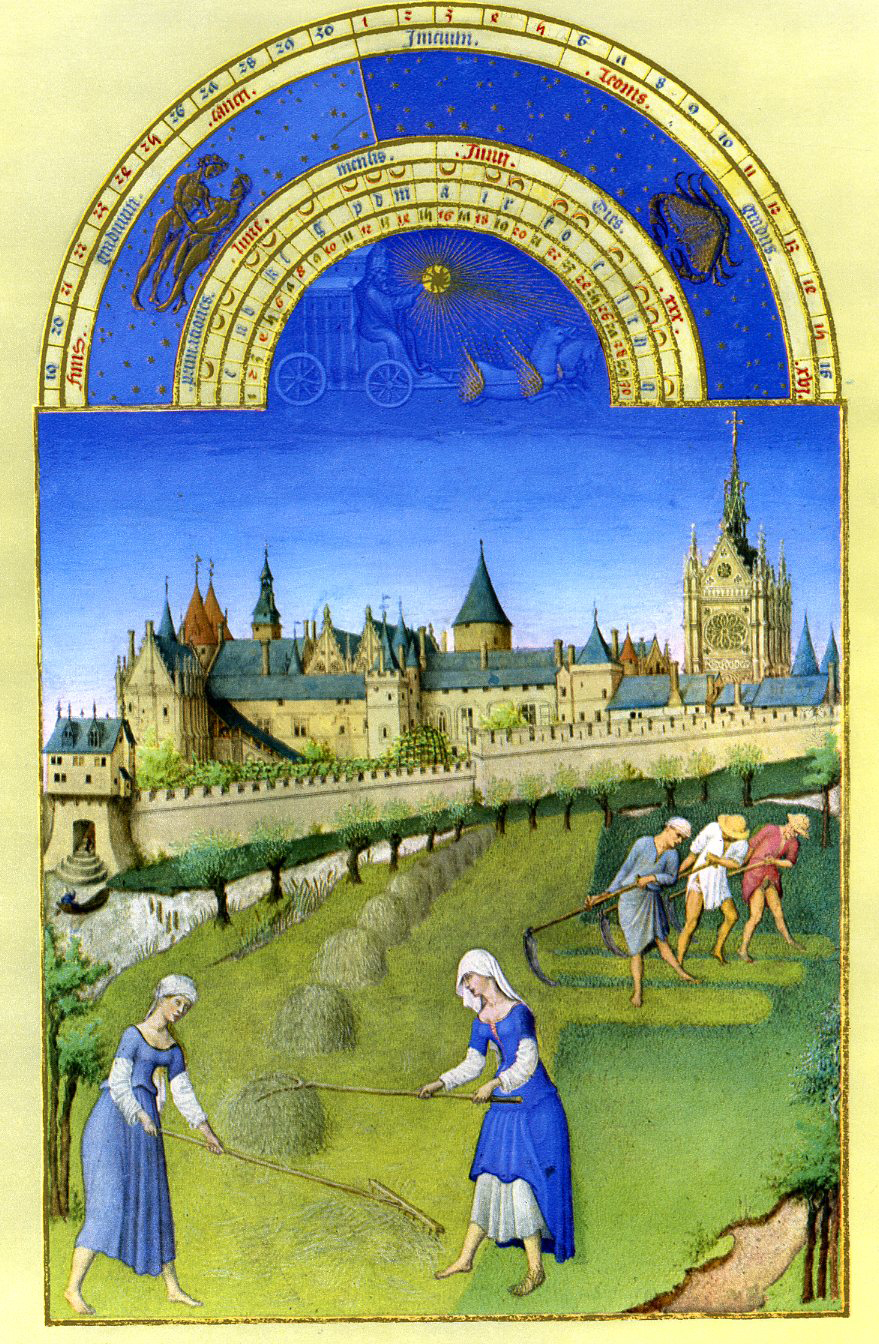
Far more glaring, however, is the difference between how poor people in the Middle Ages ate and how poor people eat now. Now, of course, it is common for poor people to eat junk food because it is cheap, and junk food is terribly unhealthy. But in an agrarian society like those of most of medieval Europe, poor people are farmers. In sufficient quantities, farm-grown food will just about always be healthier than junk food. And in most cases, medieval peasants did have sufficient quantities. Sure, there were sometimes food shortages and even famines, but in general your average medieval peasant--the guy or gal on the bottom of the social hierarchy--worked hard and ate a nourishing if bland diet. Some meat, some vegetables, and a lot of grain. Granted this may be stylized, but see how fit these peasants look.
And if the difference is bad between the Middle Ages and now, it was much worse between the Middle Ages and the Early Modern period. The poor then didn't have the luxury of being unhealthily nourished by cheap junk food, so they basically didn't eat at all. It's a common myth that people in the Middle Ages were very short. In fact, the average medieval height was almost what it is today in modern developed countries. Our collective memory has been misled because people were so short in the Early Modern period. The average height went sharply down after the Middle Ages (one source says around 3 inches) and only recovered to the medieval average in the 20th century. And height correlates very strongly with level of nourishment, so that's some pretty solid supporting evidence.
Sources:
Nutrition and the Early-Medieval Diet, Kathy L. Pearson
New Light on the “Dark Ages” - The Remarkably Tall Stature of Northern European Men during the Medieval Era, Richard H. Steckel
Various medieval history courses I have taken in college