I've gotten really into War Thunder (a WWII air combat game), and I started to realize just how...similar all the aircraft are. Think about it:
Engines in front. Airfoil design. Interrupter gear (to allow bullets to fire through the propeller). Three control surfaces. Flaps to adjust the aerodynamics of the wing. Retractable landing gear. Cockpit mostly over the wing. The wing being one piece (so the plane is more of a body attached to a wing, not wings attached to a body). Gun sights. Similar types of gauges. Semi-similar construction. All the planes almost look like they came from a common ancestor, which I imagine was the wright brothers.
So, was the design of the plane well known and distributed everywhere before WWI, and then evolved to fit the needs of the fighters in WWII? Or is this an example of converging evolution, where multiple different people independently discovered how to fly and design aircraft?
Side note: I know that there were MAJOR differences in some aircraft. Take the P-47 Thunderbolt (Jug) and the A6M2 Reisen (Zero). The Jug was armored to hell and had amazing firepower, but couldn't turn worth a damn. The Zero, on the other hand, was super maneuverable, but if you looked at it wrong it exploded. I'm talking about the general design of the aircraft...the wings, tail, etc.
I think there is more variation than you give credit for.
Regarding WWI, there were both tractor (engine in front) and pusher (engine and propeller in rear) designs. Alongside machine guns firing through the propeller arc there were a number of designs that featured machine guns above the top wing--notably the Nieuports as well as the S.E.5a. The mechanism for how the control surfaces were actually activated was also different, from wing warping to 'modern' ailerons. Monoplanes were featured early in the war, later giving way to biplane and triplane designs. You wouldn't really mistake German bomber design at this time for their English counterparts, either.
In WWII, you had low wing monoplanes and mid-wing monoplanes. Inline engines like the Spitfire, Mustang, and -109 allowed for narrow fuselages and great aerodynamics. Massive radial engines in the P-47 and -190 provided massive power but required a larger plane--especially in frontal cross section.
Also, you greatly malign the Thunderbolt (Jug). At altitude, it was both powerful and nimble. It would never be confused for a Zero in the maneuverability department, but it wasn't some lumbering behemoth either. It was armored enough to take a severe beating.
So, was the design of the plane well known and distributed everywhere before WWI, and then evolved to fit the needs of the fighters in WWII? Or is this an example of converging evolution, where multiple different people independently discovered how to fly and design aircraft?
It was much more the latter than the former. There were a number of solutions attempted in the interwar period. Planes like the P-39 were designed around a cannon firing through the propeller hub, with the engine actually behind the pilot. Biplane fighters were phased out for faster monoplane designs. Air races were held--you'd recognize the shape of 1930's British entrants in seaplane races as the direct ancestors of the Spitfire, for example.
Though there was a great deal of convergence in design between competing designs, there were great departures as well. In the 1930's the Japanese favored the long range and maneuverability of the legendary Zero. It was an excellent design that allowed for Japan's early aerial dominance, but that design had a cost. Weight had to be saved, so the plane featured no heavy features like armor around the pilot or self-sealing fuel tanks. The American designs in the Pacific like the Grumman F4F Wildcat were built to last, with redundant systems allowing for safe landings on a pitching carrier deck, heavy armor, and an overall robust design. All that weight meant it couldn't turn with a Zero, though, and it had serious rate of climb deficiencies as well in comparison.
If you have the chance, visit a local air museum. The best (in my opinion) is the National Museum of the United States Air Force in Dayton, Ohio. In person, the seemingly minor differences between planes become more glaring.
So, in sum, there were a number of features that became common because they were (and largely are) the best way to do things. However, there was a great deal more variation than is immediately apparent--especially in a video game.
And be nice to the Jug.
A lot of the apparent similarities between aircraft of similar era is because in many ways, the overall layout of an aircraft is going to be based on physics, how the craft is used, manufacturing processes available, and access to technology. A lot of my examples are going to be from WWII era craft, but the basic principles are going to be the same throughout a lot of eras.
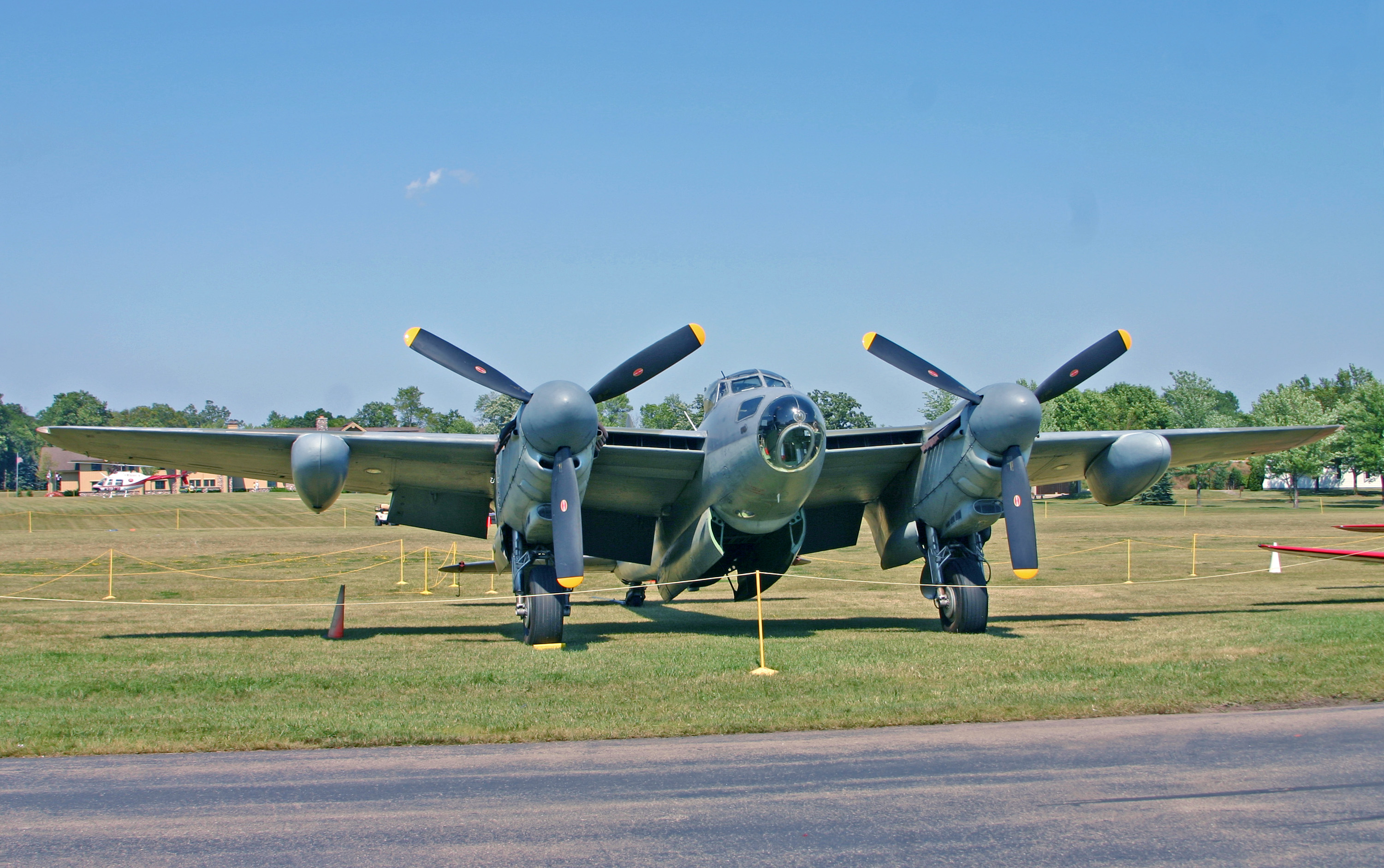
In an era before computer control and fly by wire systems, you had to build an aircraft that's inherently stable. That means that the wing is going to have to be placed on or near the center of gravity fore/aft. For aircraft that need maneuverability, you want to put as much mass as possible near the lateral center of gravity, so they will try to put the engine(s) either in the fuselage or near the fuselage (see the [Me-110] (http://www.century-of-flight.net/Aviation%20history/photo_albums/images13/31.jpg) or Mosquito for multi engine fighters, the engines are as close inboard as possible while still allowing clearance for the propellers). Then you have to deal with issues such as pilot visibility, so you see a cockpit high above the fuselage such as in the Fw-190, Yak-3, and P-51.
As far as a low vs. high wing this is often a case of trying to maximize pilot visibility and structural integrity. It is often easier to build around the main wing spar (the main beam that connects the two wings and supports them) so you wind up with a lighter aircraft since less supports are necessary to maintain structural integrity. Less weight means longer ranger, faster acceleration, and more maneuverability. Retractable landing gear came into vogue as larger and more powerful engines became available. This is because retractable landing gear reduces drag and as engines became more powerful, the drag penalty of fixed landing gear outweighed the weight penalty of retractable landing gear.
Long story short, form will follow function. If you look at aircraft from WWI, WWII, Korea, and even the cold war, you'll see that aircraft that have similar functions will often look like each other because they all have to obey the same laws of physics and the aerodynamic technology they have available to the designers will often be relatively close. Compare a Spad XIII, Nieuport 17, Sopwith Pup, Albatross D.III, and Fokker D.VII. They all look pretty similar because they by and large had similiar technologies available for their design. The differences are mostly due to how the designers decided to implement those technologies. The same goes with the MiG-15, Su-7, F-86, and Dassault Mystere. Get to 4th generation fighters and compare a F-15, Su-27, MiG-29, and F/A-18.
Now all of those outward similarities can hide a lot of differences. Differences in wing design, avionics, control surfaces, etc all play a large part in how the final design will fare.
Is the Eindecker in War Thunder? It was a WW1 German design that didn't use what we consider the traditional flight surfaces. It used what is known as wing warping instead of ailerons. It was also a monoplane at a time when most planes had multiple wings.
The designs were similar because there were similar desires. Fighters should be both stable (accurate guns) and maneuverable (out turn). If you put the engine in the center, you lose some of the stability in cases where the plane is flown past certain limits (The P-39's mid-mounted engine placed weight in such a way that if the pilot spun the aircraft, it was harder to get out of the spin). Canard designs aren't generally as maneuverable as the conventional tail design.