Holy, Shitsnacks, I just got home from school like, This was a tiny question didn't except it to be big thanks guys
Leading up to the 1950s, the U.S. enjoyed its nuclear monopoly, since nobody else had developed their own Bomb.That changed in 1949 when the Soviets detonated their first atomic device, igniting the nuclear arms race.
In short order, the pace of development increased, and by 1952, the U.S. had developed the more powerful thermonuclear warhead (otherwise known as the H-bomb). The Soviets caught up faster this time, testing their own H-bomb in 1953.
This technology leap allowed explosions in the megaton range (many orders of magnitude greater than the first A-bombs alone), with notable demonstrations including the American "Castle Bravo" 15Mt blast, and the infamous Soviet "Tsar Bomba" 57Mt monstrosity, although that was in '61. More on these milestones here.
But the story wasn't just about technology - it was also about delivery systems. The Soviet Union was still recovering its industrial base from the War in the 1950s, and as such, the U.S. had much more capacity to deliver its bombs (although even that was still quite limited until the mid-50s). And this was well before the development of ICBMs, so both sides relied on strategic bombers first and foremost in this decade. So when you think about sparking 1950s nuclear war, it's not the "30 mins 'til doomsday" scenario of the Cuban Missile Crisis ('62) -- there would be a bit more time than that for things to develop.
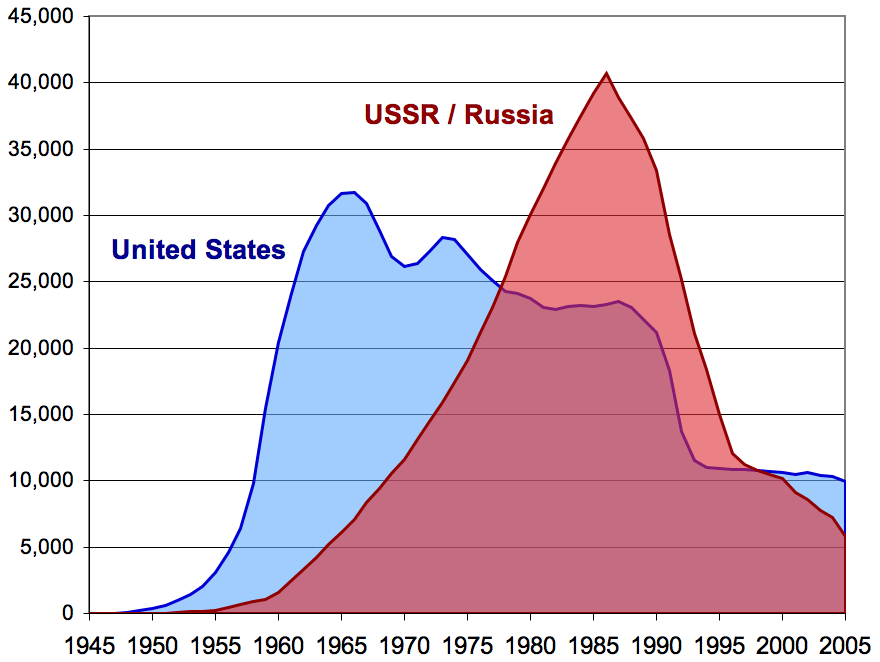
And as for stockpile, the U.S. ran away with an overwhelming lead in the 1950s. Here is a visual for how the stockpiles matched up over the entire Cold War. Note that even into the 60s, it wasn't even close. The U.S. was far-and-away more prepared to produce nuclear devices, both in terms of materials processing, and physics & engineering expertise.
^(This was a quick little summary, but my master's focus area is nuclear weapons -- if you'd like some harder citations on this decade, just let me know.)
In terms of numbers, the US basically just got its weapon production system online around 1950. So at that point it was suddenly able to produce well over 100 bombs a year, with the numbers growing each year out. Prior to 1950 it was producing far fewer bombs per year. You can see this trend here.* The Soviets took time to catch up in terms of quantities.
In terms of the actual weapons, by 1949 the Soviets had weapons that were more or less on par with American weapons. This is largely because US weapon development technology had not advanced very quickly over the course of the late 1940s. (There are many reasons for this.) The US had a slight edge but the Soviets had made good on catching up in terms of technology, and this, incidentally, was not because they were good at stealing secrets (the Soviets could have developed a far better weapon for their first test, but were required to duplicate the first US bomb in the name of being certain it would work).
The US figured out how to make an H-bomb in 1951, and tested it in 1952, but could not really weaponize it until 1954. The Soviets detonated a "thermonuclear device" that is not what we would call a real H-bomb in 1953 (it was not megaton-range), but it was still a big bomb. They tested a deliverable, "true" H-bomb in 1955. So US and Soviet capabilities here were approximately equal.
The real areas of difference are not the weapons themselves. They are the quantities of the weapons (the US had many more), and the delivery vehicles. The Soviets had no reliable ways of projecting nuclear weapons to the continental United States until the 1960s. This is because ICBM technology took a long time to develop and the Soviets lacked heavy bomber technology that could reliably make the long voyage over the pole without getting tracked and probably shot down.
The United States here had a huge advantage in that it had already been investing in long-range heavy bomber technology since WWII and had built up a huge body of technical and tactical experience with them. But more importantly they had many advance bases in Europe, the Middle East, and Asia that allowed them to put their nukes very close to Soviet territory. When I lectured on this to my students I showed them this little map I made which gives some indication of how the geopolitics made a huge difference in the 1950s.
The Soviets could certainly project nuclear weapons to Europe and Asia, however, so that's not nothing. However not until the development of reliable ICBMs could they project them to targets further than this. The early Soviet ICBMs were not accurate enough to be relied upon (they could destroy a lot of the USA, but they would have trouble aiming them at anything in particular; also, they didn't have very many of them for a lot of that time). The Soviets increased their capabilities by the late 1960s and early 1970s. This strategic imbalance is one of the reasons for the Cuban Missile Crisis situation.
*Why did it take so long for the US nuclear production system to get up and running? There are a lot of reasons. One is that the Manhattan Project infrastructure fell into disarray between 1945 and 1947, when the Atomic Energy Commission took it over, and it took time to get things back on track, get good people running it again, to get all of the technical stuff ironed out. They had serious problems with the Hanford plutonium-production reactors for many years, and they did not have weapons designs ready to use U-235 in their bombs — they didn't want to use gun-type weapons but hadn't yet quite figured out how they were going to use U-235 in an implosion weapon. So the fissile material they could easily use (plutonium) was relatively scarce for awhile, and they had an abundance of U-235 but they couldn't easily use it. During Operation Sandstone in 1948 they first tested mixed fuel cores, which were very successful, and allowed them to start more rapidly growing the stockpile. But getting everything into place takes time — you can't turn around an industry overnight. By 1949/1950 they had got things rolling and could more or less produce the exponential rate of weapons development that you see in the stockpile graph.