Its a simple but yet some times mind boggling thing I keep wondering. How did people speaking different languages first transfer their language to each other.
Of course if someone who spoke a dead language, lets use latin, was to talk to a person now or even in their age. How was communication between them ever possible. Simple stuff like what they call the Sun they would just point and repetitively say Sun in their language, but as you start to get more complicated words and sentences, how were you able to ever understand if you've never experienced this language before.
Today we have languages classes which is so helpful and handy but how have people learnt other languages without those and still understand all the thoughts and ideas they were able to transfer between speech. Language started thousands of years ago but if I was just dropped off in the middle of a pacific island with a native tribe and had to fend for myself, how would I ever be able to learn their language from just guessing alone. Sorry if my question sounds really uncertain about what Im asking.
You are better asking this question over in /r/linguistics. There are indeed methods for learning languages without a bilingual speaker teaching, or any written materials. It is not that impossible, you just need to have some understanding about how it occurs.
One problem with your question is your talk of "transfer." I'm not sure what that means.
Also, are you talking about adults or children? Children don't need to take language classes if they are immersed.
This has happened historically on a large scale a few times, namely during the 15th/16th centuries. Here's a thread about how the first European explorers communicated with Native Americans.
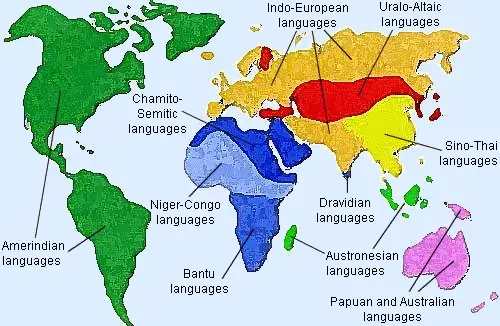
The degree to which "language a" is different from "language b" depends upon which family or families the languages are from. Here's a map of the main language families, very broadly speaking. Since you brought up Latin in your example, here's an example of the evolution of languages descended from Proto-Indo-European (one of the families on the previous map). The farther the connection between languages, the harder it would be to understand. For example, it would probably be more difficult for me (a native English speaker) to understand Hindi than German. This also means that, even though Latin is a dead language, you would have an easier time communicating (given you are an English speaker) than if you tried to communicate with someone who spoke only, say, Mandarin (assuming you have had little exposure to Mandarin). You would probably recognize the Latin word frater as being the first part of the English word fraternity and through contextual clues figure out that it means brother, that labor means work, or that urbs means city (think urban).
Even if you are in a situation where you are trying to communicate with someone in a language you know absolutely nothing about, you probably would not be in a situation where you are "guessing" meaning in a complete void. Meaning is gleaned not just from the spoken words, but from contextual clues (objects, gestures, facial expressions, body language, etc.). From there you can pick up basic vocabulary and over time and with immersion, build up to fluency. I tutored two kids from Moldova who didn't speak English, and I certainly don't speak Moldovan. I would create vocabulary sheets using images (an apple, a car, a book, etc. etc.). I would write the English word, they would write the Moldovan and together we would practice pronunciation. Eventually we moved on to simple sentences ("I eat apple," "You read book"). Anyway, all this is to say, it's not as impossible or as difficult as you'd think.