I've always seen the use of flamethrowers in the two world wars, with particular prominence in the Pacific Theatre of the Second World War. However, I haven't really seen any specific details of the doctrine behind using them.
I'd like to know how their use was dictated in the various fronts of both wars, like when during the battle they would be unleashed (in an offensive, mopping up etc.) and how this varied due to the difference in conditions between, say, the Pacific and the Eastern Front.
A little follow-up if possible:
Is there any evidence to suggest that soldiers using flamethrowers had a significant difference in casualty rate than the standard infantryman?
Flamethrowers were developed just prior to the First World War, and going into the conflict... well, no one really knew exactly what they were capable of accomplishing. (Note: this is true of some of the most pivotal and memorable weapons of WWI, including poison gas, trenches, barbed-wire, the machine-gun, air-power, and submarines).
But as the Entente and the AxisCentral Powers armies began to dig down into the trenches that would chew through an entire generation, the flamethrower found its purpose: clearing trenches. The flammenwerfer, first invented in Germany by Richard Fiedler in 1901 could fire a single-burst of flame some 20 yards from the soldier firing the weapon. Critically, if a second shot was to be fired, the igniter would need to be replaced. Like so many of the German weapons of the First World War, it relied on surprise ... it's this rather limited usability that likely prevented the German Army from using their twelve companies of Flammenwerferapparaten until February 1915, when they were deployed against the French positions outside Verdun. It would be employed to far greater effect in July of that year against British trenches at Hooge. In both instances, the flamethrowers was used primarily not as a killing device in itself, but as a means to flush a trench-full of enemy soldiers out of the safety of their fortifications and into the line of raking machine-gun fire, a far surer way to kill.
It proved to be really only effective when fired from a trench, to an enemy trench... which meant that it could only be employed in situations where enemy trenches were less than 20 yards apart - an uncommon state. Moreover, a full charge of the ignition gases was enough for only 2 minutes of sustained fire before being exhausted. Still, the situations in which it proved useful were common enough that over the course of the conflict, Germany would find more than 600 engagements to utilize their terrible flame weapon.
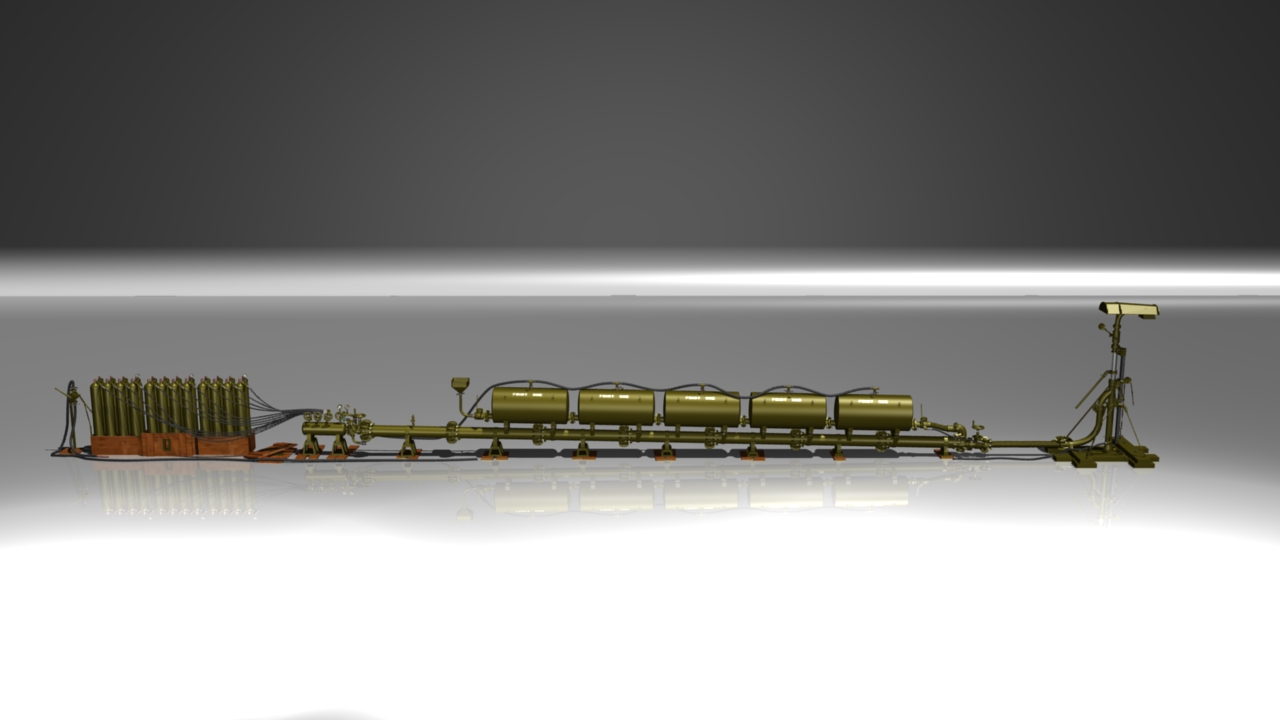
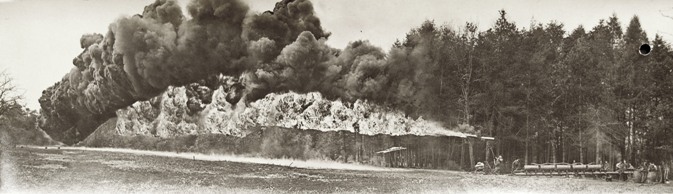
For the allies, they quite simple couldn't match the German ingenuity of the flammenwerfer, confined to using the completely non-portable "Livens Large Galley Flame Projector" more like a short-range artillery cannon than what we'd think of as a "flamethrower." Here's a shot of it in action.
In the Battle of Okinawa, US forces were expecting massive resistance, and so they shelled the island non-stop from late March, firing approximately 3 shells for every person on the island and literally leveling mountains. When they made their beach landing halfway up the island on the first of April 1945, they were shocked to meet almost no resistance whatsoever. Soldiers and civilians had mostly gone into hiding in caves and the jungle and mausoleum-style ancestral tombs, and while the intention on the side of the Japanese varied throughout the battle, it mostly ended up being brutal guerrilla-style fighting comprised of suicide attacks from these hiding places.
As a result, it was standard procedure for a squad of infantry, when they found a hiding spot such as a cave or tomb, to broadcast a warning in Japanese for any inside to evacuate and surrender, and then after waiting for a period, they would torch the entrance. Those inside who didn't die from the heat and flames died from oxygen deprivation. Some Okinawan civilians didn't speak Japanese very well, or having heard horror stories of the American soldiers were scared to come out. Some were being kept by force by the Japanese soldiers; some used as human shields for suicide charges. And some were actively resistant. Because of the chaotic and slow going, American soldiers claimed to have immense difficulty in distinguishing between civilians and combatants, and used this flamethrower technique to establish a zone of control from the landing area to the ends of the islands. It was incredibly effective, given that nearly everyone on the Japanese side, civilian and solider alike, were in hiding. Unfortunately, it was also one of the major factors contributing to the astronomical level of civilian casualties (average estimates being around 100,000, which is around a 1/3 of the population at the time).
My knowledge of the battle is only a fraction of what is out there to be read; the Battle of Okinawa is incredibly well-documented on both sides, with whole books centered on particularly bloody battlegrounds (e.g. Sugar Loaf Hill). One of the most well-known overview texts of the whole battle is "Typhoon of Steel: the Battle for Okinawa" by James and William Belote.
http://www.amazon.com/Typhoon-Steel-The-Battle-Okinawa/dp/0060102829
I'm happy to try to answer further questions, although I don't know how much more I can help with flamethrower specific queries.
My uncle was a flamethrower operator in the Marines during WWII. He was KIA during the battle of Okinawa on 7 May 1945. So it goes.
The tactic of the flamethrower was actually not to just spray fire on the enemy and burn him to death, but to get within 60 feet of an enemy bunker / pillbox, fire a 7 second burst or two into the enemy space, the fire would immediately suck up all the breathable oxygen, and the Japanese Marines would slowly suffocate to death, right before they started to burn to death.
Needless to say the Japanese saw Flamethrower operators as their #1 Target. I've studied the M2-2 Flamethrower used in WWII and I humbly contend that it was the shittiest job in the history of the American Military:
A flamethrower operator gave up a standard 11 lb MI Garand with a range of 440 feet, or a 10 lb Thompson Machine gun with a range of 160 feet, for a 70 lb weapon with a range of 60 feet.
Not only that, the 70 lbs was due to what was basically a highly flammable gas tank on your back.
So, not only were you target #1 for the enemy, but they just didn't have to shoot YOU to end your life, but could also hit the 60 lb gas tank on your back, resulting in an explosion that burnt you and any buddies within 5-10 feet to death.
Because of these facts, the job was usually volunteer only for the extra strong / crazy / brave guys. My Uncle's nickname in his unit was "Muscles" which is why he probably took up the heavy M2-2 Flamethrower on Okinawa.
He was a PFC for 1st Battalion / 5th Marines / Co."H".
His Sgt. wrote home after the war and wrote "if you have a picture of Albert on the wall, put at least 10 notches on the frame. I was right next to him when be bagged his first nest of Japs."
If you want to know how their use was dictated the War department had a manual specifically for that (like everyhting else). TM (Technical Manual) 3-378 Manifold, Portable Flamethrower, E-4 and it is publicly available online here. That's simply operationting the flamethrower. How to tactically employ it is described in the FM (field Manual) which I'm having a hard time finding but I think this is it. This website though has a bunch of historic FMs though so searching through the Infantry FMs might yield some results.
I have a quick follow-up question if that's ok...
I have often wondered if any soldiers were reluctant, or even refused to use particularly nasty weapons such as the flame thrower. Although there is probably no such thing as a 'nice' way to die in war, being burnt alive is generally regarded as one of the worst. So, are there any accounts of soldiers refusing to deliberately inflict it upon their enemies?
I haven't seen anyone respond to how flamethrowers were utilized on the Western Front in WWII yet, so I was wondering if anyone knew stuff about that? Would the Normandy Beach scene in Saving Private Ryan, where the entrance to a machine gunner nest is cleared, and then the flamethrower is sent in be a good example of flamethrower protocol?
And sorry if I'm getting terms wrong, I'm just a civilian asking questions.
Does anyone know anything regarding the Japanese use of Flamethrowers? I'd heard they were used in China, but have never come across information regarding how common they were or how they fit within the battle plan.