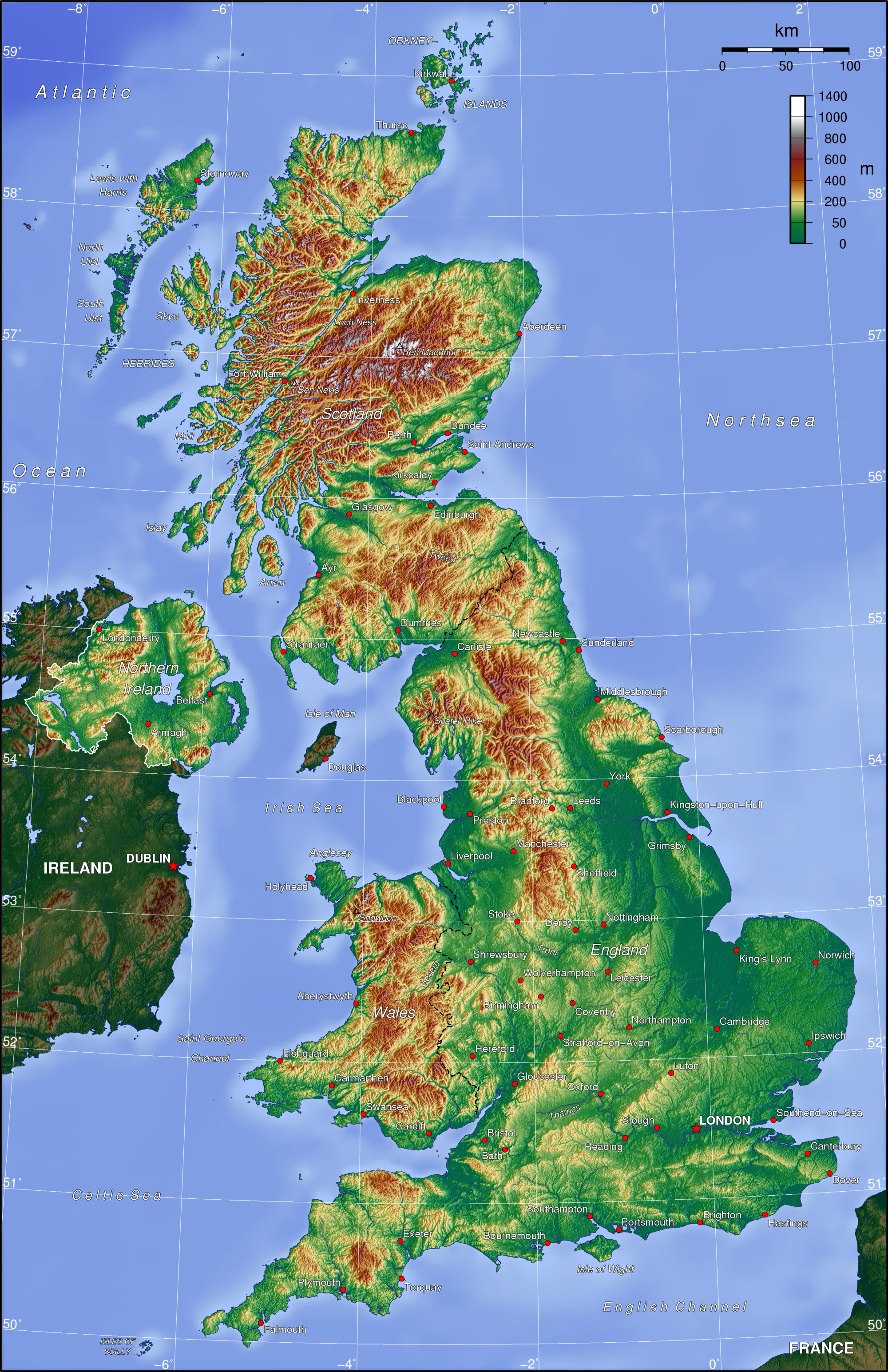
To my (American) understanding, there are only three areas in Great Britain that retain a Celtic identity as opposed to England's Germanic identity: Cornwall (eventually became a part of England, though I am a bit curious why they kept their Celtic identity when the rest of England did not), Wales, and Scotland. Scotland makes sense to me because Hadrian's Wall is an historic barrier between the relative north and south of Great Britain, but Wales doesn't have any kind of natural defenses along its border--no mountains, rivers, walls, anything. Why did the Anglo-Saxons just seemingly stop when they got to Wales?
A first important point is that Celtic identity is a relatively recent construct. People in the Early Middle Ages did not see themselves as Celts, nor did their neighbours: for instance, the Irish thought that the Picts, speakers of a Celtic language in modern Scotland, were latecomers to Great Britain, and that they arrived by ship from Scythia (a legend echoed by Bede in the first book of his Ecclesiastical History). Similarly, the so-called Celtic world was not static: over the course of the Early Middle Ages, the Pictish language of Scotland was replaced by Gaelic, the language of the neighbouring kingdom of Dal Riada. I would therefore tend to think that it would be more appropriate to say that they retained a Celtic language, rather than a Celtic identity.
A second important thing is that conquest/assimilation by Anglo-Saxons incomers was not a sudden process. It is unfortunately quite hard for us, if not impossible, to understand what happened in the 5th and 6th century in Britain. What we know is that the Anglo-Saxons first settled on the south-eastern coast of England (the earliest finds, if I recall correctly, can be found in East Anglia). Now, archæologists have become very reticent (for good reasons) to equate the movement of goods with the movement of people; if someone finds a “Germanic” brooch somewhere, they will emphasise that it can have been brought by changes of fashion, for instance, in native peoples. Conversely, there are areas in the British islands that we know were “Germanised,” and for which we have scarcely any early Anglo-Saxon finds. Nonetheless, our current understanding tends to tract two different phases: in the 5th century, “Anglo-Saxon territory” was still centred on the coasts of the North Sea (here is James Campbell's reconstruction of a plausible map). In the 6th or even late 6th century, many native kingdoms of the West Midlands were taken over (though we are not sure how; in some cases, especially in the kingdoms of the North, Deira/Bernicia, it may have been a simple replacement of small elites groupes).
After 600, Germanic expansion stabilized. Border kingdoms (West Saxons for Cornwall, Mercia for Wales, Northumbria for Rheged, Elmet, Goddodin and the Picts) continued to encroach on Welsh/native territory, but at a much slower pace. Why? Certainly, change within Anglo-Saxon societies themselves is an explanatory factor: the surge of conquest in the late 6th century favorised social stratification and the creation of affluent lineages of kings, a situation that may have been less favourable to conquest than that of c. 500 (though it should be noted that we know almost nothing of it).
Another important element for the preservation of the Celtic languages is that remaining areas were rather more remote, and less interesting to conquer than the fertile Midlands and the rich coastline of the North Sea. You mentioned the absence of natural defenses alongside the Welch border; it may be true, but Wales is also a mountainous area by British standards, and it meant that it could be defended much more effectively (as a side note, Hadrian's Wall did not serve as a border; in fact, Northumbrian Old English expanded as far north as Edinburgh in the Early Middle Ages—in what is shown as red on this map). Another consequence of the marginality of areas remaining under native control is that even when these areas eventually were conquered (in the case of Cornwall, or even Wales, though it was a lot later), they remained relative “backwaters” where there was no strong incentive for assimilation to Anglo-Saxon society (except for the aristocracy; in 10th century Cornwall, for instance, we have examples of aristocrats adopting a new Germanic name alongside their old Celtic one).
In the case of Cornwall specifically it's largely due to the remoteness of the location and marginality of its land as the top voted comment said. The region is sparsely populated even to this day and the River Tamar forms a strong natural barrier, if you look at its course it almost makes Cornwall an island. The sheer distance (in pre modern terms) from the large population centres, the poor land and its defensiveness all combined to maintain somewhat of a Celtic identity. The language survived in this isolated outpost primarily because of the lack of incentive for outsiders to move in but even as far back as Henry VIII's time it was in recession because of outside pressure. This being said Wessex subjugated Cornwall in the late 9th century/ early 10th century and politically it was under Germanic control and dominance ever since. Today Cornwall is significantly less Celtic than Wales, the language is spoken by a tiny number of people to a fluent level and it seems that the Celtic identity is often played up for tourist reasons more than anything else (as someone who grew up in Devon - which was part of Dumnonia along with Cornwall.)