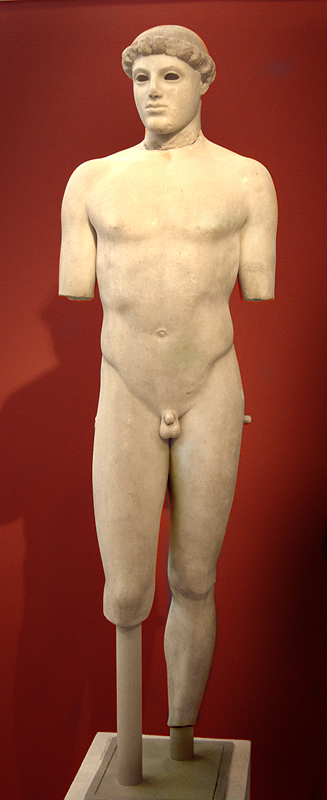
It seems that in the 7th and 6th century BCE that Greek Sculpture was so-so. But then by the 5th century onward it's impressively realistic.
How did they get so good at it so fast?
(ok, a few centuries isn't crazy fast, but it seems like a cultural evolution much faster than any other contemporary cultures).
( I checked the FAQ and didn't see any obvious links there )
And by extension, how did the Ancient Greeks get so good at so many other areas like math, philosophy & drama so fast?
Was it better farming and surplus food leading to specialization? Were there some specific breakthroughs that occurred? Was it due to borrowing from/exposure to other cultures?
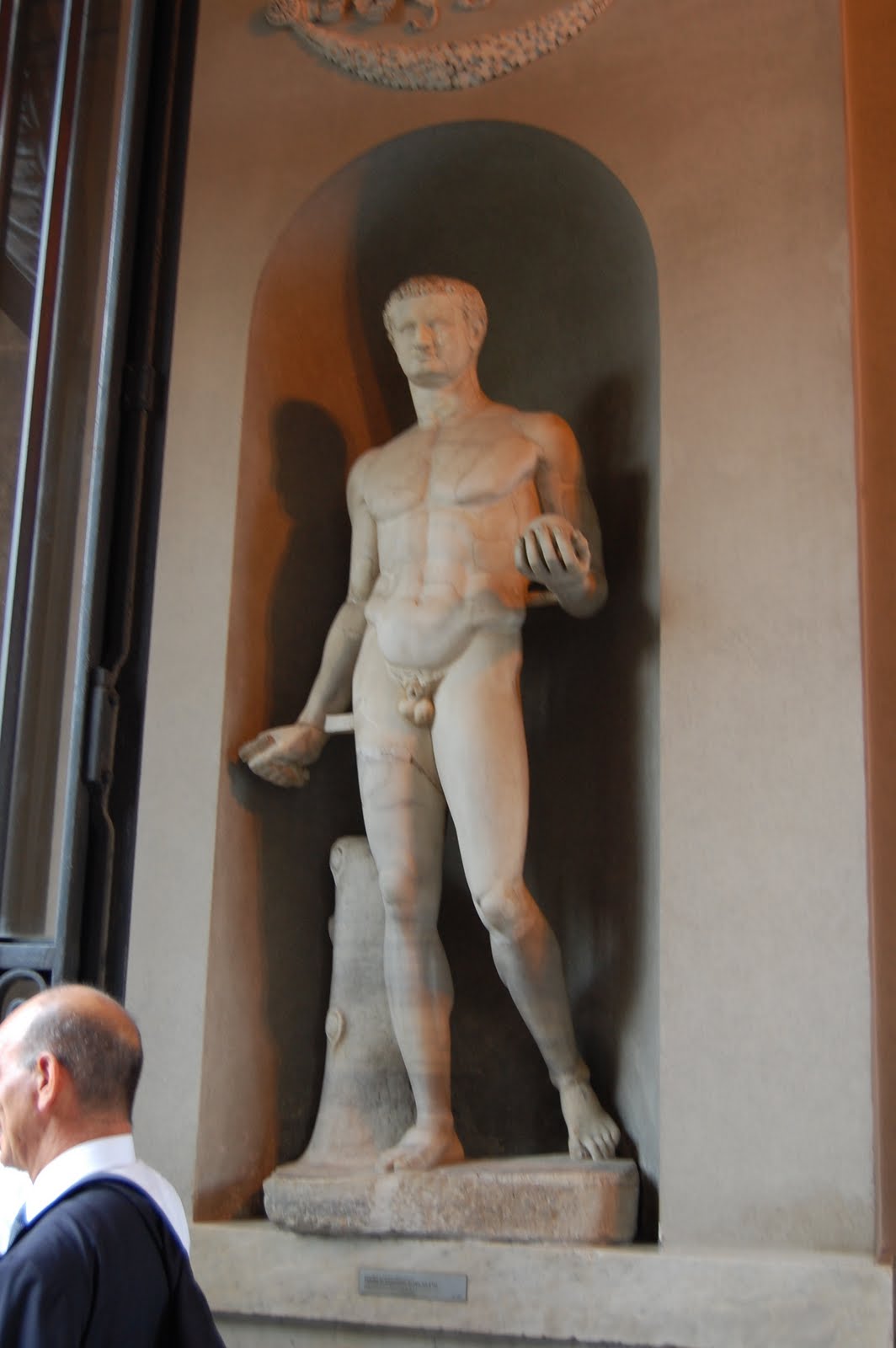
Depends what you mean by 'so good'. The theory that Greek sculpture improved on a linear scale like Darwinian evolution is really a bit dated. We need to bear in mind that only a minute fragment of Greek material culture survives, and what does is typically that which was copied for posterity by the Romans, such as Praxitiles' 'Aphrodite of Knidos' or the 'Doryphoros' sculpture[s]. It should also be borne in mind that many sculptures we now think of as being 'marble statues' were at first rendered in bronze - the marble editions are copies, often with beefy tree trunks at the ankles of the figures to stop the legs snapping off (see e.g. https://1.bp.blogspot.com/_KTTB9kuC9_Q/TESm_QR5QkI/AAAAAAAAALY/DyZd0ZngDqM/s1600/DSC_0609.JPG ).
A key breakthrough was the introduction of the lost wax method to bronze casting ( http://www.metmuseum.org/toah/hd/grbr/hd_grbr.htm ). This method allowed for sculptors to build up their designs by shaping clay, by hand, rather than chipping away from a stone block. This is vitally important because you can quite boldly experiment by messing around with clay, whereas a mistaken thump of a chisel can spoil a month's work. The lost wax method made experimenting with new forms much, much easier. On the flip side, bronze is easily melted down into ingots, so surviving bronze material culture is desperately rare compared to ceramics or stone. The most complete finds are often from shipwrecks, such as the 'Riace Bronzes' ( http://www.nowitaly.com/wp-content/uploads/2014/02/bronzi-di-riace.jpg ).
p.s. for what it's worth I think archaic material culture like Exekias' pottery is the coolest.
OK, so I think I should address three points before actually answering your question:
It isn't as if the kouroi were a stagnant art form--besides a fair degree of variation, their period of production was not terribly long, and there are a large number of "transitional fossils". The Archaic period in general is characterized by dynamism, and so you shouldn't take one sort of statue as a sort of ideal type--the kouroi were on a long spectrum that included later Classical statuary.
Greek statuary didn't get "better", or at least if we want to say that we need to be very clear about what we are talking about. The kouroi statues took the form they did because that reflected the particular desires and idiosyncrasies of their time period. Classical statues were not mute stones, and even in the Roman period they need to be seen more as signposts than museum pieces, so the style of the kouroi is reflective of a particular set of communicative needs, and what appears to us as a lack of skill is actually design. I think the best way to see this is by hopping about a bit and looking at Assyrian sculpture which appears at first to be somewhat ungainly and crude, but quickly grows more intricate and powerful the more you see it for what it is.
Related, quality is in many ways a product of reception, not creation. A large part of why we think Sophocles is so great is because we have been trained to appreciate him.
That all being said, yes, there were some major changes going on in Greek society, and this is reflected in craft production. I wrote a detailed post on this, but can't seem to find it, but broadly speaking yes, the Archaic was a period in which Greek societies became wealthier, more populous, and more complex, and specialized craft production increased. I don't think this process was really faster than anywhere else, but because of the enormous influence this period had on later Western culture it seems that way.