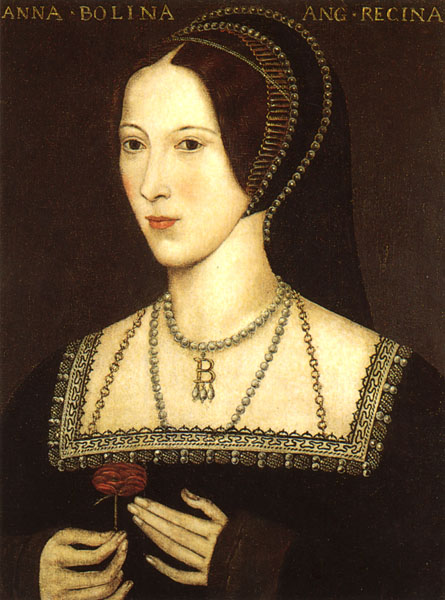
I was just wondering after I came across pictures of Anne Boleyn and Elizabeth I. As you can see, in both of them, they are holding what resembles a red flower. I wanted to know whether or not these were Lancastrian roses and if they were, why in the Tudor dynasty??
In the portrait of Elizabeth I, the rose she is holding is a so-called Tudor rose, which Henry VII adopted on his marriage to Elizabeth of York: it combines the red rose of Lancaster and the white rose of York, symbolising the union of the two houses into the Tudor dynasty.
In the portrait of Anne Boleyn, the rose she is holding is indeed red: by the time of her arrival to court, nearly 40 years after the aforementioned marriage, the red rose would have lost many of its political associations. The red rose is traditionally a symbol of love and fertility, and this is likely what it symbolises in this portrait: Henry VIII married her for love, and thus she gained her station mainly because of her feminine virtues. Furthermore, as the mother of a royal child, though not a son, she would have been revered.
These two are probably carnations I’d say. They symbolize love and marriage. It comes from a Dutch tradition whereby the bride to be hid a carnation somewhere on her body, which the groom was to discover, either on the wedding night or at an earlier public celebration. The tradition was spread with Dutch artists. There’s another painting of Elizabeth I holding a carnation: http://en.wikipedia.org/wiki/File:Elizabeth_I_Steven_Van_Der_Meulen.jpg
Elizabeth was the virgin queen, but at some time in her early rule she was on the market for a husband. Which is how the painting should be read.