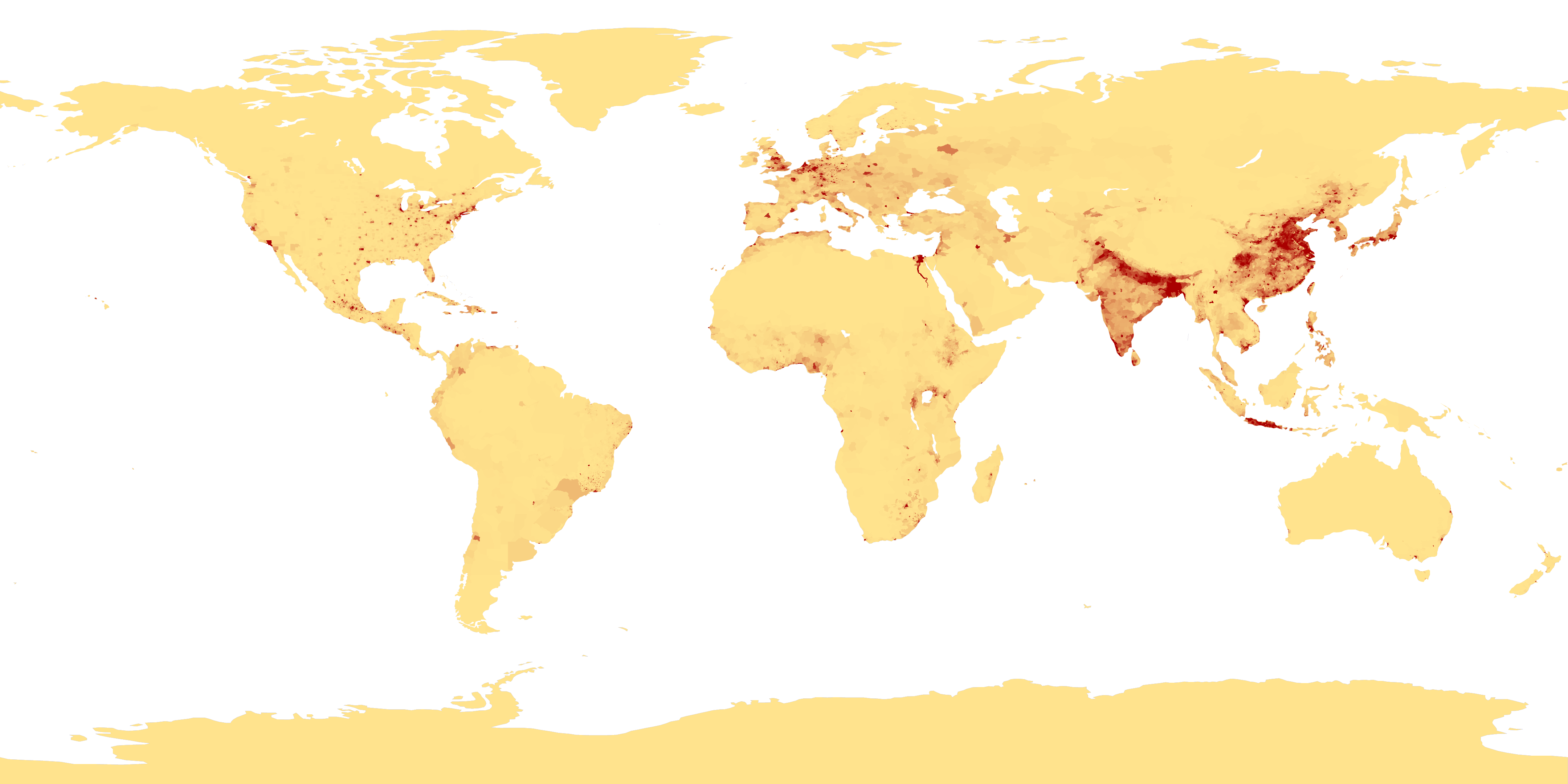
I guess this question is pretty self explanatory.
http://www.reddit.com/r/AskHistorians/comments/wk6ea/why_do_china_and_india_have_such_massive/
http://www.reddit.com/r/AskHistorians/comments/12ydq2/what_made_china_and_india_the_most_populated/
Try looking at these.
Short version of the story is fertile river floodplains, climate sutiable for growing rice, rice being a highly fullfilling food crop. End result is a abundance of food and hence population growth.
The Indus, Yangtze, and Yellow River Valleys are among the "cradles of civilization," areas of extremely high fertility conducive for farming. These areas saw some of the first human civilizations and have continued to be fertile throughout most of human history, allowing a large population to begin growing and to grow larger than elsewhere on the planet.
This is a pretty simplistic answer and hopefully someone with an academic background in this area can chime in, but that's a big factor.
This is more in the form of a follow up question than an answer.
I have come to understand that the population explosion in those two areas occurred in the 20th century as a result of the Green revolution, and that while they were heavily populated throughout the course of time, they were comparable to other areas until the 20th century.
Am I wrong in my understanding? And if not, why is this never mentioned when this question pops up? There wasn't a billion people in India in the 1500's...
Also, there doesn't seem to be much correlation between the Indus valley and the bulk on Indian population today. For example the densest part of India is east of the Indus valley...
Besides ignoring the fact that China is a huge country with plenty of fertile land for people to live on, the Chinese population greatly increased during and after the Ming Dynasty simply because there weren't many civil wars being fought which was often the cause of drastic population swings over the long 4000+ years of China. Many dynasties didn't last past 400 years, and often a long civil war occurred. For instance, a third of the population died during the Three Kingdoms era (220-280) after the fall of one of the most prosperous dynasties that China has ever seen (Han). During the Ming, the population more than doubled and since the Qing Dynasties take over didn't have much bloodshed, it allowed for the population to continue to boom and led to the huge Chinese population we see today.
Edit- Just realized I said "any" civil wars, I had meant "many". Sorry.
Also worth noting that at least within the Hajnal Line, fertility was delayed through the postponement of marriage to the mid or even late 20s for women. This resulted in fertility rates and population growth being lower than in contemporary China and India.
This means that the areas of France, Germany, Britain, the Low Countries, Scandinavia, and northern Italy might be somewhat "underpopulated" relative to what might have been the case if more standard fertility patterns prevailed as in Asia.