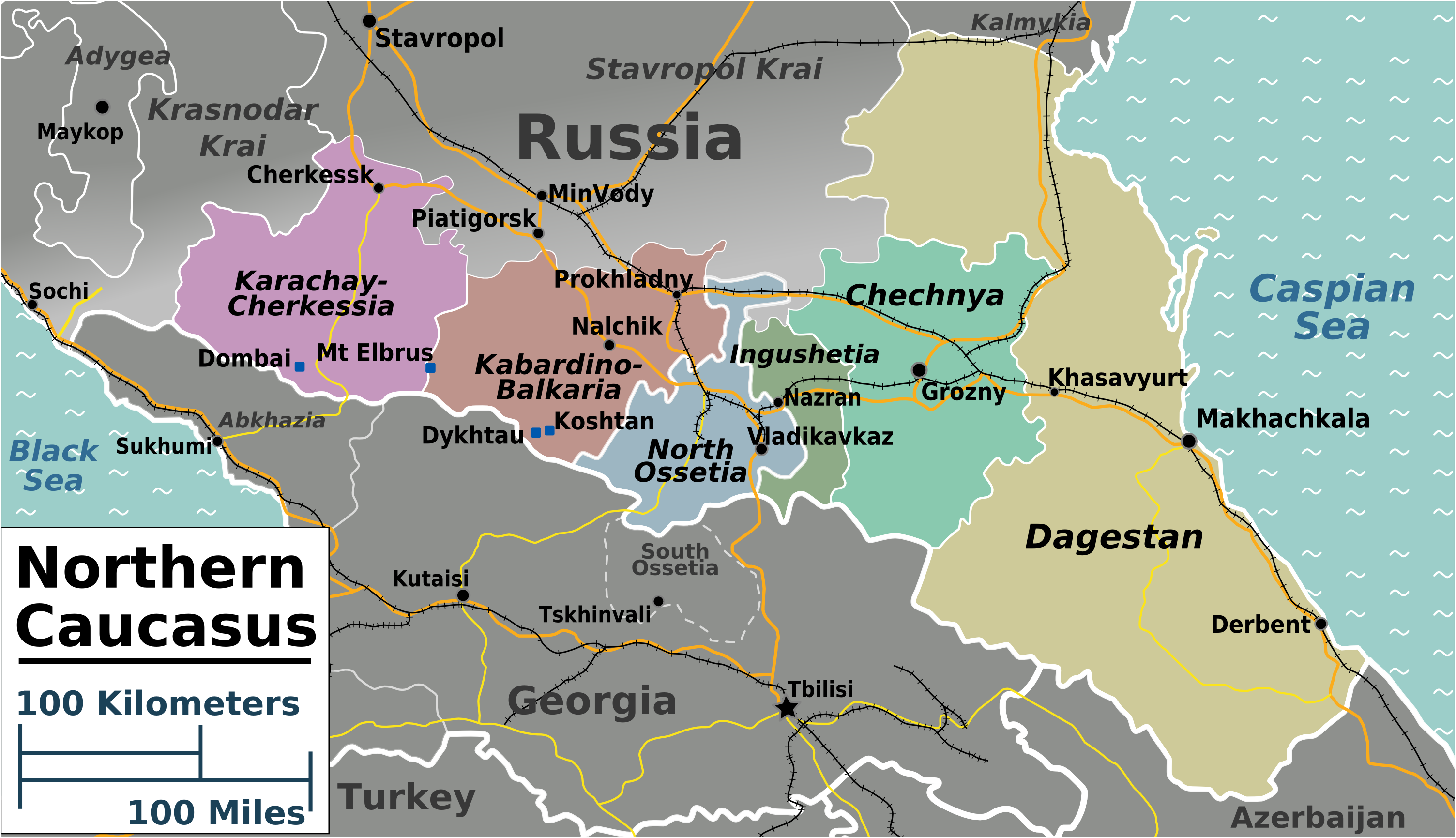
The Soviet Union had well over a hundred different ethnic groups, but only fifteen full union republics when the Soviet Union came apart in 1991. Some groups ended up with union republics, like the Ukrainian SSR or the Georgian SSR; most didn't. There was no hard and fast rule for which ethnic groups got national republics, but there are some general principles.
First, all things being equal, larger groups were more likely to get their own republic.
There were some fairly sizable populations, though, which did NOT get their own union republics. Before WWII, Jews and Tatars had sizable populations but without their own union republic. In the case of the Jews, it was because they were scattered throughout the Soviet Union. The Tatar population was more ethnically concentrated.
The Tatar case shows another principle at work. Generally, union republics had to have a border with a foreign state. The Tatar population on the Volga River was completely surrounded by Russian territory.
Groups that did not get their own union republic did often receive something short of that--an autonomous region or republic INSIDE a full union republic.
SO: the North Caucasus lacked foreign borders, most of the ethnic groups there were relatively small, and the populations were often intermixed. They ended up with autonomous regions or republics, not full union republics.
There were places besides the North Caucasus that had those sorts of small autonomous regions. I've mentioned the Tatars of the Volga. Northern Russia has several regions for Finnic populations; there are also small enclaves in Central Asia.
Some good books on this are Richard Pipes, Formation of the Soviet Union, though it's rather old and tends to be more anti-Soviet than more recent work, Terry Martin's Affirmative Action Empire, and Fran Hirsch's Empire of Nations.
North Caucasus also was and still is divided into autonomous Republics for the different ethnic groups. The Autonomous Republics were subjected to Union republics and had no right to leave them by the constitution.
The reasons for different treatment were random. F.E. Russia recognized Ukrainian independence so it couldn't be an autonomous part of Russian SFSR. Instead it joined the USSR.
Chechnya is not the only Autonomous Republic that tried to quit. Abkhazia, South Ossetia and Adjaria also have, each, been an Autonomou Republic or Oblast of Georgia. They went ballistic over being demoted in status by the newly independent nationalist government of Gamsakhurdia. Nagorno-Karabakh was an Autonomous Oblast of Azerbaijan inhabited by Armenians. It became the subject of a conflict between Armenia and Azerbaijan.
It effectively was:
After the Revolution, the Caucasus became independent; briefly, as in a few weeks, as one state (the Transcaucasian Republic), then as three separate states (Armenia, Azerbaijan, Georgia; all roughly corresponded to their modern borders). As the West (British) were concerned about the future of the Baku oilfields, they heavily supported the Whites defending the region during the Russian Civil War. However once it became apparent the Bolsheviks were going to win, the British left, and the Caucasus were effectively left undefended.
Bolshevik agitation began almost immediately, though the Soviet Union signed a treaty with Georgia agreeing to not invade or interfere, that didn't happen; they first occupied Armenia, then Azerbaijan, and finally invaded Georgia, taking back the whole region by 1921.
It was now up to the People's Commissar of Nationalities, Joseph Stalin, to decide how to handle the region. An ethnic Georgian born and raised there, he was familiar with the workings of the region, and knew how much of a tangled mess it is ethnically. Initially the three states were merged into one republic, the Transcaucasian SSR; it was this state that formally signed the Union Treaty in 1922 leading to the official creation of the USSR. This lasted until 1936, when under the new "Stalin Constitution" it was broken back up into the three republics, with Georgia having a few autonomous republics/oblasts (Abkhazia, Adjara, South Ossetia) and Azerbaijan having Nagorno-Karabakh.
The concept of not granting every group full republic status, but only that of an autonomous republic/oblast, came from Stalin's divide and rule policy. As the Caucasus have long been an issue for the Russians, or anyone, to effectively control, he forced large minorities into full republics so that they would spend more time fighting each other rather than Soviet domination. It proved a largely effective move, as the wars over Abkhazia, South Ossetia and Nagorno-Karabakh since 1988, and the continuing tension to this day, prove.
Sources (disclaimer, I am most familiar with Georgia, so they lean towards there):
Coene, Frederik. The Caucasus: An Introduction (Abingdon, Oxfordshire, United Kingdom: Routledge, 2010).
Cornell, Svante E. Small Nations and Great Powers: A Study of Ethnopolitical Conflict in the Caucasus (London, United Kingdom: Curzon Press, 2001).
De Waal, Thomas. The Caucasus: An Introduction. New York: Oxford University Press, 2010.
LeVine, Steve. The Oil and the Glory: The Pursuit of Empire and Fortune on the Caspian Sea (New York City: Random House, 2007).
Rayfield, Donald. Edge of Empires: A History of Georgia (London, United Kingdom: Reaktion Books, 2012).
Suny, Ronald Grigor. The Making of the Georgian Nation, Second Edition (Bloomington, Indiana: Indiana University Press, 1994).