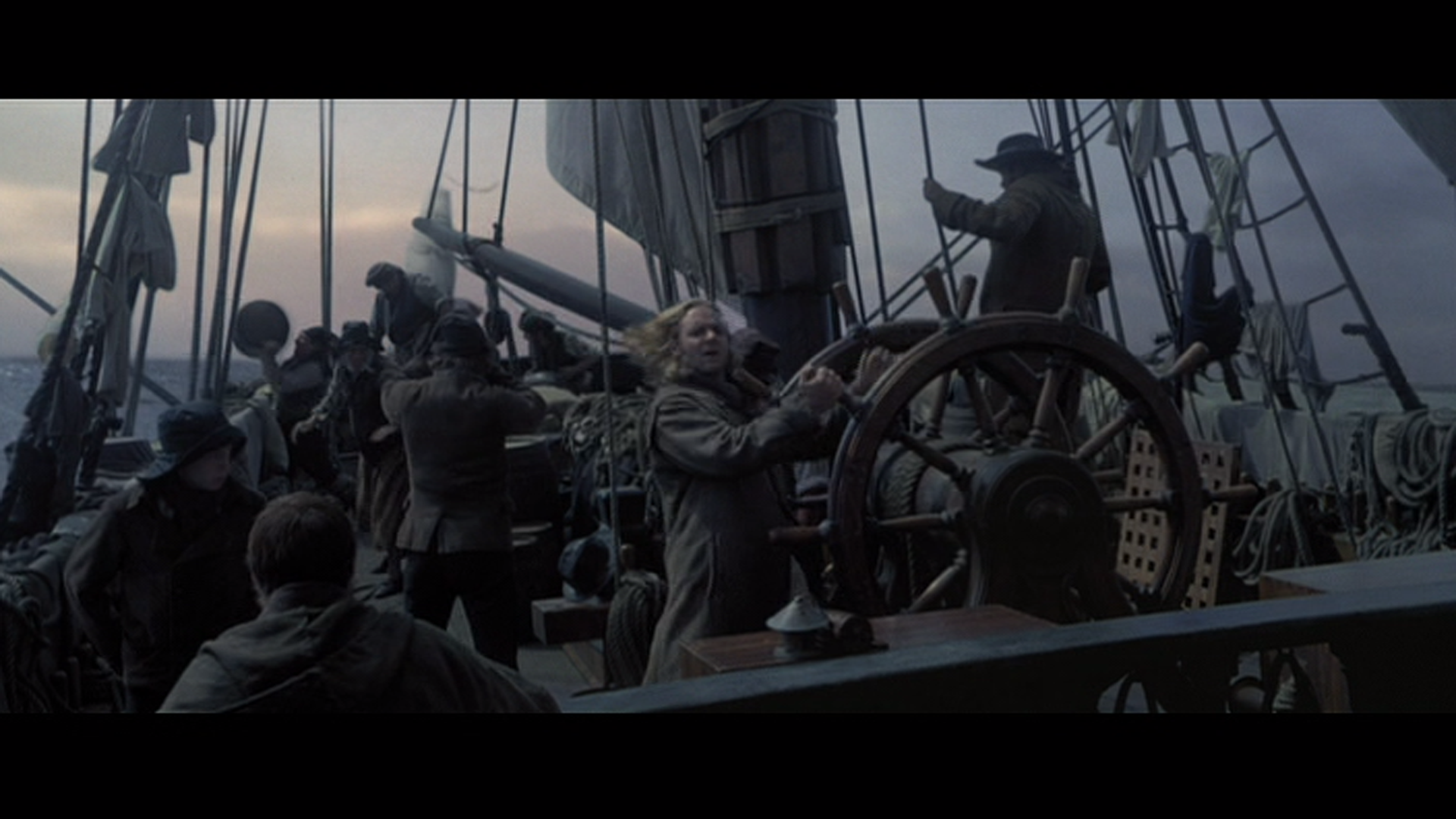
I recently re watched Master and Commander today and was wondering if the tasks performed by the crew would be possible f they're so far away from friendly ports (replacing a whole mast for example)
Quick bonus question: would a "Movie inaccuracies" thread be allowed here? Would love to discuss MaC with qualified historians
Yes - to an extent, is the short answer. It all depends on circumstances.
I assume you're talking about the first battle at the beginning of the film. She wasn't dis-masted at all. She got some nasty holes in her sides of course, but they were plugged. Given enough able seamen who probably had a variety of experiences repairing things at sea, and a good ship's carpenter and parcel of carpenter's mates - plus supplies, you could do a remarkable amount of repair at sea. The carpenter would have his locker on the orlop deck and he would worth with his supplies in that room and around the ship. That's the general idea I received from reading a number of books on the way 17th to 18th century ships operated such as The Arming and Fitting of English Ships of War, 1600-1800 by Brian Lavery.
A prepared ship even at the most basic levels would be carrying spare lines of various sizes, tar, oakum, planks, sailcloth, paint, tools, and so much more. Eventually the sails could be patched or replaced, lines spliced or replaced, and so on. Lines were getting replaced regularly anyway due to use (especially running rigging that move around a lot) and any sailor worth the name knew how to deal with and replace them. The biggest concern are yards (things sails are on) and spars (parts of masts). Ships would carry spares of such things (how many all depended on where the ship was voyaging, for how long, for what purpose, and how much could be afforded by ship owners or Navy) - and in the case of the HMS Surprise they carried at least a couple spare yards with them (which they used on the mizzen). Not sure if they carried something they used to replace the topsail mizzen spar (can't remember if that ever got replaced after going around the horn carried away that spar) but it's not an impossibility. The wounded mizzen mast main spar, the part closest to the top deck, appeared to have been wounded in the film during that first battle, but they managed to repair it to make it at least serviceable for most circumstances ( as can be seen here ). Overall, replacing an entire mast (or at least the lowest part of it) is extremely difficult, but not impossible to do outside of a port. It might be more effective to do so when pulled up on shallows like one would do while careening, but it could be done. If you had a mast with you to replace it, or if one could be obtained enough skill in the manpower could pull it off. But in that movie, they didn't replace the whole mast.
Mariners in the Age of Sail were surprisingly resourceful and often skillful people, and the fictional characters of the Aubrey-Maturin series as presented in the film represents what such a ship could be like at it's finest, with almost all being handpicked able seamen with working familiarity with the captain (not to mention significant faith in and liking of said captain). A ship could keep itself repaired enough without a major port for a surprising amount of time because of them. I've read about it being done in my work with pirate history as well. For the peak era of the Golden Age of Piracy, with Nassau taken back into authority by the British government under Woodes Rogers, there weren't really any other ports like that to go get supplies and repair. Most everything had to be done at sea. From 1719-1724, a number of pirate crews operated for a number of years in the Atlantic. Of course, they had several differing circumstances/advantages. They could switch ships (and often did) when they wore one out or thought a new ship they captured was better, they could steal supplies and skilled workmen to repair their ships (or, they did when they could), and their crew size often helped provide work forces when needed (compared to say, a typical merchant ship crew that might be a dozen men more or less).
Hope that answers your questions - unfortunately there's not going to be one book that addresses this specifically. But besides the book I mentioned previously, I would also recommend John H. Harland's Seamanship in the Age of Sail for a good book to give as thorough an understanding one can get without physical experience at sea. Sailing is by far a many-year skill that can't be picked up like that and isn't the easiest thing to express in a book - but some have made valiant efforts to the benefit of all.
Remember that by the early 19th century England had friendly or neutral ports around the world. Depending on whose side Spain was on, ships could resupply in Chile, they could go to the Chinese ports, they could call on British ports in India, etc.