How prevalent was the use of plate armor in medieval armies and how expensive was it to produce? Could any blacksmith produce plate armor or was it a highly skilled trade?
It depends on what you define as "plate". Combat archeologists usually use the word for full plate armor, which covers large portion of the body, for example, the gothic armor which became popular between 1400 and 1480.
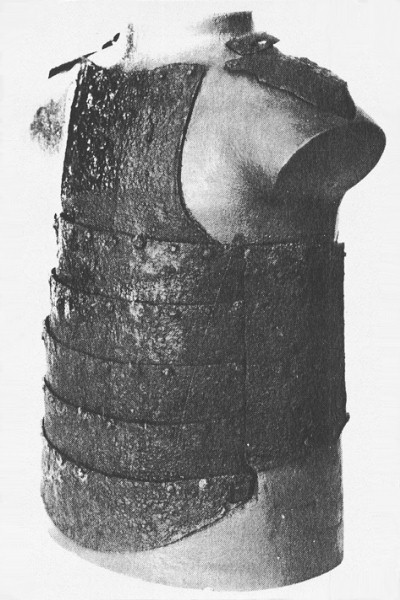
Prior to that there were "plate-ish" armours, like the Visby plate 1300-1400, which was essentially an apron with palm-sized plates riveted to it.
SImply put, around 1300 the basic idea of a coat made of small plates riveted to/sewn into a garment mutated in two directions: towards plate armour, made of large plates of sheet metal, and towards the brigandine(edited spelling); a waistcoat made of tiny plates riveted very closely and sewn over with fabric.
While the brigandine(edited) coulds concievably be made by any armorer/platesmith, a full plate armor was much more difficoult. First of all, it required large sheets of metal, which could not be realistically made by hand. Large plates became realistic with the invention of waterwheel-powered hammers and rolls.
Even after that, each of the dozens of parts of the armour had to be carefully hammered into shape, tailored to the individual user, made to mesh seamlessly with the rest of the set, without leaving any openings or jamming, while keeping it lightweight and relitively easy to put on.
In effect, the cost of a single suit of armor was enormous. Since the introduction of more advanced armor led to the development of more potent weapons (like the arbalest-heavy,cranked crossbow) and pike tactics, it became obvious that some cheaper alternative to knightly plate is needed for the common soldiers. THis led to the introduction of the "munitions armor", cheaply made, one size fits all suits that were loaned to a soldier for a battle, and then taken back to the armoury.
Because of all of this, plate armour was very slowly introduced, started in the 1300' then for about 2 centuries remained an extremely expensive property of the richest of knights and feudal lords, then in 16'/17'th century, became cheap enough to be mass produced for common foot soldiers (still, only for the elite formations, and for very specific use, like countering the pikemen on foot).
R. E. Oakeshott, European weapons and armour: From the Renaissance to the industrial revolution
Nowakowsky A. - Armour and weaponry of the Teutonic Order
Here are the answers, one by one.
The economics of equipping infantrymen is quite different than equipping cavalry, because while knights bought their own equipment, infantry were often equipped by the knight/lord that employed them (some infantry, such as city militias or mercenaries, would buy their own stuff). So infantry have plate armour when their employers are willing and able to buy it for them, or when they could get it for themselves, which is not often. Generally, semi-mass produced infantry armour (called 'munition armour) is most common in the 16th century, when increasingly powerful royal families were equipping increasingly large and professional armies of infantry and establishing armouries under the direct authority of the crown to equip them (see below for details). Such armour would protect the body with a cuirass, the head with some form of open-faced helmet, and sometimes the arms with simple plate arm defenses. In other cases, soldiers would wear cloth armour (a jack) or a mail shirt underneath it, and arms would only be protected by what the soldier was wearing underneath. This less complete protection both to saves on cost and weight/heat, which is important when you are fighting on foot.
Pictorial evidence does show armour being common in the late 15th century in Switzerland, perhaps because mercenary pikemen and halberdiers could afford it. Note that generally their legs are unarmored: http://commons.wikimedia.org/wiki/Category:Tschachtlanchronik#mediaviewer/File:Bendicht_Tschachtlan%2C_Die_Schlacht_am_Morgarten_%28c._1470%29.jpg
A breastplate for a infantryman, circa 1480. Note the relatively simple decoration and the lack of a lance rest: http://upload.wikimedia.org/wikipedia/commons/8/8d/Breastplate_%28infantry%29_in_the_German_style%2C_Milan%2C_circa_1480_-Higgins_Armory_Museum-_DSC05463.JPG
Plate armour was expensive. I couldn't track down the costs in my source, so as far as I can remember a full suit ('harness' in medieval English) could cost around 6 pounds sterling in England in the second half the the 15th century. By contrast retained archers (who were skilled laborers making much more than most workers) made 4 pennies a day. There are 12 pennies in a shilling, and 20 shillings in a pound, for a total of 240 pence/pennies in a pound. So plate could cost 360 times the daily wage of a highly skilled worker...or about a year's pay. Needless to say, archers did not buy full suits of plate armour for themselves -- this shows why it was restricted to the landed aristocracy, and infantry would make do with less complete varieities of protection.
No, local blacksmiths could not produce plate armour. For that matter, they couldn't produce mail or swords either (mail-making requires drawing wire, and swords require high-carbon steel and heat treatment)! Generally local blacksmiths made hoes and plowshares and other farm implements.
Plate armour is very sophisticated equipment that requires several things: -Lots of iron in large pieces since you can't just weld two pieces of iron together and make armour that will hold up in battle. Plate armour becomes common when blast furnaces are introduced to europe, which allows making large chunks of fairly high quality iron. This iron would then be turned into steel by a variety of processes. These pieces were then hammered flat, often by water-powered hammer mills. By the 16th century, high quality iron from Austria was being exported as far away as England for the purpose of armour making. Blast furnaces would produce the raw material, mills would hammer it flat, and then and only then would armourers buy it and get to work.
-Lots of skilled labor. Making a full plate harness can require dozens if not hundreds of man-hours, and the most effective way to do this is with a large shop.
The medieval guild system allowed for a master armourer to command a large number of journeymen and apprentices, would would do the 'grunt' work of armour production. Different workers would specialize in different parts of armour (helmets, greaves, gauntlets, etc) or different parts of the process (initial hammering, burnishing/polishing, riveting the finished pieces together).
So many armourerers workshops were relatively large and operated in large cities along major trade routes. Knights from all over Europe would order armour from Milan in Italy, and there were regional armouring centers in most European countries. To use an example, an English knight might buy armour from Londo or, have it shipped over from Flanders or even order it from Milan. Some armouring centers seem to have specialized in mass producing armour for infantrymen (see above), particularly Koln/Cologne in Germany.
By the 16h century, Kings were more and more powerful and so they established their own royal armouries in places like Innsbruck and Greenwich. These produced armours for royalty and favored courtiers, but they could also produce thousands of pieces of armour for the King's armies, at least in the case of Innsbruck (Maximilian I ordered 1000 breastplates from Innsbruck in a single order).
Other armouring centers include Landshut and Augsburg in Bavaria (home of the great Helmschmied family).
Sources: The Knight and the Blast Furnace, Dr. Alan Williams
Arms and Armour of the Medieval Knight, Edge and Paddock.
I recommend the latter for a general introduction to medieval and early modern armour. It's available at most libraries and you can get a cheap used copy online. Dr. William's book changed the field of armour studies, but its only available at university libraries and is sold for a small fortune.