It depends on how precise you intended to be about that 2000 year number. This was a time of great change in India, and going a little bit earlier or a little bit later changes the answer dramatically. So it would be good if you could clarify whether you mean exactly 2000 years ago, the year 14 AD (discounting changes in the Gregorian calendar), or if you just mean that as a ballpark number.
Here's some context.
This is India at the time of Alexander's conquests in 324 BC. The largest political entity in India at the time was the Nanda Empire. This is what made Alexander stop his push east. Alexander had just fought Paurava, a small border kingdom of India. Although he defeated Paurava, it was the single most expensive battle of his career in terms of soldiers and resources lost. Beyond lay the Nanda Empire, about 20 times the size of Paurava, with an army many times larger. Alexander's soldiers rebelled at the idea of taking on the Nanda Empire, and pretty much forced Alexander to turn back.
This is India 75 years later, in 250 BC. The single largest political entity at the time was the Mauryan Empire, under king Ashoka, grandson of Chandragupta Maurya. The Mauryan Empire included all of India except the southern and eastern tips, all of present day Pakistan, Bangladesh, the southern half of Nepal and the eastern half of Afghanistan.
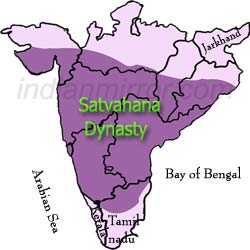
The Mauryan Empire collapsed in 184 BC when the last emperor was killed by one of his generals - Pusyamitra Sunga. But he was not able to keep the empire intact. The northwestern half broke off into a number of Indo-Greek states, the west broke into dozens of small kingdoms. The south broke off under the growing power of the Satvahana Dynasty, when Satkarni, the 6th king of the Satvanahas defeated Pusyamitra Sunga around 180 BC. The only part he retained was the northeast - which also happened to be the richest and most populous part, being located on the fertile Gangetic plain. This was the Sunga Empire, and around 180 BC, it was the largest single political entity in India.
For a few years around 170 BC, the Kalinga Empire (modern day Orissa) spread rapidly to take over parts of Sunga, but it didn't last. The Sunga Dynasty fell as it was made, by assassination. The last Sunga emperor - Devabhuti - was assassinated by his own minister, a man called Vasudeva. Vasudeva then took over the throne and started the Kanva Dynasty, but he lost the western half of the Sunga Empire, as the Sunga Empire had lost the western half of the Mauryan Empire. The Kanva kingdom had no pretensions of empire, it barely covered the two modern Indian states of Orissa and Bengal, plus Bangladesh. This is the state of India around 50 BC. At the time, the largest political entity was probably the Satvahana Empire.
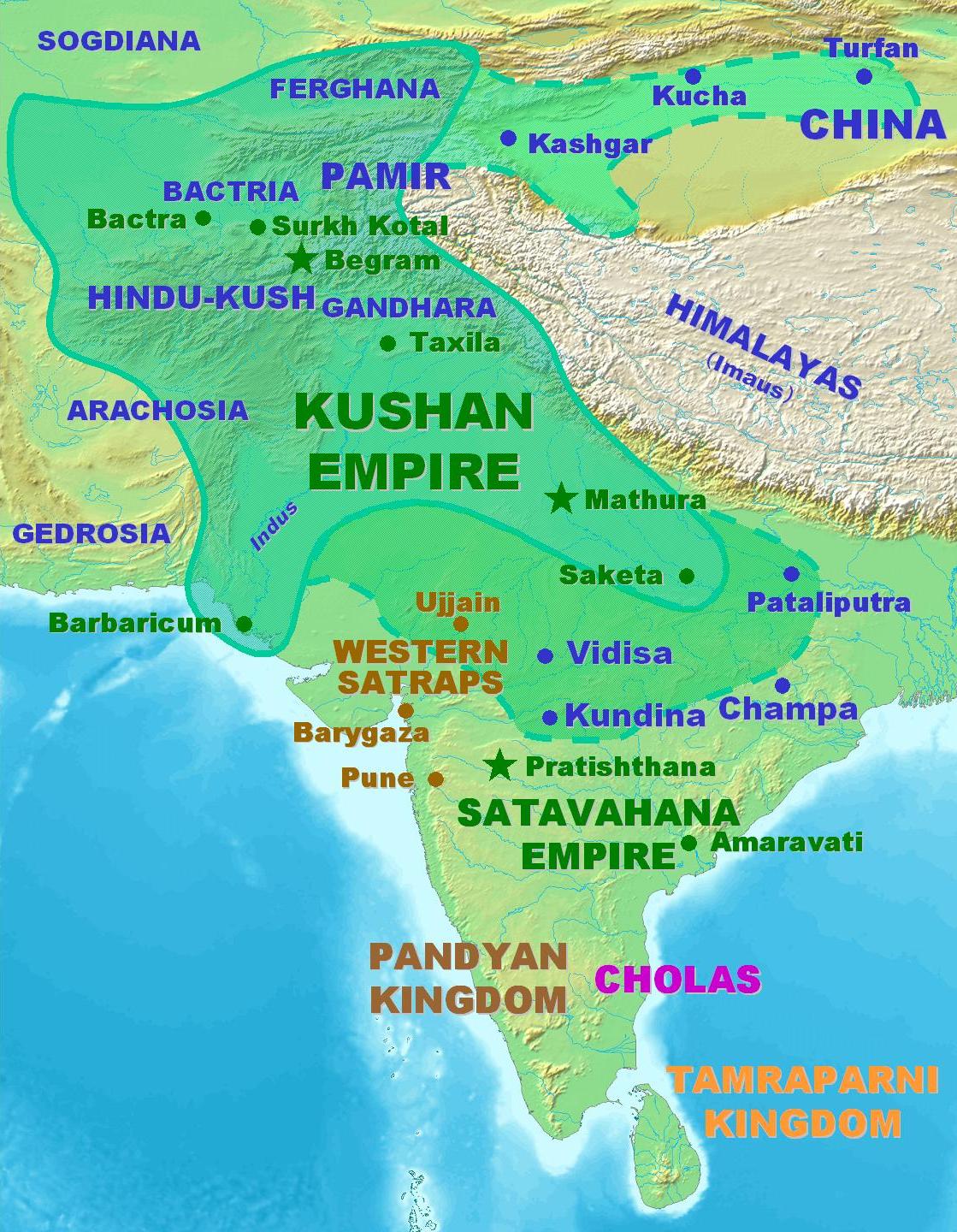
Getting to your specific date of 14 AD, this is a somewhat muddled period of Indian history. The Indo-Scythians invaded northwestern India, where a number of kingdoms known as the western satraps would be set up, leading to their eventual takeover by the Kushan Empire. The Satavahanas were extending their conquests into the east and for a time also into coastal Gujarat in the west. This is the maximum extent of the Satavahana Empire and it's as close to that magic number of 2,000 years ago as I can get, so I would say that it was probably the largest political entity in India at the time.
This would not last very long, as the Kushan Empire grew, spanning from modern day Tajikistan and the Tarim Basin down to central India. The Satavahanas were pushed south. This would be the state of India around 130 AD at the time of King Kanishka.
The Kushan Empire did not last very long, and started breaking up around 225 AD. In 250 AD, India was a collection of small kingdoms, but the Gupta kingdoms had already begun to rise in the east. Under Samudragupta in 350 AD, the Gupta Empire covered most of north India, Bangladesh and Pakistan. This would last until 600 AD or so, when it was brought down by Harshvardhan.