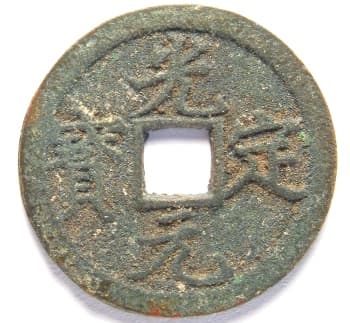
Has any culture not used round coins?
Edit: a couple of clarifications - I'm wondering particularly about ancient cultures, as they also minted round coins and I'm wondering if there was a specific reason why. Additionally, a couple of people have suggested the British 50p piece as a non-round coin, and while yes, that coin isn't circular, it's still essentially round, and modern to boot. I'm wondering about coins minted in unusual shapes like triangles or rectangles.
In answer to your secondary question:
The classical-era Spartans didn't use round coins. They were ideologically opposed to the idea of wealth, or at least, the kind of wealth than can be easily spent. They were happy with concentrating land ownership in the hands of a small core citizen body. But they didn't like ostentation, and as a means to prevent Spartiate citizens from showing off, coinage from other Greek cities was banned and they used iron rods, treated with vinegar to make them unusable if melted down, as money. Each rod was relatively low value, too, so they'd have needed a whole lot of iron rods if they wanted to buy anything of any real value. This meant it was impractical to purchase or sell luxury goods like jewellery, or hoard money in large quantities. In practice, many Spartiates did in fact use Corinthian or other coinage, as they were far more practical to use.
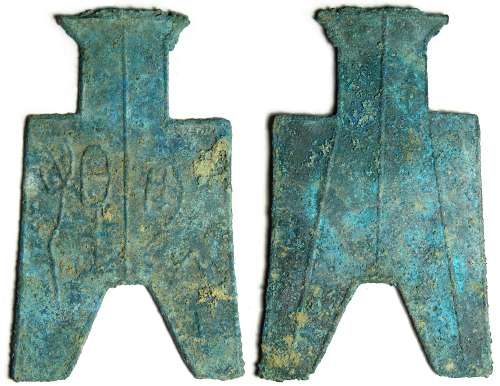
From the Warring State period (770-221b.c.) to the Han Dynasty (206b.c.-220a.d.) knife and spade shaped had circulated among the Chinese masses. How this form of currency started circulating is uncertain. These utensils replaced shells as the main form of currency.
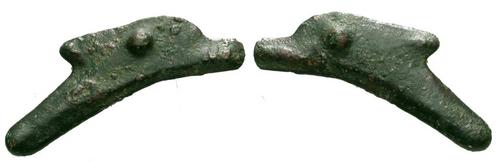
Also made were dolphin shaped coins from Olbia on the Black Sea. They were made by ancient Greeks out of bronze from 600b.c. to 400b.c.
Lastly where square coins minted in the area that was the Mauryan Dynasty (India) after its fall in 200b.c.
It's simply a result of the metalworking techniques. A precious metal was set between two iron or steel blanks which were then pounded upon with a hammer. It doesn't matter all that much what shape the metal blank was at the start, the coin is going to squish into a roundish shape.
You can see it in the example that you linked. The original blanks were not perfectly uniform, and the resulting coin is a bit oblong.
In later years the use of milled edges made for more circular coins.