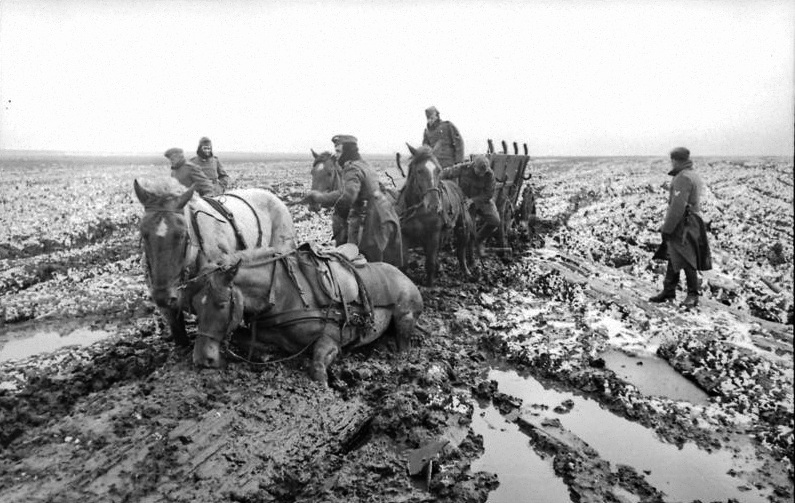
Today, I've heard something very interesting during History class. The teacher, said that both Hitler's and Napoleon's were prepared for the Russian winter during each sieges, and, thus, winter was not the enemy, but rather, spring, whereas the snow melted, creating a type of mud, increasing the difficulty of movement.
Was the Russian Spring, in this case, Napoleon's and Hitler's biggest enemy, and not the Russian Winter as generally thought?
In respect to Napoleon, your teacher is wrong. Napoleon and the remainder of his army had left Russia by December of 1812. The real problem for the Napoleon's failure in Russia was the system in which the French army procured supplies. In enemy territory, French troops would forage for food and supplies for horses and such, thus the supply train would only keep important items such as weapons and ammunition. This helped keep the French army much faster than any other army in Europe but worked against Napoleon in the underdeveloped country of Russia. By the time Napoleon had reached Moscow, his methods drained the Russian countryside of the few resources that he had and the Russians pushed him back the way he came in, preventing him from using the countryside again when he was retreating. So a barren and hostile countryside is the real enemy for Napoleon.
I would argue that your teacher thinks this because Hitler & Napoleon (though wrongly) are tied together in their invasions of Russia. Both invaded Russia for different reasons and both acted on their invasions differently.
what he may be referring to is the so called Rasputitsa or the "season of bad roads" - referred to with a sense of humor by Napoleons soldiers (and later in the trenches of the great war) as the ever appearing 'General Mud'. As the snow thaws - even during or before the onset of the cold winter - Russia's system of unpaved roads both in the war of 1812 and during world war II turned them into an unimaginable morass of mud that never seemed to end.
In this vast collection of mud and muck men, machines, horses, equipment, guns, trucks, and any number of other moving part would be ground to a halt or even swallowed by the suction of endless tracts of black gunk. I'm more familiar with its effects during world war II - but the closely tracked and wheeled vehicles and tanks used by the Germans contributed to their difficulties as they had a supremely difficult task of navigating the horrendous conditions of the roads. Staff cars, tanks, and trucks often required large teams of men or adjuncts to free them from the constant stoppages caused by the deep muddy tracts. The Rasputitsa would swallow hundreds of vehicles and other pieces of equipment during the Invasion and battle for Russia on the Eastern Front. The rasputitsa created a logistical nightmare for German units as supplies and men could not reach the front in an expedient enough manner to either execute operations timely or to resupply beleaguered units. Russian vehicles by comparision such as the venerable T-34 had unusually wide tracked setups with exceptional suspension that allowed them to navigate the conditions of Russia with much greater ease and speed than the Germans could ever hope to muster.
The Wehrmacht at this time was still largely horse driven, and many infrantry units had to march to battle mostly on foot. During the thaws and rasputitsa a landser (or infantryman) could easily loose a boot to thigh-high pools and mud and water. Its difficult to describe the terrible conditions soldiers had to endure during these thaws and seasons, as the muddy tracts became infamous among those who dared to invade the vastness of the Russian nation.
These thaws and seasons definitely had a great effect on the effectiveness of German troop movements, their logistics, and their morale when faced with such an insurmountable obstacle. These dark, cavernous, and unending dreary roads so clogged with filthy particulate slowed entire German formations to a halt many times over their time on the Eastern Front. It was a formidable obstacle with which both sides had trouble - though the large quantity of Lend Lease, quality trucks and willies jeep's that were supplied to the Soviets made their tenure a much less fateful encounter with the familiar rasputitsa
some pictures for reference
addendum: In regards to him saying winter was not the enemy - I can say with little doubt that he is unequivocally wrong in that regard. The Germans did not prepare adequately for the winter of 1941 or 1942, they planned for a quick campaign of encirclement and victory over the soviets before such equipment or gear was needed. Goebbels even petitioned German families at home to provide winter clothing, fur coats, and other articles to support the troops - most of which was in vain, as little reached front lines troops and that which did was mocked by the soldiers. Those were not the actions of a government or military command that had adequately prepared for a strong winter. Many German units outside of Moscow and Leningrad in the infamously cold winter of 1941 had no winter clothing and thus cases of frostbite soared during these times. The Soviets on the other hand had ample supply of padded winter jackets, thick boots (which the Germans stole off dead soldiers with a ravenous zeal), rabbit fur gloves, and fur Ushankas in order to stave off the cold - although not enough for all of their troops. The Germans had to contend with frigid temperatures which their units had little to no supplies for. In the Stalingrad Kessel for example many quartermasters were burning new uniforms and other articles of clothing under orders while their compatriots froze to death from both a lack of fuel in the treeless steppe, or from a lack of protective clothing - many would attempt to save the clothes from the furnace by grabbing at them, thus burning themselves. Both the winter and the rasputitsa were major enemies of Wehrmacht operational capabilities and logistics, they were both formidable obstacles in the way of their conquest of Russia