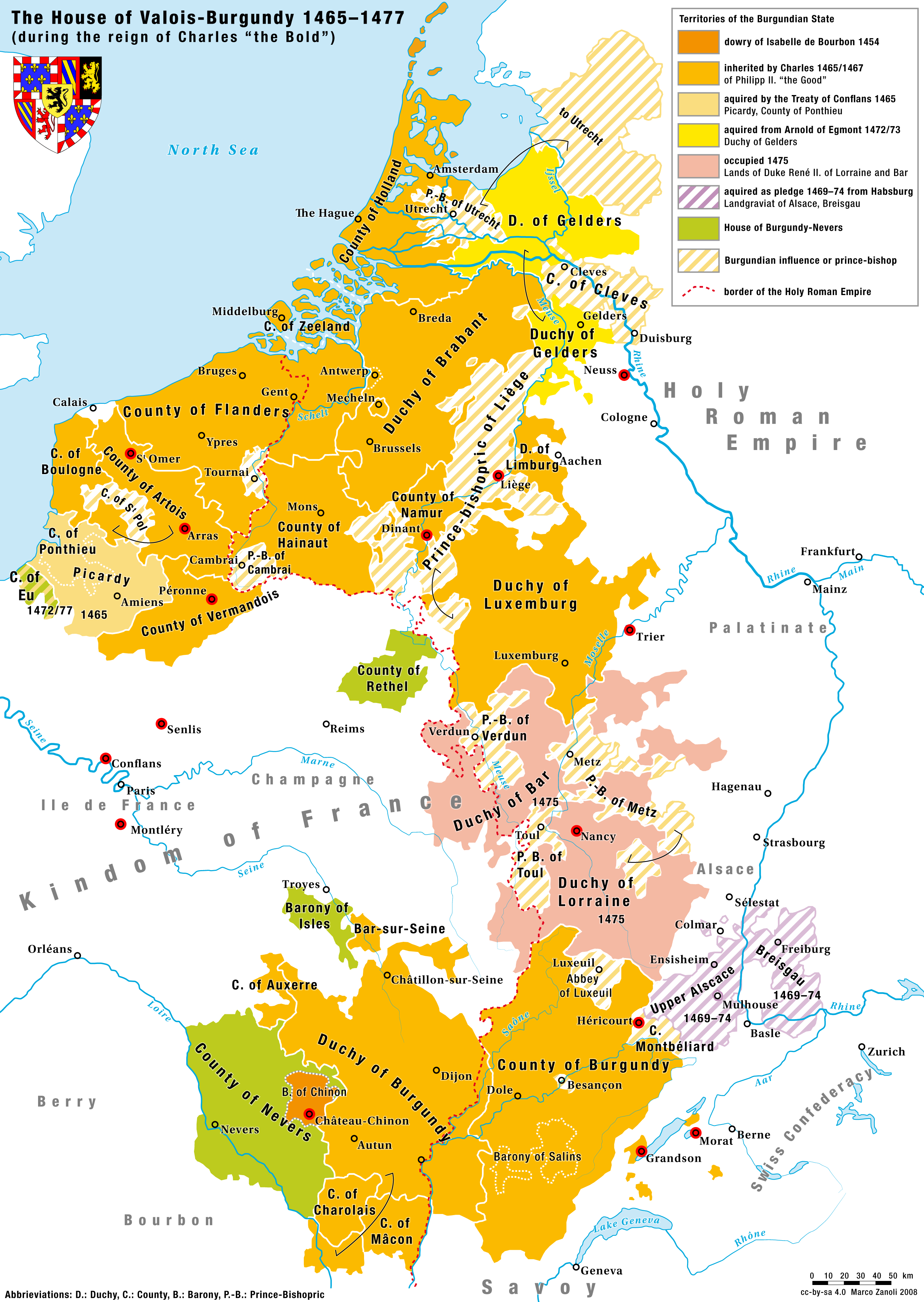
I didn't even know of Burgundy until I played EU4, and Wikipedia seems to have sparse information on it. It seems like it went through some interesting times, and changed a lot until France pretty much conquered it. Who were they, how did they start, and how did they end?
A compact version, then:
The story of Burgundy starts with Philip the Bold, the fourth and youngest son of King John II of France - part of the house of Valois. It was his brother, Charles V (not to be confused with Charles V Holy Roman Emperor), who inherited the crown of France. Philip, however, got the Duchy of Burgundy and French-Flanders as a reward for his bravery in the battle of Poitiers. On top of this, his brother arranged a marriage between him and Margaret of Flanders. This marriage brought Flanders, Artois, Nevers, Rethel and the County of Burgundy (there were two Burgundies) into Philip's hands.
The original intention of Charles V was to regain control over some of the peripheral areas of France through his brother. This didn't really go his way, as Philips the Bold decided to be a real maverick and to go his own way. Philips had the ambition to recreate Middle Francia and more specifically Lotharingia, which was the middle part of the 843 AD split of the Carolingian Empire. This... did not go over well with the French kings. It didn't help that Philip at several points tried (and succeeded) in taking control of France as regent. The relationship between France and Burgundy became mixed, then. This quickly led to a war after Philip's death, when his son, John the Fearless, feuded with the Armagnacs during the Hundred Years' War. Eventually, John was assassinated and a treaty was signed between his successor, Philip the Good, and the French crown, officially recognising Burgundy as an independent entity.
Under Philip the Good's rule, Burgundy expanded even further. Philip got his hands on Brabant, Limburg, Luxembourg, Namur, Holland, Zeeland and Hainaut. His son, Charles the Bold, went even further. After incorporating the duchy of Gelre and the Prince-bishopric of Liège, Charles wanted to connect the two parts of his lands by conquering Lorraine. Up until that point, Burgundy was divided into the northern bit in the modern day Low Countries and Northern France (the Landen van herwaerts overe or the Païs de pardeça - the lands here) and the southern bit with the Duchy of Burgundy itself (Landen van derwaerts overe or Païs pardeça - the lands there). Here's a good map of all that: http://upload.wikimedia.org/wikipedia/commons/8/8d/Karte_Haus_Burgund_4_EN.png
This didn't really go according to plan. Lorraine revolted and Charles died in the Battle of Nancy in 1477. Now. This was a problem. While his grandfather had died an unnatural death as well, Charles the Bold didn't have any male heirs. Male heirs were pretty important during those times. His daughter, Maria of Burgundy, was now in charge. Technically. What actually happened was that several recently added parts of the tiny empire took their chance and reclaimed their independence, while the French king took the Duchy of Burgundy and invaded the southern Netherlands. Mary's only solution was to marry Maximilian of Austria, part of the Habsburg family, who immediately fought back the French and settled the internal unrest. Unfortunately for them, the loss of the Duchy of Burgundy could not be undone.
Mary of Burgundy died fairly shortly after in 1482 after taking a nasty fall off her horse. The Burgundian Netherlands were now fully in Habsburg hands and with that begins the story of the next phase of the Low Countries - that of Habsburg domination. After all, Maximilian's grandson was Charles V, Holy Roman Emperor. But that's another story entirely.
So that, in short, is the story of Burgundy. It's coincidentally also part of the story of the unification of the Low Countries, which took its first steps under Burgundian rule.
I hope that answered your question.
Hello I have read "l'état bourguignon" by Bertrand Schnerb, a very good book, if you read french. The burgundian dynasty started as an accident. The previous dinasty was extinct and the Jean II of France took the duchy for the crown. Then the duchy was given to one of his son Philippe. Philippe was one the most powerfull noble in the kingdom and married the daughter of the count of Flanders and so his successors had a territory split in two, in Burgundy and Flanders. Then Charles VI, became king at a very young age and the uncles of the kings who were all dukes ruled as regent but tensions arose, and led to the Armagnac–Burgundian Civil War. The duke John the fearless had to take Paris to remove the other nobles oppose to his regency, at the end of the day he was assassinated. It was also an opportunity for Henry V to continue the hundred years war, but the english spared burgundian territories. In a desperate position the king of France was forced to make the son of the king of england his heir. While the other nobles favoured the heir of France, the burgundians supported the dual monarchy of England and France. At this point the burgundian territories became independant from the "legitimate" kingdom of France, even after the reconquest of the kingdom, the Joan of Arc epic. In addition they secured a parent as the successor to the duchy of Brabant and other territories in the netherlands (sometimes with force). They enabled the first unification of the netherlands ( northern France, Belgium and Netherlands) under a common rule. A suggestion was even made to create a kingdom in the imperial netherlands but the emperor refused. The dukes had to make travels between burgundy and the netherlands through foreign territories. So they tried to secure territories to link their domain. This led to the destruction of the dynasty as Charles the Bold died without a male heir. The daughter married Maximilan of Austria, and it became the "austrian" netherlands the house of Austria married with Spain and created the "heir of europe", the behemot of inheritance, Charles V (Carlos I from a Spanish point of view)
Some details: Philippe the good had to wear a wig, and all of the court emulated the cut of it. The flag of Burgundy in EU4 is a Cross of St Andrew, it is still present as a background on some version of the royal coat of arm of spain and was present on the flag of many spanish tercios in the XVI-XVII century, as well as in "national" flag displayed during celebrations in the netherlands under spanish rule.
I hope to have answered your questions.