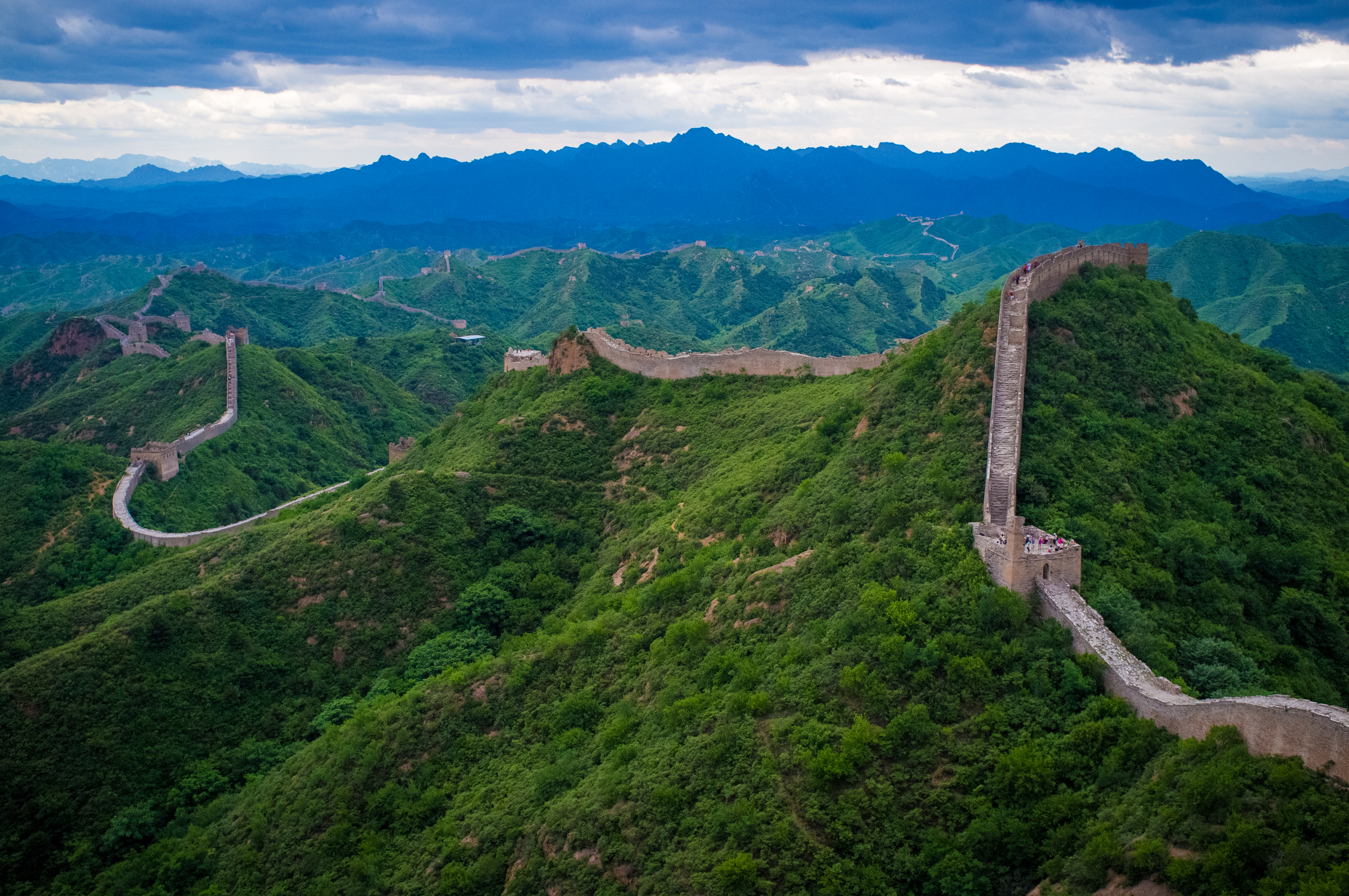
I'm speaking of photos like this where it clearly is covering tall mountain ridges. Was there any real tactical value in that? Or were there deeper reasons for it's relative unbrokeness, such as culture or grandeur?
Prior to the Ming dynasty the wall avoided impassable areas and was mostly rammed earth construction - nowhere near the impressive structure it is today. After Kublai Khan and his Yuan dynasty finally collapsed, the successor dynasty (the Ming) had something of a chip on their shoulders about barbarian invasions. So they reconstructed the wall as a masonry construction in a much more complete structure -more as a tribute to Chinese glory than to actual defence of the realm.
I second Ozymandias' comment (great name by the way), but add also the minor point that although popular imagination likes to think of the Great Wall as just that, one great wall, it isn't actually unbroken. Even the Ming dynasty wall is really several strips, and contains a few gaps. Maps from wiki are good illustrations:
Here's the just the Ming dynasty walls http://en.wikipedia.org/wiki/File:GreatWallChina4.png
But, here's all of the walls built in northern China for all of history. http://en.wikipedia.org/wiki/File:Map_of_the_Great_Wall_of_China.jpg First, I think this is a really fascinating illustration of the extents of different dynasties or kingdoms, what was the frontier for different states over time. But, I'd also point out that if look at the key and then focus only on the Ming dynasty sections, you'll see that it isn't as unbroken as the first map suggests, and that lots of it are in relatively small strips.
The logic is, most of the invaders were horse-riding nomads, large numbers of them would not be able to easily cross anything that high or at a good speed, the smoking signaling would prepare the defending army against the enemies. They were not intended as the only defense. According to the book Chronicles of Northern Invasions (北虏事迹), there were actually rangers well beyond the wall looking out for any signs of massive invasion. On the other hand invading armies would have to demolish the structure in order to pass through. There were several such instances during the Ming Dynasty. For example in 1550, Altan Khan's invading army demolished the portion in their way and made their way to Beijing.
Wouldn't it have been used like a road for defensive movement too? Easier to get from 1 fortification to the next.