Right after World War II, after the Russians had rolled over the Germans, why didn't they give Germany back to the Germans? Didn't they want to have as much land and power as possible?
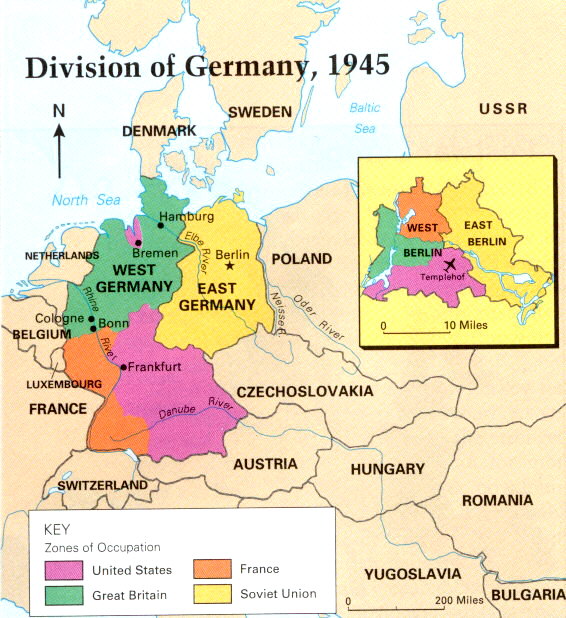
During the war, Russia was aligned with Britain, France, and the United States (Allies). You're right to say that the Russians rolled over the Germans, but they actually did get to occupy a big piece of Germany. At the Yalta Conference, the Allies had to agree on several post-war conflicts of interest. Russia was communist and the other three allies weren't, but they tried to divide up Germany equally. Here is a map of the division of Germany. Berlin was also divided, which is where the Berlin Wall was built by Soviets. (Austria and Vienna were divided for occupation as well.) Deutsche Wiedervereinigung (German Reunification) happened in 1990 when West Germany and East Germany became united.
A distinction needs to be made in this case between outright annexation and control or "keeping" East Germany to themselves. To a great extent, the Soviets did keep Germany for themselves but they did so without annexation. The Western Allies took the lion's share of German territory while the Soviets took all of Eastern Germany, both parties occupied for years. The difference is that the Soviets put a puppet regime in place while the Western Allies did not.
Land does not necessarily equate to power in geopolitics. The power politics of the Cold War emphasized influence. The Soviets liked to install puppet regimes who were nominally Socialist while the Allies had different ways of going about acquiring influence. The Soviets did something very different than the Allies (here on out please see "Allies" as "western Allies"), they did try to make East Germany into a far weaker state than it had been in the past. The Soviets packed up all the industry they could get their hands on and every bit that was useful to the U.S.S.R. and shipped it East. The Allies on the other hand realized rather quickly that they needed a buffer against the Soviet's and started helping West Germany get back on its feet with measures such as Marshall Plan.
The Soviets wanted buffer states against the West too, both side knew that direct confrontation between American and Soviet soldiers would be hard to back down from so they tried to minimize contact by creating buffer states or satellite states. Before reaching the U.S.S.R. the Allies would have to cross East Germany and Poland which meant contact between armed forces was nearly impossible unless that was the express goal.
The Soviets, after the war, left with East Germany's industry and still had the largest and most powerful army in the world and that is how power was quantified at the end of the war. It did not need to "own" Germany outright, it needed Germany cowed. Which is exactly what they got.
They could point at East Germany and say they had another ally, a far more important thing for the Soviets than extra land. It's also important to note that the post-war status of Europe had largely been decided at Yalta, including what would happen to German industry, the Allies simply realized that what they had agreed to do with Germany was not in their best interest so they backpedaled. Not that it really mattered because the Soviets did have troops stationed in East Germany. They had control over what they had taken during the war entirely, they did not need to annexe East Germany to make that clear.
Primary sources used were Iron Curtain: The Crushing of Eastern Europe, 1945-1956 by Anne Applebaum and some information from The Sword and the Shield: The Mitrokhin Archive and the Secret History of the K.G.B. by Andrews and Mitrokhin.