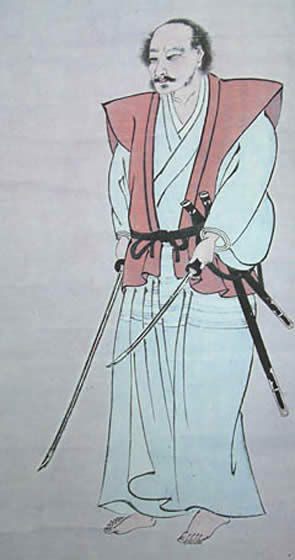
I assume the shorter sword was just a back up for if the Katana broke or they were disarmed... or fighting indoors. I know Musashi claimed to fight with a sword in each hand though.
Legend says Samurai trained to draw and attack with the sword in one motion... but the "upsidedown" carry style seems counter intuitive to this?
I also have heard the Tanto was possibly exclusively for Seppuku suicide, is this true?
Possibly related: Are there accounts of warriors cutting each other's armor off? It seems Samurai armor was held on with Rope for the most part, and could be compromised by skillful cuts.
It is possible to fight with both swords. There's a two-sword style in kendo (Japanese fencing,) although it's fairly uncommon. Wielding a 3 food sword, even a bamboo one, single-handed is pretty tiring. Generally, the second sword seems to be used mostly for parrying rather than as an offensive weapon, although I imagine in less formalized fights it would be employed offensively where appropriate.
The 'upside down' way the blade is carried doesn't really affect its ability to be drawn quickly. If you look up 'iado' on Youtube you'll find any number of demonstrations that show this quite well.
There were tantos made specifically for suicide, but the term 'tanto' was applied to a vast array of knives used for a variety of purposes, including women's self-defense blades and weapons of war.
All of the knots that held samurai armor in place were on the warrior were on his back. One would assume this discouraged a samurai from dishonoring himself by retreating ;) But really, the only way to cut the armor off of an opponent who wasn't fleeing would be to surround him or impale him.
I know Musashi claimed to fight with a sword in each hand though.
Here is Musashi's own self portrait. Note the length of the sword in the off-hand position.
The English use of the word "sword" should not mislead you into thinking he was dual wielding 2 longer swords.
http://upload.wikimedia.org/wikipedia/commons/7/7c/P03jigazou.jpg
Legend says Samurai trained to draw and attack with the sword in one motion... but the "upsidedown" carry style seems counter intuitive to this?
The Katana was worn edge up, typically with the scabbard through the sash.
Observe these men: http://upload.wikimedia.org/wikipedia/commons/c/c0/FirstJapaneseMission.JPG First Japanese Embassy to Europe. Nadar, 1862
They wear or hold their swords in a variety of positions.
This should indicate to you that there was no set rule for how it was used or worn, simply the user's training and preference.
There's a reason a lot of them used edge up katanas, it was that it was effective in delivering a good first stroke or parry as you drew the sword.
Observe the thrid man from the left in the previous image.
Drawing edge up, he would be lifting his sword to a similar position as in the image, so that as it drew from the scabbard it would already be close to providing a blocking protection for the head and upper body as he drew it up and across his body with his right hand.
The left hand would have the scabbard firmly and if an attacking blow arrived before he cleared his own weapon, the scabbard can hold the sword tip firmly enough to help block a downward strike from a similarly armed opponent.
An edge down draw would require the user's strength to parry the blow.
Secondly, if attacking, the edge up draw allows for the tip of the sword to be striking the target with the user's strength and the sword's weight.
In comparison to the Tachi style of edge down, which if used to deliver a combination draw and strike would need to rely on the wearer's weaker muscles at the back of the shoulder rather than the stronger pectoral muscles used in a downward strike.
The body parts also encountered would be different.
edge down, unless the draw and strike were two separate moves, the blade would first encounter lower extremities and then torso.
Edge up with a draw-strike, they would encounter head and upper body, with a much higher chance of winning the fidht or duel with the first cut.
Third, and least important in my opinion, is simply comfort.
Observe the men here:
http://upload.wikimedia.org/wikipedia/commons/5/5c/Satsuma-samurai-during-boshin-war-period.jpg
If they wore it with the edge down, then the weapon would protrude a lot more, with the possibility of snagging.
Seating, walking, and other activities all are made easier if the sword is worn in this fashion when wearing civillian clothes.
When used in armour and on horseback, the Tachi method was most common, using cords to attach it to the armor rather than have it held in the sash belt.
http://en.wikipedia.org/wiki/File:Samurai.jpg