On my commute to work today, there was a brief story about political intimidation in Pakistan.
My rather weak knowledge of the two countries leads me to understand that while India has not been entirely the most democratic country in it's history, with the recent elections unseating the main party for the first time in it's history (thereby implying that single party meant exclusive political rule), Pakistan has been more plagued by military coups, police and intelligence agency intimidation against political opponents, as well as being "unreliable" in it's foreign policy commitments.
Is there a historical basis for this?
Oh...and no, "Because Muslim," is not a good answer.
Excellent question, to which I am going to give a somewhat inadequate answer.
You've probably heard a lot about the Sykes-Picot Agreement since the American invasion of Iraq in 2003. This is the secret WWI agreement on the division of the Ottoman Empire into zones of British, French and 'international' control in the event of a victory by the powers of the Triple Entente (French Third Republic, British Empire and the Russian then-Empire). Russia had a revolution, the agreement was exposed, embarrassment ensued and then the Middle East got carved up anyway, making T.E. Lawrence look like kind of a dick in the process. The (completely arbitrary) borders between the French and British zones of control strongly influenced the modern borders between Jordan, Syria and Iraq, arguably contributing to endemic regional instability and intra-state ethno-religious conflict.
Almost the same thing happened to Pakistan.
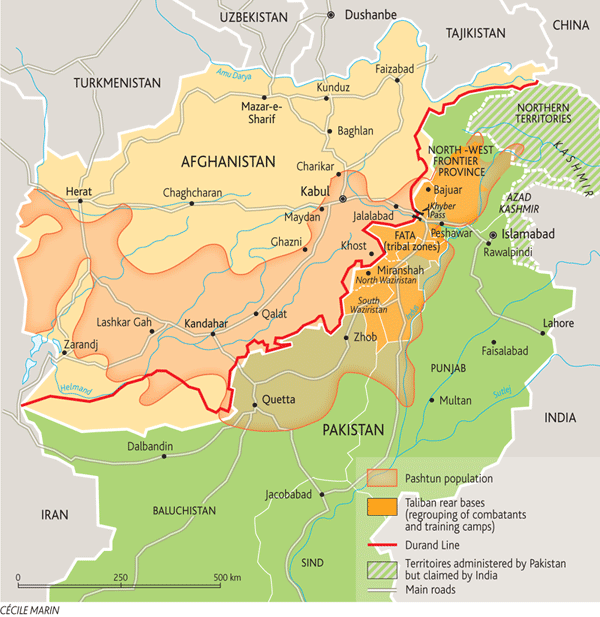
In 1893, Sir Mortimer Durand represented the British Raj as Foreign Secretary of India in negotiating spheres of influence with the neighbouring Afghan Amir, Abdur Rahman Khan. Afghanistan's territorial integrity was, at this time, guaranteed by the British, putting them at a decided advantage. The resulting 'Durand Line' ran over 1600 miles straight through the middle of Pashtun tribal territories. The Durand Line is the modern border between Pakistan and Afghanistan, to this day porous, unrecognised by Afghanistan and considered the most dangerous border in the world.
As if Durand's perfidy wasn't enough, the Radcliffe Line establishing the borders between West and East Pakistan (Bangladesh) and India in 1947 created a second unstable frontier, though this line at least attempted to respect ethno-religious majorities.
If you can get behind the Taylor & Francis paywall, there is an excellent overview of the relationship between contemporary political problems in Pakistan and the Durand line.
The first difference between India and Pakistan lies in its conception whereas India was created as secular multi-religious multi-ethnic state Pakistan was created as an Islamic (Liberal initially) state. So what happened as a consequence: When the question of ethnic diversity arose both in India and Pakistan in the 50s 60s n 70s India was more receptive in accommodating these identities than Pakistan. (Ethnic Diversities : both India and Pakistan are very diverse when it comes to lingual groups. Major groups of India include Tamils, Punjabi, Telugu, Bengali etc etc. Over 300 languages are spoken in India as well as over a 1000 dialects. Pakistan consists of primarily Punjabi, Sindhi Balouch, Pashtun and Bengalis (before creation of Bangladesh) as their major ethnic groups.)
Example of this can be the fact when the agitation for provinces based on Language (like creation of Maharashtra in 1960 from the State of Bombay as a province for the speakers of Marathi language), India accepted the demand. Whereas when the question of the National Language of Pakistan came Urdu was chosen despite large scale dissatisfaction with the Bengali population. Pakistan throughout its history tried to undermine its ethnic diversity by homogenizing the country by Islamification . this policy had repercussions such as the turmoil resulting in the creation of Bangladesh, as well as the increased power of the clergy as the political and military class used them to Islamize the nation. Another reason for the great influence the clergy has in Pakistan is because of the Soviet war in Afghanistan in the 80s when Pakistan became the launch pad for intrusion of the mujaheddin into Afghanistan, this helped in making inroads for the hardliner Islamist into Pakistan.
As for the military coups, at the onset of the creation of Pakistan both its top leaders Md. Ali Jinnah and Liaqat Ali Khan died (1948 n 1951 respectively) this led to a creation of a Political vacuum in this crucial stage of Nation Building. This vacuum was filled time and again by the military.
As for the flourishing of Democracy one of the main reason was a dedicated, patriotic and extremely talented set of leaders at the onset. Men like Nehru, Patel, Ambedkar, Maulana Azad, Rajendra Prasad were dedicated to installing democracy in India. These people laid a strong Institutional foundation for the growth and sustenance of Democracy through the decades in India.
In the end I would like to state that
Source:
India part: India after Gandhi: the History of the World's Largest Democracy by Ramchandra Guha (2007).
Pakistan part: The columns written by Pakistani journalists like Khaled Ahmed & Husain Haqqani for the English Daily "The Indian Express".