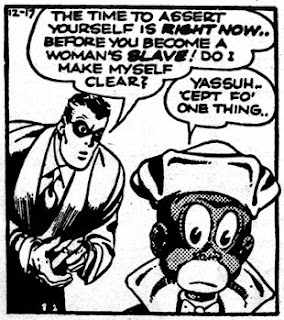
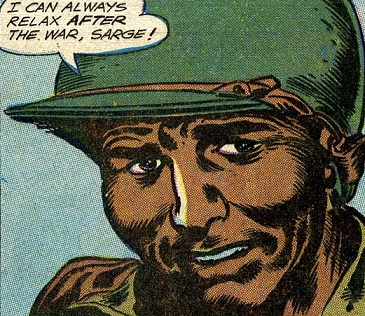
I've read that comic books were fairly racist during and following World War II (mostly towards Asian peoples), but I'm confused about the ways in which comic books presented black Americans.
Were they more racist or progressive? Were they focused on integration into white America or black empowerment? Were these perceptions dependent upon different publishers?
Aside from All-Negro Comics (a one-off series in 1947), I can't find much information on black people appearing in comic books until the 60's with characters such as Gabriel Jones in Nick Fury's Howling Commandos or Black Panther who appeared in Fantastic Four in 1966 and got his own series in 1973.
Additionally, how heavily were comic publishers decisions on race dependent upon the bottom line, financially speaking? When black people were eventually incorporated into comics (and eventually had their own series), was the decision to do so based on predominantly financial or socially progressive reasons?
Lastly, what academic literature can I read on the subject to further my knowledge on the issue? (/u/Bufus)
Comic depictions of African-Americans were often very crude stereotypes well into the 1940s, practically minstrel-show pickaninnies: see for example Captain Marvel's sidekick Steamboat, or The Spirit's sidekick Ebony White. These portrayals died down somewhat by the 1950s, and there were a few sparse efforts at black-centric, -drawn, -written, or even -published comics, like the All-Negro Comics that you mentioned or some experiments like "Negro Romance."
In 1954 of course you have Fredric Wertham's Seduction of the Innocent and the institution of the "voluntary" Comics Code Authority in an attempt to quash the lurid material that was common in comics of the time, possibly including the most virulent racism; this had the side effect of quashing much that was interesting about comics of the time, including progressive tendencies. By the mid-to-late '50s, some less-stereotyped but still rather tokenish and unthreatening black characters start to appear in the background of mainstream comics, like the soldier Jackie Johnson of DC's Easy Company (1959). There were also exoticized, lion-skin-wearing African noble savages like Waku, Prince of the Bantu from 1954.
These depictions did vary among different publishers, and a few pushed the envelope as far as they could. Probably the most famous example of civil rights-related pushback against the CCA is the 1953 story "Judgment Day," written by Al Feldstein and published by EC (Entertaining Comics, the eventual creators of Mad Magazine), which you can read here. To summarize: a helmeted spaceship pilot investigates a robot society with blue and orange "races" where the orange robots subjugate and oppress the blue ones; the pilot decides that they should be excluded from the interstellar community due to their obvious bigotry. In the last panel, the pilot takes off his helmet to reveal himself as a black man. When EC attempted to republish it in 1956, a CCA censor tried to block it (notably without any particular grounding in the Code). The EC publisher, Bill Gaines, went ballistic and called the censor's bluff; the story ended up running unchanged, but it was the last comic book that EC published, as they were already in the process of shifting towards a full-time focus on Mad.
The introduction of numerous black comics characters in the '60s can almost certainly be attributed to the publishers' desire for fresh, socially relevant material to keep their existing audiences—as well as draw new audiences. African Americans themselves were becoming more vocal about the whitewashed vision presented in the world of comics, as this magazine advertisement from 1970 or so indicates. By the early 1970s, the CCA restrictions were beginning to relax as the industry scrambled to keep up with the changing times, and socially relevant material—i.e. serious and well-developed characters of color—became fashionable (rather than cutting-edge) in the comics establishment.
Source-wise, the only decent monograph on black comics that I'm aware of is Jeffrey A. Brown's Black Superheroes, Milestone Comics, and Their Fans, which deals more with the '80s to the present but may still be useful.
You can study the comic books, but it will be very hard to study perceptions and how comic books influenced perceptions. Even if someone has written a journal, diary or blog about it, it would be just one person's perceptions (and I doubt we have lots of source material from the actual comic book readers, especially pre- and post- reading the comic books with the Black stereotypes).
I think it's safe to say that minstrel-show pickaninnies didn't have a positive effect on many people's perceptions of Blacks.
Sounds like a good topic for more research, though.