Most initial civilizations developed along rivers but that doesn't appear to be the case with Crete. What made the Minoans a seeming exception to this pattern?
I will start with a diffusionist perspective because it is an easy, intuitive starting point and can help organize the social geography of a question like this. I will, however, later complicate it, because as good of a place to begin as diffusionism is, it is often a very bad place to start. The essentially problem with this perspective, which sees ideas, trends, and cultural features beginning at one point and "diffusing" out is that it takes an overly mechanistic view that is very convenient for models but ultimately does not include the human aspect that, after all, stands at the heart of all historical inquiry. It is also tied up in a lot of colonial ideology, which is not in itself necessarily a reason to discount, but does at least give a hint that there might be problems.
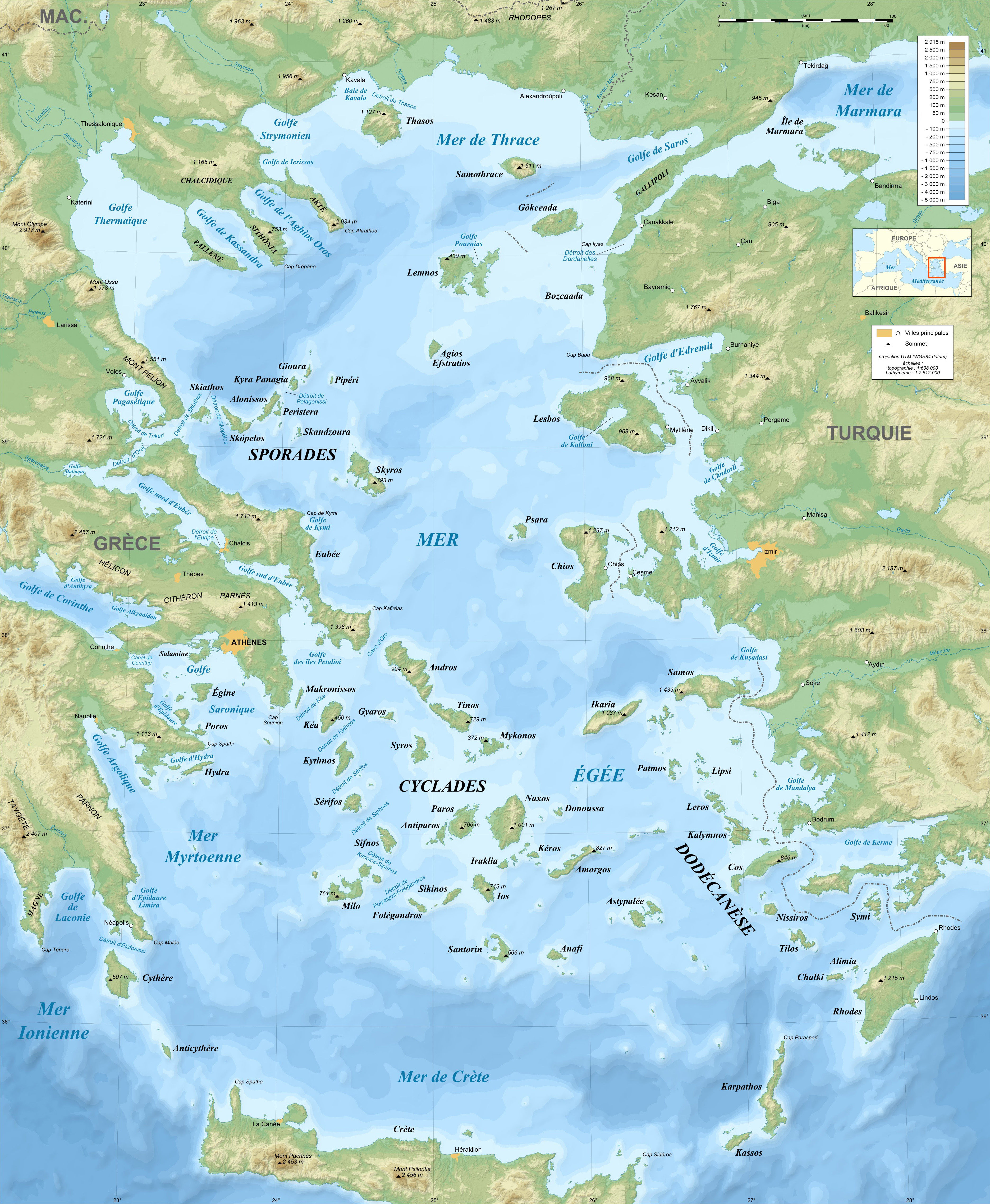
So, if you want to see ex orientia lux urbanized civilization began in the Near East, either in Southern Anatolia and the Levant or Mesopotamia depending on your definition of urbanization. It then spread out like a web, including the area of modern Fars province in Iran (ancient Elam), the Nile, and up through Anatolia. Into Europe, it spread up along the Black Sea and through the Balkans, but also from the Ionian Coast across the Aegean to the Mainland. The Aegean is a tightly bound marginal sea, as you can see from this map, and as Crete forms an integral boundary we can see the spread from the Mainland, to the Cyclades and then to the Mainland.
Now, the problem with this view is that it is mechanistic and ignores the agency of the Cretans--they attained cities, they did not have cities thrust upon them. Civilization, which is a term that is generally frowned upon but regardless, isn't the Blob, spreading endlessly and engulfing all in its wake. It must be understood within the context of the societies that chose to urbanize. But we wouldn't want to discard the chronological model altogether, as it does in fact exist, so instead we should look at the phenomenon as a product of trans-social interaction. The Aegean is a very tightly bound interaction sphere, and exchange networks go back very far, far before the Minoan Civilization. The development of complex societies in Anatolia had major repercussions, namely that they are, so to speak, hungry beasts. While exchange is natural to all societies, complex, highly stratified societies require more goods of a more diverse type from farther away. This can be simply in terms of resource requirements (to hop across the globe, I have seen arguments saying that the development of centralized control in Bronze Age China was a result of resource hunger) but also for prestige goods. The stratified social structure of a complex society needs to reify itself through continuous display--or, to put it in other words, social elite need to demonstrate that they are social elite in order to maintain the hierarchical social structure. One easy way to do that is through difficult to acquire material goods (top of the line sports cars, for example). Thus, the development of complex, stratified societies along Anatolia induced an intensification of exchange networks. More trade, more wealth.
But, the greater wealth does not fall on everyone in society equally, and those who are able to best capitalize on new exchange patterns are able to increase and solidify their status with new material wealth. The greater centralization of power within individuals allows for the development of more complex societies, which we might conventionally term "civilization". For Crete in specific, they were able to capitalize on increased exchange patterns across the Aegean.
Barry Cunliffe has a good description of this process in Europe Between the Oceans, although I should not my model here is heavily influenced by his Iron Age Communities in Britain and Champakalakshmi's Trade, Ideology, and Urbanization.