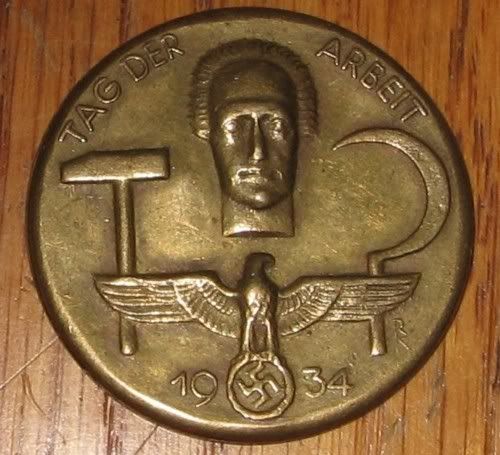
The coin -> http://i45.photobucket.com/albums/f78/jonjayray/laborday.jpg
Weren't they killing and hating each other a few years later?
There'll be a special upvote if anyone find out who the guy with an afro (nazi-afro?) is.
I tried to google about it but i couldn't find valid information, only dubius and conflict information.
The Communist symbol is traditionally a hammer crossed over a sickle, not just the presence of a hammer and sickle. Given that the coin was minted for Labour Day, their use is as more generic trade union and worker symbols.
It may be worth noting that the hammer and sickle appear in a very similar fashion in the Austrian coat of arms, with connotations having nothing to do with Communism.
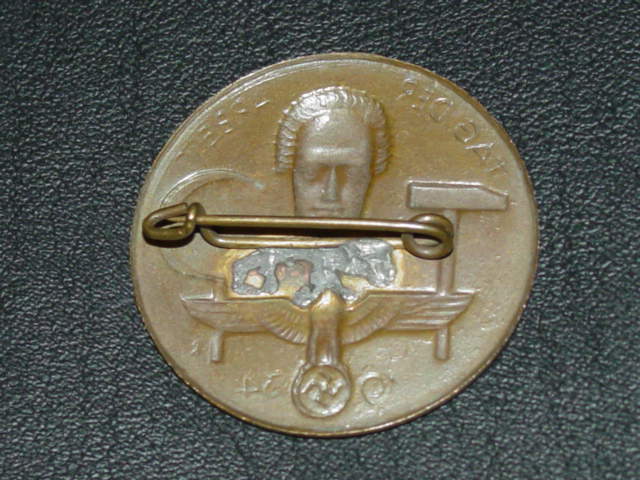
It's not actually a coin. It's a 'tinnie' (in collector vocabulary), a tin badge. See this image of the reverse of such an artefact (see this one also).
For what it's worth I would like to make it clear that I have no interest in this kind of collecting.
Working off of prior comments, I have a few things to add: first of all, the "tinnie" displayed here has no connection to trade unions or communism, as the NDSAP was starkly opposed to unions and connotation with socialism or communism, and actually outlawed unions in Frebruary of 1933 with the Zerschlagung der Gewerkschaften 1933 Trade unions were outlawed and replaced with the Deutsche Arbeitsfront (DAF), the state-run national, multi-trade labor "union," under which workers' rights disintegrated gradually for the good of the Reich.
The connection /u/Exovian mentions is the adaptation of the coat of arms used by the First Austrain Republic after 1919, utilizing both classicly "Austrian" images and the addition of the hammer, sickle, and broken chain. These images are under debate for their use, but my understanding (and interpretation) is use not as communist symbols, but representative of the rule of the people (in a republic), thus the use of people's instruments (hammer and sickle), over a monarch's instruments (Orb, sword, and scepter, as it had been with the Austrian Empire).
Tag der Arbeit Itself is an invention of the NSDAP in commemoration of Blutmai, or Bloody May, a communist riot/massacre (depending on who is telling you about it) occurring on May 1, 1929. In 1928, The ruling Socialdemokratishepartei Deutschland (SDP) outlawed all public demonstrations, and the Kommunistpartei Deutschland (KPD) encouraged labor marches to commemorate May Day, like there were the working world over. Over 30 protesters were killed in Berlin. Much of the clash was contained to the locality of Wedding, and after Blutmai, the two workers' parties (SDP and KPD) were even more fractured than before, opening the doors and increasing support for the upstart NSDAP.
Sources: (In German) (Deutsches Historisches Museum Berlin On the elimination of unions; on the DAF
["The Symbols of the [Austrian] Republic"] (http://www.bmi.gv.at/cms/BMI_OeffentlicheSicherheit/2006/11_12/files/Wappen_und_Flaggen.pdf) from the Austrian Ministry of the Interior
Bolby, Chris "Blutmai 1929: Police, Parties and Proletarians in a Berlin Confrontation"