I'm just copy/pasting my answer from the Small Arms AMA a few weeks ago.
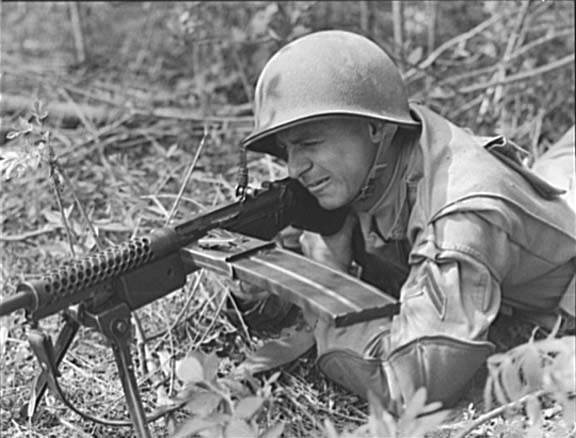
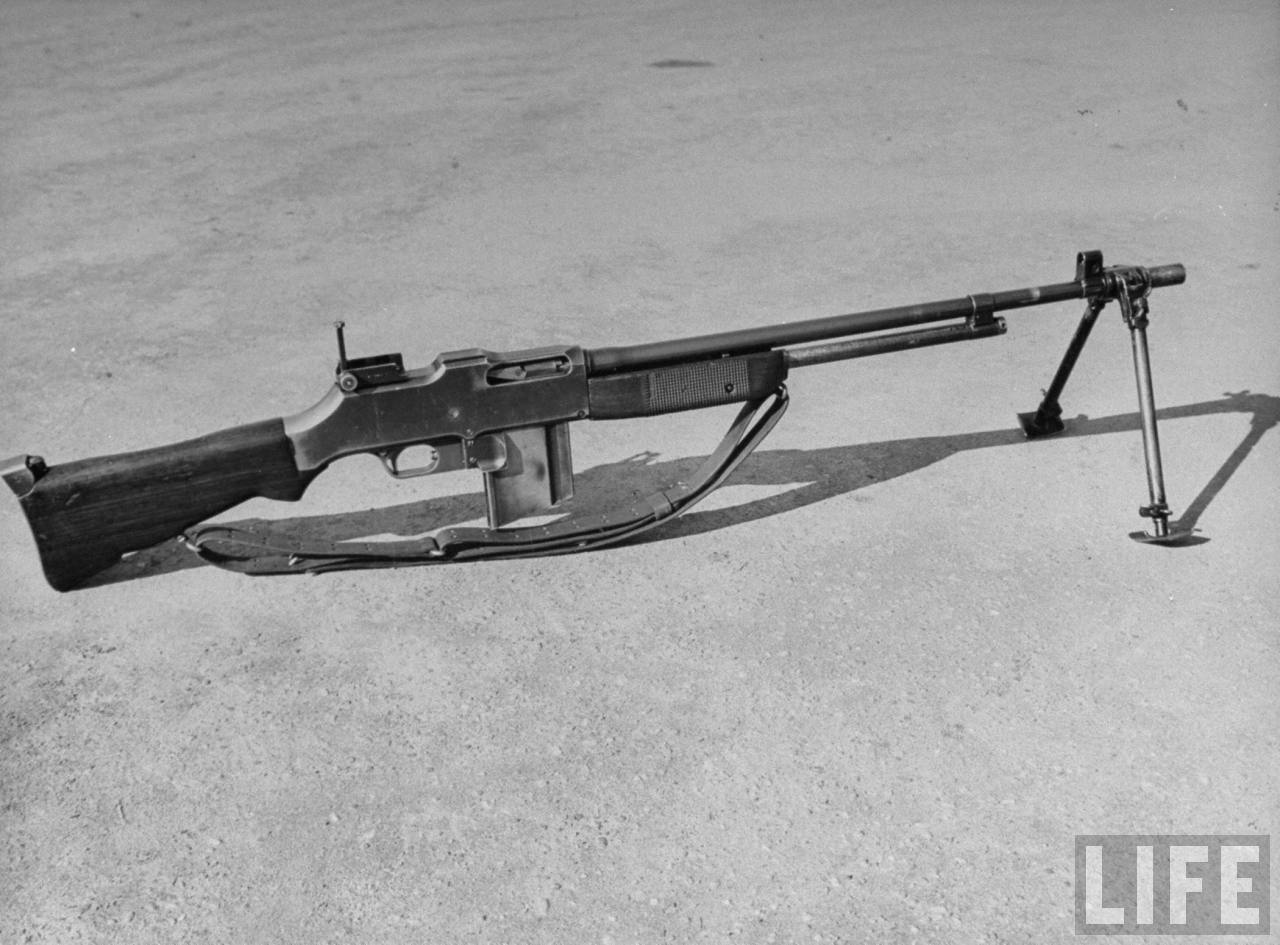
Well with the BAR you need to understand that it wasn't designed to be a light machine gun (ie used from an emplaced position), but an automatic rifle, used to provide what was termed 'walking fire'. When developed during WWI, the idea was that the gunner would walk across No-Mans-Land providing covering fire for everyone else. It even came with a cup device you can see here to keep the butt of the gun steady. Working in a three man team, they all would carry extra ammunition, but since they were supposed to be walking, it would be far to awkward to use a belt. The box mag was the only real option.
The BAR was kept, and improved upon, through the inter-war years and found itself shoehorned into the LMG role, as the US lacked a proper light or general purpose machine gun. Compared to the MG34 or MG42, it was woefully inadequate in many regards. Those were proper GPMGs, fired from a bi-bod which allowed them to be mobile, and belt-fed, which allowed them to provide much more fire than the measly 20 rounds of the BAR. The Browning M1919 was the closest thing the US had, but being a true medium machine gun, and fired from a tripod, not a bi-pod, it couldn't fill that role, so the BAR had to do it, although attempts were made to make the design work in an LMG role.
The only place that the BAR truly excelled in, compared to the MG34/42 was its mobility. A single soldier could pick it up and continue to use it while moving - a relic of the walking-fire role it was made to fill. It was great for that, and that was a role the Germans couldn't fill properly - the FG 42 might be the closest equivalent. But that was not nearly as important a role as the LMG/GPMG.
So to summarize that, the BAR was not developed with the LMG role in mind, and US military doctrine didn't put enough stock in developing something like the MG34/42, so it had to fill the role the best it could.
The BAR's magazine capacity was limited due in part to it being 'bottom feeding', with the detachable box inserted into the bottom of the receiver, rather than from above (as with designs like the Lewis and later Bren), or from the side, such as with the later 'Johnson'. This prohibits the use of larger magazines, which would produce an unergonomic profile. From this photo, in which a BAR is 'rested' on the bipod and rear of the stock, you can see how an extended magazine would compromise ergonomics.
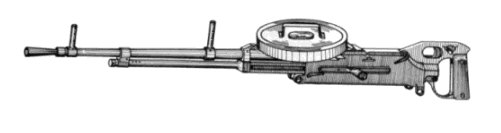
A Polish design based on the BAR, the 'Karabin maszynowy obserwatora wz.37', actually had a 91-cartridge 'pan' magazine, but this design is substantially removed from the original automatic rifle, being designed for use on aeroplanes. Photographs of larger BAR mags do survive but they seem to be limited to use with AA platforms, where the ergonomic problems of a large bottom-feeding mag aren't such a big deal.
Source and further reading; J.L. Ballou (2000), 'Rock in a Hard Place: The Browning Automatic Rifle'.
The BAR wasn't an MG and it was never meant to be used as one. Comparing it to the MG42 is pretty pointless.
American infantry tactics were based on the idea that a platoon of rifleman, armed with semi-automatic rifles would put out enough fire to make a dedicated MG unnecessary. Any threat that would have required even more heavy and sustained fired was meant to be dealt with via fire-support (i.e. artillery or mortars) or air-support. Thus the BAR was only required to provide a very limited amount of fully-automatic fire.
The MG42 was one of the first examples of what is nowadays called a GPMG, i.e. it wasn't an LMG, either. It wasn't nearly as mobile as the BAR r even an LMG and wasn't really usable on the move. German infrantry tactics were centered around having multiple MG34/MG42 as the primary sources of sustained cover fire, while the other infantrymen carried only the bolt-action 98k carbines. This only changed when the first assault rifles were issued very late in the war.