Today:
You know the drill: this is the thread for all your history-related outpourings that are not necessarily questions. Minor questions that you feel don't need or merit their own threads are welcome too. Discovered a great new book, documentary, article or blog? Has your Ph.D. application been successful? Have you made an archaeological discovery in your back yard? Did you find an anecdote about the Doge of Venice telling a joke to Michel Foucault? Tell us all about it.
As usual, moderation in this thread will be relatively non-existent -- jokes, anecdotes and light-hearted banter are welcome.
I found a cool thing at the National Archives (College Park) this week. While looking for something completely different, I stumbled across an original edition of the Franck Report from June 1945. The Report is basically a petition by scientists working on the Manhattan Project to the US military to do something other than dropping an atomic bomb on a Japanese city without warning. It is considered rather important historically.
Two years ago I had written a blog post about the fact that the Franck Report that most people know was actually censored by Manhattan Project authorities. But even that version was missing one sentence which had been X'd and scratched out.
Anyway, I found a version that was still X'd and scratched out, but I was able, after staring at it for a very long time, very up close, to make out the missing sentence. In context, here it is:
One may point out that the scientists themselves have initiated the development of this "secret weapon" and it is therefore strange that they should be reluctant to try it out on the enemy as soon as it is available. The answer to this question was given above — the compelling reason for creating this weapon with such speed was our fear that Germany had the technical skill necessary to develop such a weapon without any moral constraints regarding its use. We fear its early unannounced use might cause other nations to regard us as a nascent Germany.
The new part is in bold.
Here's what it looked like in person. Here's a close up of the last part — you can make out "Germany" at the end, and "early" above it. The hardest word was "nascent" which I'm not 100% sure is correct (definitely an "n" at the beginning and an "ent" at the end and a few letters in between, but it was intensely scratched out). It wasn't a situation where I could do the old "look for the indentations" approach because the original was a mimeograph of some sort and the scratches/etc. were done over that.
Anyway I feel pretty chuffed to have stumbled across it (in a weird place, at that) and to have figured it out. Advancing historical understanding, one sentence at a time!
Last week I won a competition to work with the British Library on a new digital project - the Victorian Meme Machine.
The VMM will create an extensive database of thousands of Victorian jokes that will be available for use by both researchers and members of the public. It will analyse jokes and semi-automatically pair them with an appropriate image (or series of images) drawn from the British Library’s digital collections and other participating archives. Users will be able to re-generate the pairings until they discover a good match (or a humorously bizarre one) – at this point, the new ‘meme’ will be saved to a public gallery and distributed via social media. The project will monitor which memes go viral and fine-tune the VMM in response to popular tastes. Hopefully, over time, it’ll develop a good sense of humour!
The project is still in its early stages, but if you'd like to know more you can take a look at an introductory video and blog post here. Hopefully I'll have some good new gags to share with you in the coming weeks.
I don't know if I've shared it here yet, but I recently published a short magazine-style piece about how the border between Alaska and the Soviet Union opened in 1989.
I spent last week cycling 400mi/640km through the backroads of the (US) state of Georgia last week, which is not particularly historical in and of itself, but it was a reminder that the South is chock full of interesting, disturbing, and downright odd bits of history. And it's easy to get distracted when your view is this, for hours and hours.
For instance, while riding through the tiny ("city hall" was basically a large toolshed) town of Sharon, GA, I happened to notice a sign for the "GA's 1st Catholic Church and Cemetery" established all the way back in 1790 (Europeans, please stop giggling). What's left today is a sight only an archaeologist could love, though what is left is clearly still being somewhat maintained. Interestingly, many of the remaining headstones were for clearly educated, upper-class individuals, such as M. J. Sheehan, M.D. (1800-1878), born in County Kerry Ireland. I don't know if this was a factor of which graves have survived or if this was truly representative of the parishioners, but it was certainly a twist on the typical conception of early Catholic migrants to the (brand new) United States. Like with all old cemeteries, though, there were an clear reminders of the vicious child mortality at the time, as with Dr. Sheehan's daughter Catherine (1861-1862).
The next day I passed a Baptist cemetary that was established in 1789, but it wasn't nearly as well maintained. Also saw a few Baptist churches, still extant, which were of an age or older than the Sharon church, although I don't have pictures of them handy. Really though, once you've seen one Baptist church you've seen them all. No sense of style, the Baptists.
There were also the predictable uncomfortable moments, particularly with certain monuments. No tour of the rural South would be complete without a monument to Confederate Soldiers, like this one in Washington erected in 1908. That particular monument in Wilkes County had a particular sort of flair though, with this inscription:
MEN OF WILKES!
Know through all time that they fought to maintain a just union; to defend constitutional government; to perpetuate american liberties, and left you their patriotic spirit.
That one sentence is, for anyone familiar with the US Civil War, utterly baffling when applied to the Confederate side. This is, after all, a part of the country that felt the need to separate out WWII veterans by race, as this memorial in Thompson shows. I couldn't find a date that particular monument.
Very personal war memorials such as those, not much more than the names of men from the town who served and sometimes died in conflicts, are another common feature in Southern towns. Not all are such glaring reminders of the segregated South, however, like this one from Metter. Of note, down in the bottom left there is a section for the 1927 Nicaraguan Conflict, which claimed the life of one Rastus Collins. I thought I knew my Western Hemisphere history pretty well, but I learned I knew nothing about the more than a decade long occupation of Nicaragua in the early 20th century. For some reason the Monrovian Imperialism that followed the Spanish-American war never featured boldly in my history classes.
Finally, there's outright weirdness to be encountered on the back roads. For that I give you the DiLane Plantation. It is right outside of Waynesboro, the Bird Dog Capitol of the World, and you can read a bit of the history in this picture. Allow me to draw your eye to the important part of that plaque though, which describes a rather unsual graveyard on the property, in which are interred:
... one hundred twenty-two bird dogs, four horse, one pet cat, two pet cocker spaniels and two mules
That's right. It's a bird dog cemetery. And each one has a little epigraph from the Henry Berol, who bought the plantation to raise and train bird dogs. Here are few of my favorites:
Anyway, the point is that history is omnipresent if you take some time to look around you, particularly if you take time from the 60-100 miles you might be biking that day. Also, most of it involves death.
Has anyone read Liz Cheney's book on James Madison? Is it any good? I don't know anything about her other than her relationship to the former Vice President (and all the potential implications that come along with that.)
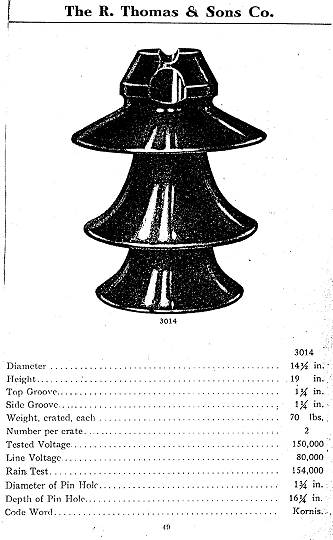
I'd like to share a little gem from my collection. This insulator First cataloged in 1907 it is a variant of the insulator used on the Niagara Falls to Lockport Line. As the article indicates, these insulators had a nasty tendency to fail in service for various mechanical reasons.
My unit is one of 12 recovered from the Hauser Dam in Montana, where they were installed in the power house as part of a lightning arrester and switch assembly. The indoor use, and lighter duty compared to a transmission line insulator ensured their survival. Unfortunately, the back of the top shell on mine was damaged during removal. It is however, one of only 13 surviving specimens and one of two with the remains of a factory inspection sticker on it.
I've been looking at the economy of Roman Asia Minor recently, and it has really driven home a rather important fact that some historical events that must have been enormously important and searingly traumatic get papered over so quickly. What prompted this is reading about the effect of the massacre of the Romans and Italians in Asia Minor in 88 BCE, and as far as we have evidence, there wasn't really one. There is an inscription from Ephesus from the late 80s talking about how much they love Rome and hate Mithridates, and how Rome saved them from Mithridates in what seems very much to be a long-winded apology for the pogroms, and Cicero raises these ghosts in a speech advocating giving Pompey command in a war against Mithridates, but beyond that there really isn't much. We have inscriptions from merchants in the 100s, and in the 60s, and both are perfectly ordinary, no indication of imminent danger and tensions or just passed tragedy. I find this particular case interesting because, unlike well known atrocities like the brutal sacks of Corinth and Carthage (the death tolls of both may have been in the hundreds of thousands), the Romans were not only the winners, they also took pride in the protection afforded to citizens. This may simply be the result of our sources (the first decades of the first century BCE are poorly documented compared to what came after) but it also really indicates a different way of dealing with these things. In the modern world we treat these as "never forget" and build monuments, but this doesn't really seem to be the case in the ancient world.
On a more clinical note, the way the story has been presented in the histories seems a bit odd--as a conspiracy between Mithridates and the leaders of Greek cities. It seems to me as likely that this was a spontaneous conflagration inspired by Mithridates' victories and the apparent end of Rome in Asia. I'm not really certain if there is much in the way of precedent for this sort of planned ethnic cleansing (Arrian emphasizes that "Such was the awful fate that befell the Romans and Italians throughout the province of Asia, men, women, and children, their freedmen and slaves, all who were of Italian blood" Mith 23 so I don't think the term is inappropriate). I also think it is interesting that this really only occurred on mainland, while islands in general tended to be more pro-Roman--perhaps they had more to fear from nearby, independent mainland powers than distant imperial ones.
On a lighter note, here is a description from Suetonius "Augustus" 6 of what seems to be a house museum of Augustus, not unlike moderns ones of Washington, Ataturk and Churchill:
A small room like a pantry is shown to this day as the emperor's nursery in his grandfather's country-house near Velitrae, and the opinion prevails in the neighbourhood that he was actually born there. No one ventures to enter this room except of necessity and after purification, since there is a conviction of long-standing that those who approach it without ceremony are seized with shuddering and terror; and what is more, this has recently been shown to be true. For when a new owner, either by chance or to test the matter, went to bed in that room, it came to pass that, after a very few hours of the night, he was thrown out by a sudden mysterious force, and was found bedclothes and all half-dead before the door.
Haunted!
I'm reviewing a soon to be published book on Oliver Cromwell (this is in no way an academic review, I am a 2nd year Grad Student, but this review is for a casual blog). The book is horrible and has no sources. The beginning of the book actually continually moans about the bad reception of the author's first book by historians (due to lack of sources, poor research, etc.). My question is, since this was a book provided by the publisher (for free) and a generalized site that often deals with novels and not well documented and researched historical texts...how do I politely explain to the reader that this book is rubbish? Thanks!
I'm reading 'The War that Never Was: The Fall of the Soviet Empire 1985-1991' by David Pryce-Jones (1995). I've had it for ages (since 2009) but only got round to reading it this week. I've found it very intriguing, not just in terms of learning about the former USSR/Warsaw Pact but also the western reception of the collapse of the 'empire'. I'm having to bear in mind that Pryce-Jones is a lifelong, Eton-educated conservative but it's still interesting.
What was the system of education like in the Byzantine Empire during the Macedonian period?
Just to note that the man with Jackie Kennedy in this photo shared by the JFK Library has still not been identified, in case anyone here recognizes him.
So apparently I'm some sort of graduate masochist - after just having completed a 42 page draft, I've decided to attempt writing an article due in 9 days. I also have two seminar presentations to prepare within the next two weeks.
Late to the party, but earlier this week, we lost a legendary jazz pianist. Horace Silver was one of the defining figures of "Hard Bop," along with Art Blakey (whom he co-founded the Jazz Messengers with), and greats including Joe Henderson and Woody Shaw started making their name in his groups.
If you're interested in his music, or just in the mood for some Jazz, a tribute mix is up on soundcloud (posted by /u/Particlex over in /r/jazz)
It feels like the free for all's participation has really declined
I'm looking for a good book to read about Norse legends.
What percent of Spanish people out side of spain have Muslim genes im relatively sure of a big culture mixing when they were In Spain but im not sure how much it happened & I don't really know much about it