Reposting from a previous thread on ELI5 and was encouraged to pose the question here. Thanks :)
Under the reign of Emperor Wu of the Han Dynasty, c. 139 BCE an emissary named Zhang Qian was dispatched along with 99 men (including a non-Chinese guide) to penetrate the military blockade the Xiongnu Empire (which were in effect the Mongolians before they were Mongolians) had set up in what is now the Xinjiang Autonomous Region in northwest China. Here's a painting of his party setting out. The Emperor had sent him to:
A) find a long-lost kingdom called Yuezhi that had become nomadic wanderers after the Xiongnu had displaced them from their ancestral homeland, and convince them to aid the Han military in retaking the area so that they could
B) find and set up trade relations with whatever kingdoms or empires might lie to the far west, if any indeed existed.
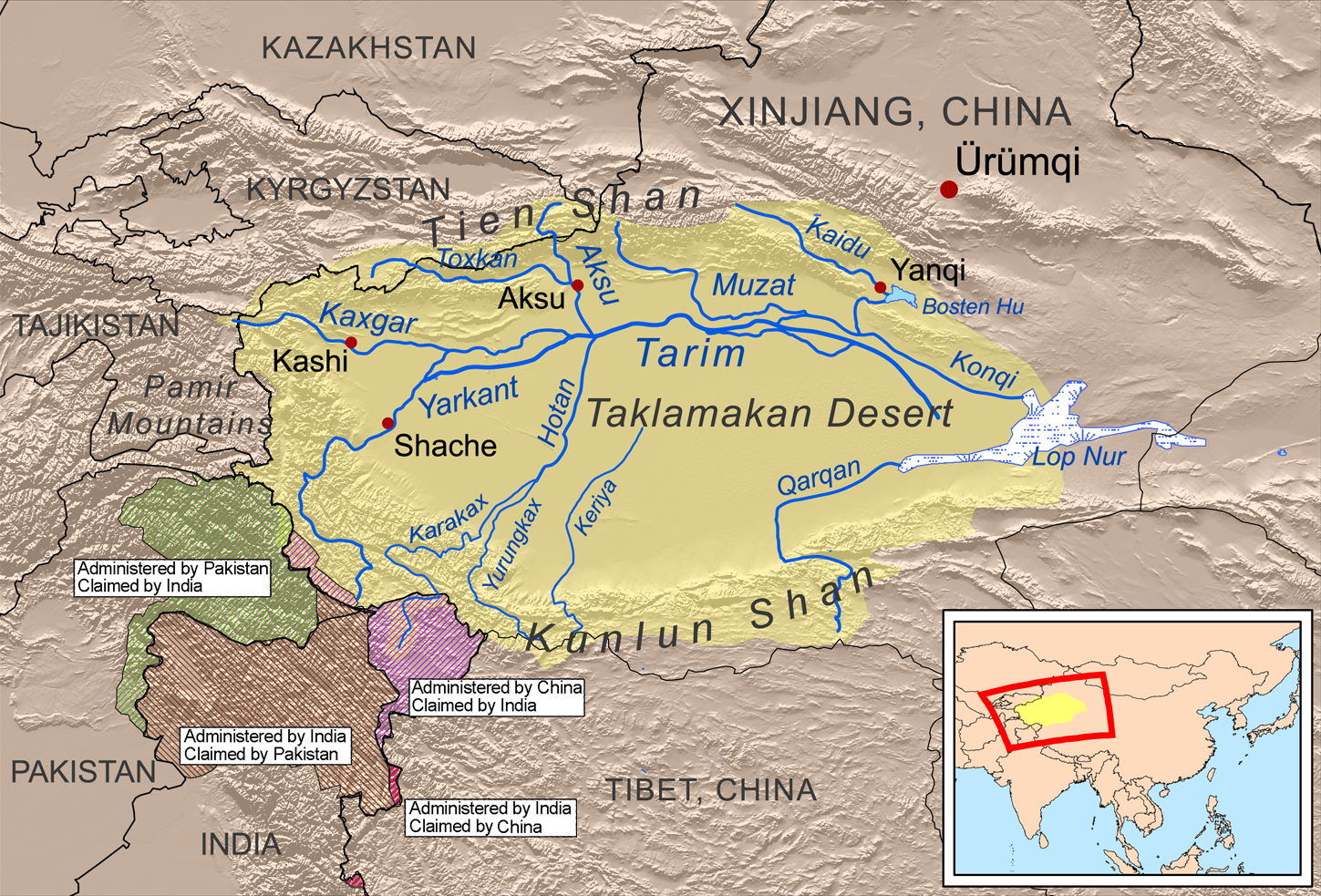
Unfortunately, they were all caught by Xiongnu horsemen as they tried to find a way through the Taklamakan Desert (the second largest shifting-sand desert in the world, btw), and took them captive. Zhang Qian languished in slavery for more than 10 years - during which time he married a Xiongnu woman and had a child - before finally managing to escape with both his family and his trusty guide in tow.
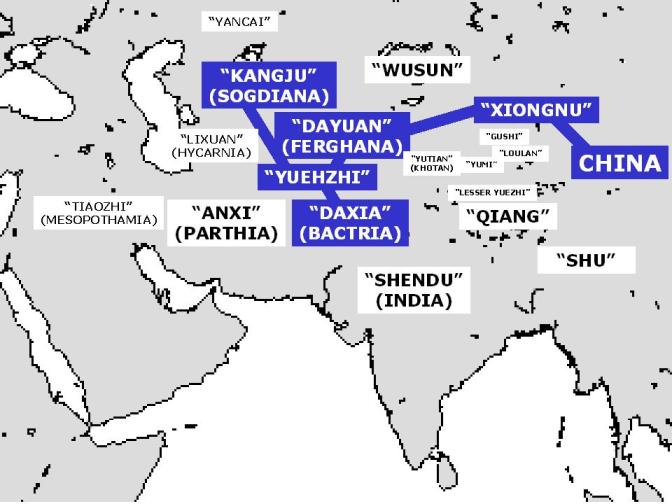
They continued west, finally making it across the Taklamakan by skirting its northern edge, and found a kingdom, but not the Yuezhi (yet). Zhang called them the Da Yuan, or "Great Yuan" Kingdom - and it's generally accepted that it was actually a transliteration of the Ionian (Greek) peoples that had colonized central Asia following Alexander the Great's conquest thereof some two centuries prior. He noted that they farmed wheat and rice, as well as producing grape wine, and numbered some several hundred thousand.
moving on, he did at last encounter the Yuezhi Kingdom, which had set up camp in and around Samarkand and the Oxus River after conquering the Bactrian Kingdom and seizing its northern territories (consisting of Uzbekistan, northern Afghanistan, and southern Kazakhstan). Zhang noted that they had 1-200,000 archer warriors.
He also visited what he called the Kangju people, which were either Turkic, Iranian, or Tocharian some 2,000 li (1,000 km) northwest of Da Yuan (the northern steppes of Asia). The Kangju were small in number, and acknowledged the sovreignty of the Yuezhi to their south.
Though he didn't visit them directly, he noted the existence of several other kingdoms, including Anxi, which was the Parthinian/Persian Empire. Anxi, he wrote down, "is situated several thousand li west of the region of the Great Yuezhi. The people are settled on the land, cultivating the fields and growing rice and wheat. They also make wine out of grapes. They have walled cities like the people of Dayuan, the region contains several hundred cities of various sizes. The coins of the country are made of silver and bear the face of the king. When the king dies, the currency is immediately changed and new coins issued with the face of his successor. The people keep records by writing on horizontal strips of leather."
Even further west on the far border of Anxi, he had heard of Tiaozhi, which is probably Mesopotamia, of which he wrote, "borders the Western Sea [probably either Persian Gulf or the Mediterranean]. It is hot and damp, and the people live by cultivating the fields and planting rice... The people are very numerous and are ruled by many petty chiefs. The ruler of Anxi gives orders to these chiefs and regards them as vassals."
He also heard of a kingdom far to the south called Shendu (modern Northern India and Pakistan), and would eventually make a second journey to visit it (though that would ultimately fail). He wrote, "The people cultivate the land and live much like the people of Daxia. The region is said to be hot and damp. The inhabitants ride elephants when they go in battle. The kingdom is situated on a great river [the Indus]."
When Zhang finally returned to the Han Chinese capital Chang'an (mod. Xi'an) - which only occurred after another bout of captivity by the Xiongnu - Emperor Wu lavishly rewarded him. On his second trip out, he was able to conduct a successful trade mission with Parthia/Persia. Upon completion, he was rewarded with the title of Imperial Grand Messenger, making him one of the nine most power people in the Han government.
Here's a map of Zhang's basic route and the approximate locations of the peoples he encountered and heard of.
Sources: Sima Qian, Records of the Grand Historian, translated by Burton Watson. (1993)
Sima Qian, Shiji. full text (simp. Mandarin)
If you're interested in this specific topic and other Chinese history, you might want to check out my podcast The History of China. We just put out the episode (25) that covers this very topic... so it was quite the serendipitous event that a question like this would pop up. Next week will cover the 4-decade Sino-Xiongnu War, so that'll be pretty exciting, rough-and-tumble stuff.
China has Zheng He, of course. He sailed the largest armada of ships the world had ever known around the South China Sea and the India Ocean. He never made it as far as Europe, but chose rather to stick to areas the Chinese had already had some contact or knowledge about.
Then Japan has the Iwakura Embassy which sailed all the way around the known world; but, again, they only went to places they knew about.
Ibn Battuta is without a doubt one of the most widely traveled individuals in pre-modern times, if not in all of history. I think it's fair to count him as an "explorer" since, although he went to places that were technically mapped, so did most of the Europeans that we consider "explorers" today. He left his home in Tangiers, Morocco to set out on the hajj to Mecca, and decided that he liked traveling so much that he would continue on. He eventually traveled through most of the Middle East, parts of Europe, East Africa, West Africa, South Asia, Southeast Asia, and China, acting as diplomat or a scholar of Islamic law since he was educated.
Today, he is well known, especially in the Islamic world, as one of the greatest explorers. Well at least, he is certainly known and held to high regard by muslim academics that I have met in Kenya. Today, there's a mall named after him in Dubai.
To say he's not an "explorer" just because he didn't encounter completely unknown lands is a bit silly-- he still encountered plenty of extreme foreignness, like cannibals in West Africa. If we're going to call Marco Polo an explorer, then Ibn Battuta certainly counts.
One thing to consider though, is that the accounts of Ibn Battuta are possibly suspect. It is entirely possible that some of the places he claims to have visited he did not actually go, for instance his trip up the Volga in Eastern Europe. On several occasions scholars have shown that his accounts match those of earlier, lesser known explorers, casting doubt on some of the authenticity of his works. Still, he no doubt did a tremendous amount of traveling for about 30 years of his life.
Personally, one of my favorite "Eastern Explorer" stories is the journey of Han Chinese ambassador Gan Ying. In the year 97, he was sent to learn as much as he could about the Roman's European empire which they called Da-Qin which means Great Qin. This is because they saw the Romans as a mirrored version of China on the other side of the world as if to equal out the world; two empires on opposite ends of the known world working towards each other conquering all the lands between; how easternly philosophical of them!
Gan Ying travelled to the western edge of the lands under the influence of China asking questions of traders along the way. He never made it to Rome itself but learned alot from traders that had regular contact with the Roman people and I've inserted some things written about his journey:
"[Roman] territory extends for several thousands of li. It has more than four hundred walled towns. There are several tens of smaller dependent kingdoms. The walls of the towns are made of stone. They have established postal relays at intervals, which are all plastered and whitewashed. There are pines and cypresses, as well as trees and plants of all kinds."
"Their kings are not permanent. They select and appoint the most worthy man. If there are unexpected calamities in the kingdom, such as frequent extraordinary winds or rains, he is unceremoniously rejected and replaced. The one who has been dismissed quietly accepts his demotion, and is not angry. The people of this country are all tall and honest. They resemble the people of the Middle Kingdom and that is why this kingdom is called Da Qin [or 'Great China']. This country produces plenty of gold [and] silver, [and of] rare and precious [things] they have luminous jade, 'bright moon pearls,' Haiji rhinoceroses, coral, yellow amber, opaque glass, whitish chalcedony, red cinnabar, green gemstones, goldthread embroideries, rugs woven with gold thread, delicate polychrome silks painted with gold, and asbestos cloth. They also have a fine cloth which some people say is made from the down of 'water sheep,' but which is made, in fact, from the cocoons of wild silkworms. They blend all sorts of fragrances, and by boiling the juice, make a compound perfume. [They have] all the precious and rare things that come from the various foreign kingdoms. They make gold and silver coins. Ten silver coins are worth one gold coin. They trade with Anxi [Parthia] and Tianzhu [Northwest India] by sea. The profit margin is ten to one. . . . The king of this country always wanted to send envoys to Han, but Anxi [Parthia], wishing to control the trade in multi-coloured Chinese silks, blocked the route to prevent [the Romans] getting through [to China]."
I always wished that he had made it all the way to Rome because it would be a valuable source of information about the Romans that wasn't filtered through Mediterranean 'strainer'.
Sources:
http://sino-platonic.org/complete/spp194_justinian_silk.pdf (this is a great read)
Book of the Later Han (for information on Gan Ying expedition)
While he certainly isn't celebrated today (especially considering Carthaginian civilization is extinct) I think Hanno the Navigator is worthy of a mention here. Hanno was an explorer, tasked with sailing around the coast of Africa. He almost definitely made it as far as Senegal, with some accounts saying he made it as far as Cameroon. What's more interesting, and relevant to your question is this:
"In its inmost recess was an island similar to that formerly described, which contained in like manner a lake with another island, inhabited by a rude description of people. The females were much more numerous than the males, and had rough skins: our interpreters called them Gorillae. We pursued but could take none of the males; they all escaped to the top of precipices, which they mounted with ease, and threw down stones; we took three of the females, but they made such violent struggles, biting and tearing their captors, that we killed them, and stripped off the skins, which we carried to Carthage: being out of provisions we could go no further"
So in other words, Hanno encountered something, which was later interpreted to be gorillas when that species was later encountered by Europeans. If what he did encounter were actually gorillas is unknown and can't really be proven one way or the other. However, his term for these "people" is where the term ultimately came from.
Considering he was from North Africa, I think it's difficult to consider Hanno as an "Eastern" explorer, however he wasn't exactly Western either, especially in the modern sense of the term. While his explorations, which did lead to the current name for gorilla, are hardly a "celebration", they are, nonetheless, a relic of his expedition that permeates modern culture.
Edit:
Source: http://resources.canaanite.org/2007/07/voyage-of-hanno_30.html
The East and the West had some contact, it was minimal but enough that each had people that knew the other existed. Mostly this is from contact due to the silk road and other minor trade. The Americas were actually not known to exist before Columbus which is why we consider them discovered.
That being said the exact distance and peoples was unknown, particularly before Alexander who was constantly telling his troops that "the Ocean which encircled the world" was just over the next hill while campaigning in India. After that there was more contact due to trade; it was still very limited but enough to prevent anyone "discovering" a new land.
Basically the idea of an explorer really finding a new land is pretty limited to the Americas because no one had any idea they were there, before that expansion was gradual enough to preclude any ideas of discovering a new land. The closest might be when Julius Caesar encountered Britannia which was seen as a mythic land and the edge of the world, particularly if we believe Tacitus but even then he wasn't seen as an explorer.
As for Eastern cultures for specifics I am less knowledgeable. They did have some types of exploring with certain leaders I know but in general they were disinterested and what they found wasn't as incredible as finding 1 or 2 new continents.
Otherwise the people we remember are conquerors or other military like Admiral Perry who "opened Japan" but weren't considered to have found it in the explorer sense. If you were looking for a trade figure like Marco Polo, who is a fun read if you are interested in the topic in general, there might be one or two figures that I don't know about but I know of no major ones; the trade was usually carried out incrementally.
I see that few posters are actually specifying whether these explorers are in fact celebrated. In the event that you are interested in "Eastern" explorers whether celebrated or not, then check out this earlier post, which includes a few more individuals: