After visiting a number of world war one battlefields it struck me these monuments where built before world war two and thus where under German control for a couple of years. So, how did the German occupation react to monuments like The Douaumont ossuary, Menin Gate, American monument at Montflaucon and others?
In at least one instance I know of, they burned it down, because it served as too palpable of a memorial to the German violence during the First World War that Fascist apology was - and is - predicated on declaring to be a myth.
In Leuven, Belgium there is an ancient University from the 1400s that had a beautiful library filled with priceless manuscripts, which the Imperial Germans burn down on purpose during the first world war while sacking the city. The report that I just linked to is euphemistically circumspect about the fate of women in Leuven, and what exactly the largely protestant Germans did to Catholic priests, in the style of the time but don't be fooled. While it is now clear that there was no centrally organized plan to orchestrate the sacking, it was obvious even at the time that it was at least a direct consequence of intentional Imperial policy. When a million poorly supervised teenagers are parked in a small country with no supplies and instructions to take what they needed while being bombarded with rumors of francs tireurs behind every bush, a violently angry and entitled powder keg is the natural result. While the week long orgy of drunken rapacious violence and arson was likely touched off by nervous sentries shooting at each other rather than either official instruction or excitable Belgians, during the sacking men lead by officers brought wood to the library and intentionally torched it with all of the volumes and indexes inside. One German officer speaking outside of an official capacity to the American diplomat Hugh Gibson while the sacking was still continuing said
“It is necessary that Leuven will serve as warning and deterrent for generations to come, so all that might hear of its fate might learn to respect Germany… We shall make this place a desert. It will be hard to find where Leuven used to stand. For generations people will come here to see what we have done. And it will teach them to think twice before they resist her.”
For the 'other side' of the story,this is the official German statement on what happened and a telegram to Wilson by the Kaiser that mentions it, as well as a written debate held afterwards.
The incident was a big part of what brought the US into the war and kept it popular in the UK. Pieces of soap were sold for the benefit of Belgian refugees with the burned University library on one side and the shelled Cathedral at Rheims on the other, such that as you used it the ruins would wash away, and Louvain (the French spelling of the town in use at the time) became a popular name for girls. It also, naturally, lead to a lot of rage within Belgium, and so when the war finally ended one of the reparations listed in the Treaty of Versailles was money and books from German Universities to rebuild the library. After the collapse of the German economy and the rampant inflation caused by the more substantial reparations, what ended up being available was no where close to enough, but luckily, societies had already formed in America to fund the rebuilding within weeks of the sacking. Whitney Warren, architect of the Grand Central Station and the Biltmore Hotel in New York, was hired to build a beautiful library with largely American money and books largely donated by American universities, but conflict arose as the library neared completion.
While the library itself was already not exactly thematically neutral, decorated as it was with the American eagle, Italian she-wolf, Belgian lion, English unicorn, and French cock, University officials quickly became administratively inclined to get on with the business of collaborating with German colleagues and leave the war behind them in the spirit of the new peace. They ended up coming head to head with young student veterans and American donors over an inscription that was planned from the beginning for the banister of the main staircase: FURORE TEUTONICO DIRUTA, DONO AMERICANO RESTITUTA, roughly translated from Latin, ‘Demolished by German wrath, rebuilt with American gifts.’ As a neutrally blank banister was being installed, a young student veteran working on the site lifted up the massive stone work and threw it to the floor, shattering it. Then, once he had been released on bail after the incident, he immediately returned to the site and threw down its replacement in an identical fashion. Also, during the inauguration of the library with a third blank replacement purchased at great expense, confetti with the inscription was thrown out from a biplane that disrupted the proceedings amid protests.
However, even all of this effort by administrators to separate the library's function as a memorial from its function as their library was not enough to save the it during the next war, now filled again with priceless American and German books. Even though books were still being delivered from German universities during the war, right up until the point it was destroyed, the German army again fired it with everything still inside after they entered the city.
After the war in the 40s and 50s, the library was rebuilt yet again with more American money, using the same plans - gorgeous flammable woodwork, big beautiful delicate windows, and all - and filled again with more rare and priceless books from many of the same universities.
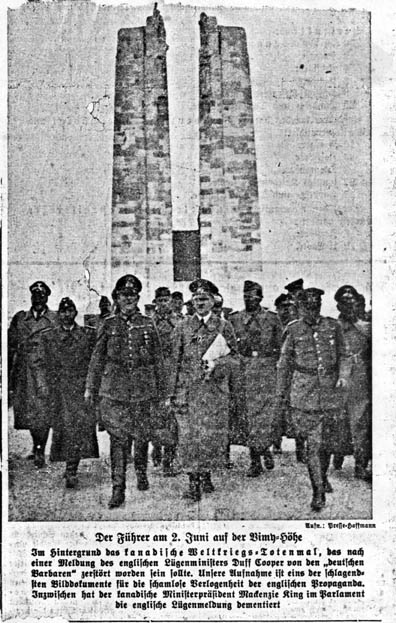
One example would be the Vimy Ridge Memorial in France, which was left untouched and Hitler had himself photographed at it, apparently in order to demonstrate that it had not been desecrated.
http://en.wikipedia.org/wiki/Canadian_National_Vimy_Memorial#Second_World_War
http://www.thestar.com/news/2007/04/07/how_hitler_spared_vimy_ridge.html
I can speak for the Australian monuments here; there was not an active policy of dismantling the memorials, but war often found its way.
The Australian National Memorial at Villers-Bretonneux (our largest in France) was used by the French as a lookout post and was thus fired upon by the Germans. It is still to this day strewn with bullet holes. There are some claims that some were done with intent but it is almost impossible to validate this.
Also, the Tank Corps/Australian Windmill Memorial at Pozieres were demolished by a tank duel in 1944 between the Yanks and thr Germans. Again, accidental. It is interesting to note these were rebuilt by American serviceman out of respect from the remains of a Sherman tank.
Finally, I believe it is the Adelaide memorial (Australian) near Hamel that was intentionally ruined by vindictive German soldiers in 1940, but this was personal rather then a wider campaign.