Today:
You know the drill: this is the thread for all your history-related outpourings that are not necessarily questions. Minor questions that you feel don't need or merit their own threads are welcome too. Discovered a great new book, documentary, article or blog? Has your Ph.D. application been successful? Have you made an archaeological discovery in your back yard? Did you find an anecdote about the Doge of Venice telling a joke to Michel Foucault? Tell us all about it.
As usual, moderation in this thread will be relatively non-existent -- jokes, anecdotes and light-hearted banter are welcome.
I'm working on my MA dissertation about Victorian and Edwardian queer men and their views about Japan and its sex practices, so I've been reading some pretty bizarre stuff.
A great anecdote that I hadn't heard before is about Oscar Wilde in his years at Oxford. John Ruskin gave a lecture at Oxford in 1874 encouraging Britain's best and brightest not to waste their time on frivolities like cricket or rowing, but rather to put their efforts into improving the community.
As a result of Ruskin's inspiring talk, that winter, twenty year old Oscar and some of his undergraduate buddies joined up with Ruskin to build a road between two Oxfordshire towns. (The towns were separated by a swamp, and it was hard to get from one to the other, so everyone figured this would be a good way to help the locals.)
So this gaggle of artistic-minded Oxford undergraduates--presumably with monocles, cigars and buttonholes in tow--went out in the winter cold and mud, and every day worked at levelling and paving the road. This carried on for some two months, until Ruskin left Oxford to go to Venice.
The undergraduates, somewhat unsurprisingly, immediately lost interest in the project and returned to their clubs and journals and dinners in the colleges. The road project was abandoned half-finished, with the road left leading, utterly uselessly, straight into the swamp without coming out the other side. As it turns out, hyper-wealthy Victorian undergrads with zero building experience kinda suck at road work.
And that is why, if Oscar Wilde should ever ask if he can build a road for you, you should politely decline the offer.
And I've got another one about the Chinese "anal violin," but it gets NSFW so I don't know if this is the place to write about it.
Cuddle up for Friday Storytime™. I haven’t told a good Caffarelli story in a long while, so here’s a little Friday nugget from my namesake’s life. Hope you guys get a smile out of it.
I read some biographical bit on Caffarelli once that claimed he was so obnoxious that he “didn’t have any friends,” which is patently hyperbole, as pretty much everyone has a friend at SOME point in their life, even the worst people you know about. But among his fellow castrati, I am pretty sure one of the few dudes Caffarelli would have called a friend would be Gioacchino Conti, stage name Gizziello (with like a million variants as the 18th c. Italians are wont to do, Egiziello, Egizziello, Ghizziello, etc). Conti was four years younger than Caffarelli, so of the same generation, but always a little behind Caffarelli in fame, which probably made Caffarelli more comfortable with him.
There are two fun anecdotes involving these buddies I’d like to share. The first dates to around 1733, and is cute, but rather dubious:
The story goes that Gizziello was singing in Rome in a revival of Vinci’s Artaserse, and Caffarelli, working at that time in Naples, heard about the promising young singer and wanted to hear his singing for himself. So he booked a post carriage to Rome and off he went (which would be a trip of over 100 miles.) When he got there, he immediately went to the opera, wrapped in his cloak, and wasn’t noticed or identified. (He would have theoretically been sitting/standing in the floor area (parterre) as that was what you’d get if you bought a one-off ticket, and that was the area for the priests (in Rome), scholars, moderately wealthy merchants etc, so probably reasonable that no one would have expected to see a semi-famous singer down there.) Caffarelli listens intently, and he is impressed by the young singer. At the end of Gizziello’s performance he shouts “Bravo, Bravissimo Gizziello! It is Caffarelli who says this!” Then, just as impulsively, he immediately leaves the theater and returns to Naples, where he is late to his own opera and appears on stage not properly dressed for the performance.
Possibly thingsthatneverhappened.txt, but cute. The second is one of my favorites. It is from 1747, and so ridiculous I believe every word of it:
You have heard of the great doings at Naples, and the rivalship between Caffarelli and Egiziello, which luckily did not, as was expected, disturb the festa. Upon Caffarelli's arrival at Naples, Egiziello went to make him a visit, and was received by that saucy creature upon a stool, where he sat during the whole visit. The affair was made up by mediators, and afterwards they appeared good friends. (source)
“Stool,” I should mention dear readers, is not like a footstool but in this case shorthand for a “close stool” which were fancy chamberpot enclosures, ranging from a humble little box you could do your deed in to a full armchair so you could lean back and take a load off while pooping. Typically these were kept in airing closets or bedrooms so Caffarelli most likely dragged a commode into his drawing room just so he could mime taking a dump in front of someone. Sometimes it’s hard live up to having named myself after such a great man.
Judging from a few things I know about the two of them, Caffarelli for one preferring to humiliate you in public if he really didn’t like you, and Gizziello being a pretty easy-going sort of guy, and the fact they made up quickly, I don’t think this little thing was a real fuck-you gesture, more likely Caffarelli just having himself a giggle m8 by pretending to receive his friend on the can. At this time Caffarelli was in town on the order of the king for a special opera, and he and Gizziello were being forced to perform together at the San Carlo, despite the two of them having mutually agreed earlier, out of friendship and respect, not to appear together on stage or perform in the same town and thusly be in competition (according to Giovanni Battista Gennaro Grossi, jump to section 8), so maybe Caffarelli was Feeling the Pressure. Both of their fanbases apparently got quite nasty as a result of this exciting head-to-head pairing, but I think they were still friends.
So think of that the next time you write out your reddit comments on the throne.
(And I found this amazing website for Gizziello, check this shit out OMG. It’s like the baroque period embodied in HTML. Actually just check out this whole damn website, WARNING music starts automatically. The Caffarelli page has gold crownmolding around his portrait and putti all over the place, which is exactly how Caffarelli would have wanted it, except it has a misidentified picture of this guy halfway down the page. Caffarelli would not like that at all… He might actually poop in front of you for that.)
I just wanted to say how much I love the moderation in here, even compared to other "heavily moderated" subs.
I asked a highly upvoted and responded to question in /r/Askscience, and got hundreds of speculative answers, no moderation until almost a full day later (and even then it was rather weak), and almost no flaired users responding. One even left a placeholder "I can't find a source since I'm on my phone..." response. I would have rather gotten no response than 350 people guessing my answer.
Anyway, keep up the good work.
Received my results for my undergraduate BA History degree and received First Class Honours! No doubt helped in great effect by a 72 (just barely a First, but still) in my dissertation on Viscount Castlereagh's diplomacy in regards to the universal abolition of the slave trade. I'm even more happy about getting a 72 on an exam on British foreign and defence policy 1890-1914 though (the actual exam was 1890-1970, but I spent all of my time on the earlier period), as that's my first and only First Class on an exam at university - I suck at them, essays are so much easier.
How and when did our current cusswords come to existing?
Here is an interesting thing I have learned: Like Christianity, Buddhism's spread is often attributed to liberationist ideals--that is Buddhism's universalist egalitarian tendencies provided an escape from the strictures of Vedic Brahmanisms restrictive varna system. It is an idea that makes sense on the face of it, as these tendencies are definitely seen in Siddhartha's writings and in the social chaos of an increasingly urbanized world (something I have complained about elsewhere, but that aside) a more flexible social religious order is needed.
The problem is that when you do an analysis of the early Sangha this narrative simply doesn't hold. Consistently around half of the members of brahman and only 1% will be sudra. And if you look at the grease for the wheel of the Sangha, there are donations by bankers, merchants and overwhelmingly upper elite. Buddhism, in short, was not threatening to the elite and its spread therefore cannot be attributed to social revolution.
I think it just goes to show how dangerous the "common sense" approach to history is that you see in a lot of popular writing.
I had been working on a "did Einstein really make the atomic bomb?" blog post anyway, and was inspired by this thread to just finish it up: A bomb without Einstein?
So I've started getting back into a very specific area of history that I used to read a lot about before I was into my current area is.....drum roll.....or rather whistle and bells cuz it's rail history! Particularly history of railway technology. Part of it was /u/Georgy_K_Zhukov's famous armored trains answer, part of it was me getting re-interested in some books I had or came across online.
An area I've always been fascinated by is the development of late steam and early diesel locomotives. During this transitional time manufacturers and railroads were trying to experiment with new technology on the tried-and-true stem technology, and simultaneously hadn't quite figured out diesel technology. This resulted in some really bizarre designs, some of which were moderately successful (or could've been, if they hadn't been made obselete), while others were dismal failures. Granted, that's true of all eras of locomotive design to an extent. But the 20th century is where things really can get wonky. I think the oldest one I'll describe is from the 19-teens, but most are from the 30s or 40s. I'm not being chronological for the individual paragraphs, instead using different areas where cool designs were used.
So, late steam locomotives. Steam locomotives are a mechanical engineer's dream (which is why I like them). To give an "on one leg" primer on how they work, a fire (usually coal, but maybe wood in earlier days or oil in the 20th century) heats water to make steam. This steam then powers the wheels, generally using a system of pistons and valves (called valve gear). Steam locomotives tended to be custom--parts were machined individually, which results in cool experimental types.
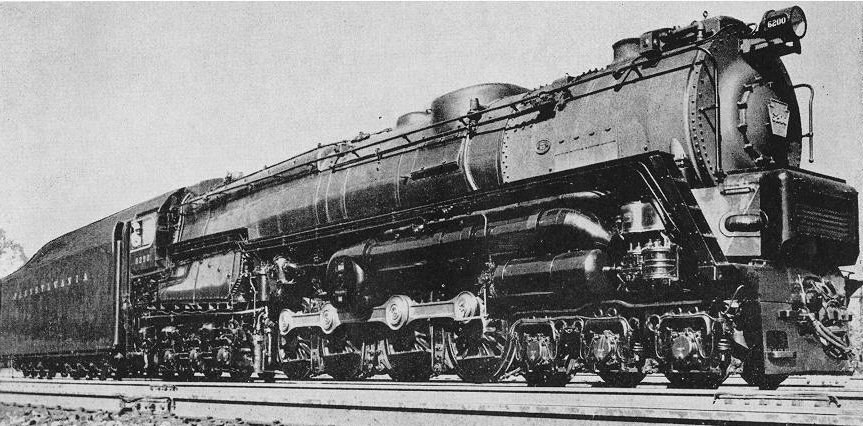
One way of making things bigger and better was articulation--making the locomotive's driving wheels separated into two sets, and having the locomotive bend in the middle, increasing the possible length, so you wouldn't get ridiculous things like 14 wheels connected together. The most famous of these is the Big Boy, with two sets of eight driving wheels. Another big one is this, the C&O 2-6-6-6, with two sets of six driving wheels. Or this, a locomotive with 20 driving wheels. Some railroads even tried three sets of driving wheels. Like this (this is the oldest one I'm showing). Some of these were quite successful. Others caused maintenance issues from their complexity, or were so big that their practicality was limited. These were mostly designed for hauling heavy freight trains up mountains at low speed. A later attempt is this, built for high-speed passenger rail. It, too, was too maintenance-intensive to be practical.
Another innovation was compounding, which expanded steam multiple times to get more power. Others generally adapted how the piston arrangement was set up. this locomotive had an interior third set of pistons--you can see the head in this pic. It's the circular thing in the middle.
But if you can't make them bigger, why not make them stronger by using high-pressure steam? This was tried during the 1920s, but ultimately was too heavy and maintenance-intensive to be worthwhile. Here is another bizarre attempt.
In the 1940s, diesel locomotives began to take over. Designers still preferred steam, though, and kept attempting new types. One attempt was the steam turbine. Instead of valves and pistons, these used a turbine to get power from the steam. Here's one attempt. It performed very well at high speed, but because of the way turbines work, it was very inefficient at low speeds, and running at low speed frequently is pretty much unavoidable for locomotives.
Learning their lesson, a new way of using turbines was attempted--the steam-electric turbine. These use steam to generate electricity, which then powers the wheels. They're effectively wheeled power plants. Here is an example. These were dismal failures. Reliability was poor, particularly because there were sensitive electronics operating around coal dust. And there were only a few examples, making them hard to get parts for or otherwise repair. And they were extremely complex. Here is a much smaller example, that looks less like a bunch of streamlined boxes and more like a horribly misshapen early diesel locomotive. This design is probably my favorite, because it uses technology of steam and diesel locomotives (the fact that it uses steam, the electric traction motors) and technology discarded by railroads altogether.
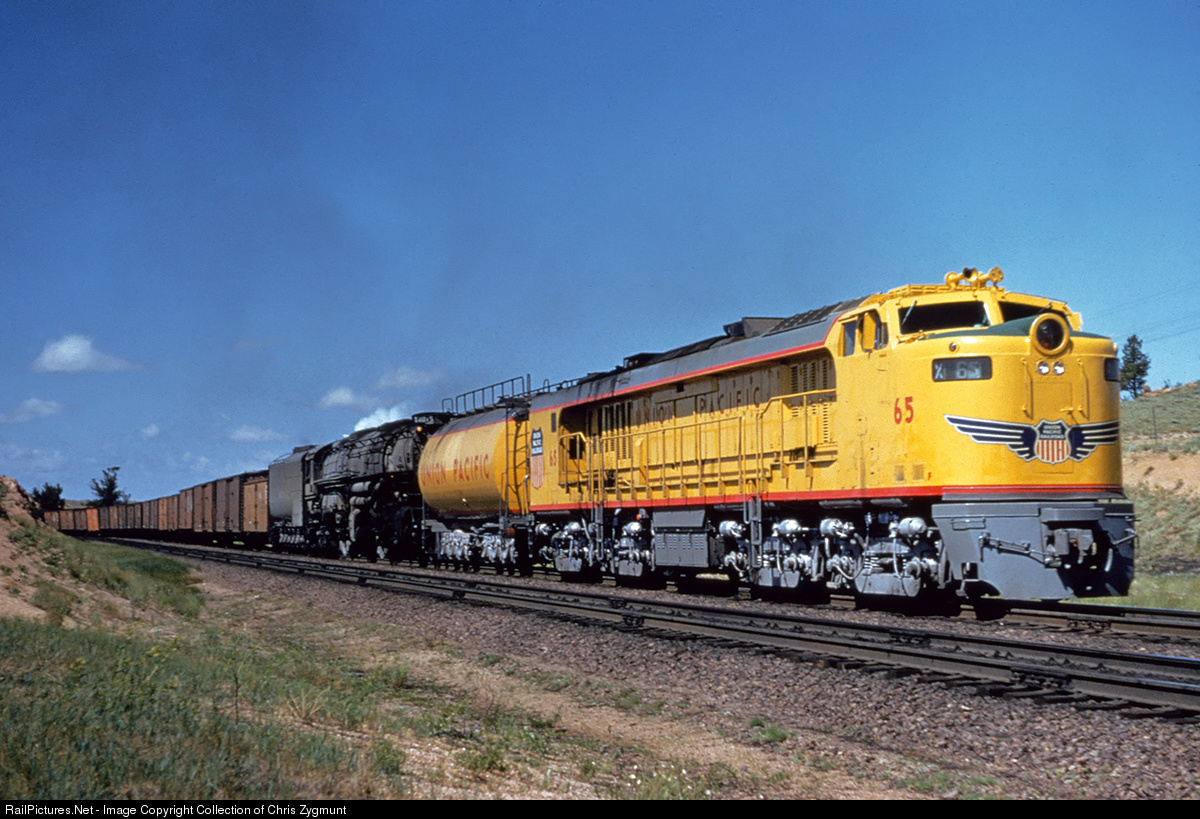
...or was it? When the switch was made to diesel, turbines weren't quite out of it yet. There were attempts at using gas turbine-electric locomotives. This is the biggest example. Their demise was caused by their extreme loudness, poor efficiency for anything other than cruising speed, and intense maintenance (see the pattern on the last two?). Here is another design, with semi-enclosed walkways along the side. That steam locomotive in back is a Big Boy. Though they failed, they were extremely powerful, and double-engined diesel locomotives were built in the 60s to replace them.
An example of a bizarre early diesel locomotive that used tried-and-true technology, but demonstrates the weird things that happened while the technology was being developed, was the centipede, so nicknamed for its absurd number of wheels. With that many wheels, you'd think maintenance would be an issue....and you'd be right. It was a failure.
Sources:
Solomon, Brian. Alco Locomotives. 1st ed. Minneapolis, MN: MBI Pub. Company, 2009.
---. Baldwin Locomotives. 1st ed. Minneapolis, MN: MBI Pub. Company, 2010.
Some pictures from this site, cataloging the weirdest of weird steam locomotives. These are just American locomotives that were actually used. Designs from other countries, or ones that never made it off paper, or ones that never were used in revenue service could be just as interesting.
Tablet, one of my favorite internet magazines (aimed at Jews), has two great historical essays on the origins of Yiddish and, by extension, the origins of the Eastern European Jewry.
The first, "Where Did Yiddish Come From?" by the late Cherie Woodworth, is actually a reprint from a scholarly review, so if you want to read it with footnotes, read it the original version is here. It introduces some of the issues in Yiddish linguistics--is Yiddish a dialect of German? Was Yiddish always separate from German? Is Yiddish "the fifteenth Slavic language"? But as the original title of the essay, "Where did the Eastern European Jews Come From?", the essay and the other make clear, however, is the debates are not just about where Yiddish the language came from but where the Eastern European Jews came from entirely. She deals with a lot of the contemporary European historiography, and what's at stake, so I'll just draw attention to two issues: one, the question of a Jewish population in Eastern Europe before it's plausible that Yiddish was spoken there and two, the "demographic miracle" of Eastern European Jewry--how the group could apparently increase so rapidly between the mid 18th and late 19th century.
The second article in the series, "The Mystery of the Origins of Yiddish Will Never Be Solved" by Batya Ungar-Sargon (man, do I love that sort of Hebraic name, especially with the hyphenated last name--together they tell you so much about her parents' politics), lays out in journalistic ease what Woodworth has to cover up with scholarly niceties: these people, this possibly second to last generation of academic Yiddishists, hate each other. There's pseudonymous book reviews trashing each other's work and a quick reversion to hyperbole:
“It’s a problem that there’s a close relationship between German and Yiddish,” said Steffen Krogh, a Danish linguist who studies the Yiddish of Hasidic communities in Williamsburg and Antwerp. “It’s like a young girl who has been raped by her father. This girl can’t deny her origins, of course, but she doesn’t want to have anything to do with her father. This is how many Jews think of Yiddish. But it’s a fact you can’t deny.”
Uhh... wot? That sort of rhetoric is not an isolated thought that "slipped out"--the field is full of such things, such as Paul Wexler declaring, "‘I deny the existence of the Jewish people. Ninety-five percent of the Jews are of Iranian origin.’" Ungar-Sargon helpfully lays out four competing theories for the origins of Yiddish: Rhineland (Weinreich), Bavaria (Katz), separate Eastern and Western origins (Beider), Slavic/Khazar (Wexler), and the meeting point of Italy and Germany (Manaster Ramer) and the political/epistemological grounding of each.
But together the essays help lay out how difficult history can be, especially social history, especially before the modern era (when people began producing a lot more pieces of paper with letters on them). The Jews, even, are a particularly well lettered group. And yet still, we have trouble figuring out basic questions of what language they spoke and where they lived and when. Both authors show us how much has to be drawn from little scraps--Rashi's commentaries, for instance, contain 3,000 Judeo-French glosses and 24 Judeo-German glosses. What do we make of that? What about the existence of late Hebrew words (for holiday, you have yontif as used in the Book of Ester, instead of chag used in the Torah) in every day speech? Does that prove that Jews spoke a Semitic language continuously from the time of the Book of Ester until those words were added to Yiddish, rather than starting with a German dialect and peppering their speech with Semitic words from their Torah study? It's fascinating because it shows just how hard of a thing this "history" is. How we never have all the evidence we want but, in the case of something like Yiddish, we probably know all the evidence that we're going to get (archaeology and genetics could give us more evidence, but it's unclear if we're going to find more documents, though there was recently a new geniza opened in Morocco in 2005, and though this one mainly covers the 17th-20th centuries, there's a small possibility that there are other genizot with caches of discarded documents waiting to be discovered).
Oh the joys of graduate work, no weekend for me because of an (already regretted) attempt to throw together an article to submit for a journal.
At least I can use the same work to build two upcoming presentations, but I feel have made a terrible mistake in attempting this.
I'm getting really interested in a new train of thought relevant to my research areas. I came across a tidbit by John Boswell in Hidden from History: Reclaiming the Gay and Lesbian Past in which he briefly suggests that there are observable socio-political differences between cultures that valued male beauty (Greeks, Persians) and cultures that generally have not (Britons/Americans, etc). His suggestion was that the cultures that valued male beauty were, accordingly, much more receptive to homoerotic literature, poetry, and behavior than those cultures that saw beauty as solely a woman's domain.
I haven't been able to shake the ideas surrounding the male beauty cultural divide, and am beginning to wonder if one could trace a predictable progression for a culture's treatment of women based off of whether that culture values male beauty or not. From personal experience in Afghanistan, it is quite clear that the maxim "Women are for babies, boys are for fun" is still adhered to in many regions -- it seems like it wouldn't be too great of a leap from there to de-emphasizing the need for women in one's culture at all. I want to get deeper into this, but don't even know where to begin.
Just wanted to share what's been fascinating me lately!
Not much to say besides "Keep reading".
When I began, I thought I had a fairly good grasp on Israeli history.
Now, everyday, I feel like I learn so much more through various books and debates between historians that I wonder how much more my brain can hold.
Fun-fact: I counted how many different historians/political scientists (not books, academicians...if that's a word) I've read books by on the Palestine-Israel conflict. By memory, I got to 34 before I stopped (I did this while driving to dinner last night). If I went through my library, I'm sure it'd be at least 50. And the list keeps growing.
No matter how much it feels like I know now, I'm always really excited by how much more is out there. It's amazing!
I want to buy a bookstand for all those larger, hardcover history books. Any recommendations? Or have you discovered another comfortable way to write down passages from books?
Most of them can only handle paperbacks and turning pages is a chore.
I do not know if this is the right place for this. Does anyone have a link for an eyewitness account of D-day (Operation Overlord) from a German at Normandy. The couple i have are very short and not very detailed.
I loved that Q book!
As a non-historian redditor I imagine the Doge of Venice used to look out his window and say "much canal. such boat. wow."