This one's a topic from /u/cephalopodie, who provided an excellent description in last week's topics thread:
I'm sure every field has them, those myths that, for whatever reason, have become cemented in the public understanding. They probably have their origins in the truth, but somewhere along the way things went a bit wobbly. Maybe A Guy wrote a book that was super popular but not really accurate? Maybe a theory was created when there was limited information, and now there's more and better information that proves that theory wrong? How have those myths shaped your field and the public perception of it? What's the real story? What bits of the myth are kinda-sorta true? When was the myth created, and by whom?
So, what are some myths in your field that people believe, despite historians attempting to rally against them?
Remember, moderation in these threads will be light - however, please remember that politeness, as always, is mandatory. Also, if you're looking to get flair, these threads are great to use for those purposes :)
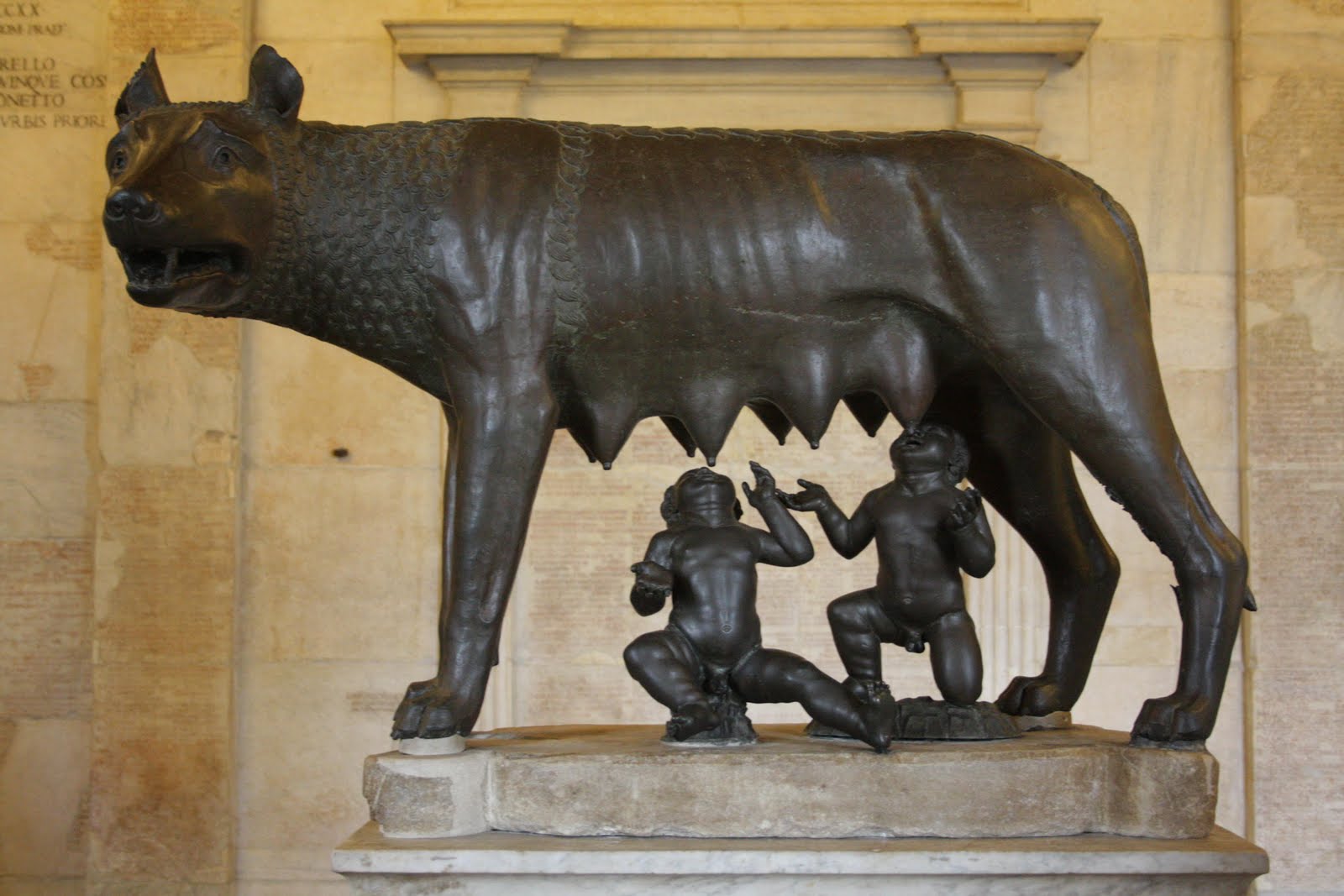
The Capitoline Wolf is one of the most iconic ancient statues and has become the unofficial symbol for the city of Rome. It has been connected to literary references, held up as emblematic of Archaic Italic art, and used to illustrate the development of Roman identity. The problem is that it is Medieval, undoubtably so. It had been debated for some time, but in the mid 1990s an art historian assigned to its restoration noticed that it was created by a distinctly medieval production method. After she pointed this out, political authorities blocked scientific dating for over ten years, but a few years ago it went through and, sure enough, the date came back as eleventh or twelfth century.
Of course, the museum plaque still says fifth century BCE, possibly Etruscan.
I get this one a lot from the general public when I tell them I'm studying queer history:
Did you know that President Buchanan/Edward II/Michaelangelo/Jesus/every ancient Greek man ever/the Marquis de Sade/etc. was gay?
In some ways, this myth drives me up the big, glittery, rainbow-coloured wall. In other ways, I understand where people are coming from when they make these assertions, and I know they have the best of intentions.
These statements perpetuate the myth that there have always been gay people. No. There have always been people who engage in 'homosex,' as we say in the trade (i.e., there have always been same-sex couplings). There have not always been men who see their sexual desire of other men as part of their character.
To say that just about anyone prior to the mid-19th century 'was gay' is anachronistic. First, 'gay' wasn't widely used to mean 'homosexual' until the 20th century. Second, the adjective 'homosexual' didn't even exist until 1869; it wasn't used in the English language until something like 1892. Third, same-sex desire wasn't even viewed as a character trait until the late 19th century; prior to that, it was a practice. (Foucault sets 1870 as the birth date of homosexuality as an identity, and I'm inclined to agree with him.)
Sure, people were rejecting gendered expectations and having same-sex relationships before the late 1800s. There were even small-scale subcultures like the 18th century Molly Houses in London. But recognition of homosexuality as a state of being rather than a habit of 'sodomy' or 'lewdness' didn't hit the (relative) mainstream until the latter part of the century. To ascribe an identity that is less than 200 years old to a historical figure from centuries or even millennia ago is downright inaccurate.
Statements like '1500 years ago, X was totally gay!' set me right on an internal Foucauldian mini-rant. Still, I do sympathise with people who say these things. It often comes from queer people themselves who are looking to excavate a history that is relevant to them. Especially among marginalised groups like LGBTQ people, it can be important to morale to have a sense of genealogy. And the phenomenon of queer people searching the past for queer ancestors is not new: in the nineteenth century, the likes of Edward Carpenter, John Addington Symonds and George Cecil Ives looked to ancient Greek pederasty as justification for their desires. Second-wave feminism and gay liberation in the twentieth century were also very invested in 'excavating' historical forerunners.
So yeah, I get it. I get how it's comforting to say that people have been gay all along. It's just technically wrong. Sexual orientation identity is a cultural/historical construct. If people want to look for their queer ancestors, I say they should go for it--just please, stop calling them 'gay.'
/rant
Further reading:
A Gay History of Britain: Love and Sex Between Men Since the Middle Ages, ed. by Matt Cook (Oxford: Greenwood, 2007)
Doan, Laura, 'History and Sexuality/Sexuality and History', in Disturbing Practices: History, Sexuality, and Women's Experience of Modern War (Chicago: University of Chicago Press, 2013), pp. 1-23
Foucault, Michel, The History of Sexuality, Volume 1: An Introduction, trans. by Robert Hurley (New York: Pantheon Books, 1978)
Kaplan, Morris B., 'Who's Afraid of John Saul?: Urban Culture and the Politics of Desire in Late Victorian London', GLQ: A Journal of Lesbian and Gay Studies, 5 (1999), 267-314
The Fall of Rome is surely the biggest one. It was a hugely important and transformative event, but no historians nowadays would argue that it led to a Dark Age for civilisation everywhere or that a coup in 476 in a collapsing part of the empire was the most dramatic event in Late Antiquity. This is especially galling for a Byzantinist like me - Rome obviously only fell in 1453! People like Petrach and Gibbon used the sources at their disposal as best as they could, but the myth lives on in the popular imagination, even though the re-discovery of how vigorous and exciting Late Antiquity was from the 1960s onwards has changed academic historians' perspective completely.
The myth of the "clean Wehrmacht" in WWII. It's astonishing that, considering the volume of literature on the war crimes and ideology of the German military, this would still be around, but it seems to deeply woven into the Western understanding of the war. I've even had professors, teachers, and otherwise very knowledgeable and intelligent people repeat this myth. It's unfortunate because it distorts our understanding of Nazi Germany and WWII, particularly in the Soviet Union.
Now that's not to say that every member of the Wehrmacht directly committed war crimes; we're talking about tens of millions of men from a variety of backgrounds. But, to be frank, neither did every member of the SS. That doesn't change the fact that both organizations were led by men who were ideologically committed to wars of genocide, and the common man in both was indoctrinated into the Nazi belief system to varrying degrees of success. In all cases where the Wehrmacht was called upon to carry out or assist in mass murder, whether against Jews, Soviet POWs, Serbs, Poles, Ukrainians, Russian, Belorussians, etc, it obeyed with zeal.
There is a few myths that always linger about the Soviet Union. I think it is not surprising because some myths have basis in anti-Soviet propaganda and have just been repeated until the myth becomes a trope about Soviet's in the first place. There is one that is constant especially in the media about the Red Army. The idea that the Red Army just threw men at the Nazis during the Second World War is one that permeates to this day and is one that refuses to die in any capacity.
The media has portrayed this idea in a variety of ways. From the hellish landscape of Stalingrad in Enemy at the Gates, where a scared Jude Law is thrust into the worst battle in history and he was given bullets and told to take the gun from a dead soldier. The very next scene we see him pressed against others in a human wave against a MG nest under threat that if he retreats he will be shot. These scenes are almost copied verbatim in the video game Call of Duty. Where instead of simply watching the battle, you are placed into it. The game puts you into several waves of human soldiers against fortified positions.
These two examples are older, but over ten years ago now, but the myth still lasts till this day. A game released last year, Company of Heroes 2, which did a radical step by putting a World War 2 game squarely in the Eastern Front, even carried on with the trope. So badly that Russians were appalled by the portrayal of Russians in the game. Polygon, a Video Game news site had an article about it, and I actually spoke about it here on /r/AskHistorians.
The truth is, the Red Army did not, at any scale, just give soldiers ammo and told them to find a gun. There was logistical problems, especially early in the war, but the logistics of the Red Army and the Soviet Union were something to behold not to make fun of in such a fashion. The Soviet Union disassembled entire factories and moved them to the Urals during the largest land invasion in history, yet they somehow can't make sure each soldier has a gun? This is just a ridiculous notion to begin with. The idea also that Soviet generals simply threw men at fortified positions is as equally a myth. The Russian leadership actually had some of the greatest Generals in the war. Gregory Zhukov is could be seen as one of the greatest Generals of Russia. He may have had less concern for the lives of each soldier, however unlike the Americans of the war, they were fighting for survival, on their own land.
These ideas of just a human meat wall has it ties back to the Germans, actually. There is a quote early in the war from Franz Halder in the book When Titans Clashed by David Glantz
Franz Halder wrote in his diary on August 11th after Army Group Center stopped its advance: "The whole situation makes it increasingly plain that we have underestimated the Russian colossus. . . . [Soviet] divisions are not armed and equipped according to our standards, and their tactical leadership is often poor. But there they are, and if we smash a dozen of them, the Russians simply put up another dozen. . . . they are near their own resources, while we are moving farther and farther away from ours. And so our troops, sprawled over an immense front line, without any depth, are subjected to the incessant attacks of the enemy."
The idea that killing a dozen Russians would just make another dozen reappear could be a basis for the myth that the Russians simply just sent men at the problem. There is also further documents of the Wehrmacht referring to the Soviet Human Wave.
The major problem with this myth is it truly downplays the sacrifices each Russian made during the war. The Russian Red Army fought bravely throughout the conflict, and not by simply sending its men to their deaths. Each inch they pushed the Germans back was paid by Russian lives, but not lives simply wasted in what more than a human stampede. The Russians fought with tactics and strategy, that by the end of the war they stood as one of the strongest, if not strongest, ground army in the world. They did not win World War II by using tactics better saved for games of Starcraft and to say they did disrespects the fighting each man gave during the Great Patriotic War.
Note: This is not saying that I condone the breaches of human dignity that the Red Army committed throughout the war and after. For example the Red Army did perform heinous crimes against the Germans, such as the Rape of Berlin, or the treatment of POWs.
That clothing was uncomfortable, unyielding, heavy, and downright deadly. It seems between skirts, shoes, and corsets women were catching on fire, twisting their ankles, fainting, and re-arranging organs constantly. There are a lot of sources for these sorts of things, like the early 20th century propaganda against corsets, but I think it now continues on with movies and the Victorian trope of the weak woman.
Also, that the Pilgrims had buckles. On everything.
Knights required pulleys to be craned onto their horses. This myth seems to have been largely dislodged from the public mind due to many admirable efforts by historians, museum curators, and well researched laymen, but I still run into it occasionally. The myth's tenacity lies in the fact that it's a small, "fun" factoid that can be thrown around anytime someone feels like being pedantic. Like many other pernicious historical myths, it also disparages historical people by highlighting some element of primitive or misguided buffoonery. These types of myths are especially popular because the purveyors love to revel in smug self-satisfaction at being born in a more "advanced" era. It's related to the historical fallacy that modern periods are inherently superior to older ones by virtue of simply being more recent.
Although the myth's roots are in the 19th century and tied in with that era's Medieval Revivalism, it was Laurence Olivier's 1944 film Henry V that cemented it in the public mind. Olivier simply used it as a visual device to convey the decadence of the French aristocracy, but he did a great disservice to medieval history in the process. Part of the problem is that much of the movie is actually quite authentic thanks to museum curator and armour historian Sir James Mann, who served as historical adviser and vehemently protested the use of the crane. That feeling of authenticity lent credence to the crane scene which caused the myth to plant itself in popular culture.
The simple ones that are passed on to grade school children are ones that grind my gears. Things like George Washington and his father's Cherry Tree. It bothers me that children are more or less given short shrift on their history because most teachers at that level didn't like history (generalization I know) and thought it was boring and dry. Therefore they look for things to "spice up" the history to make it "fun" for the students and in doing so spread myths and do a disservice to the children they teach.
I've taken it upon myself to teach my children history and geography. I've already heard from some of their teachers that my children know more about the states and their histories than they do. I don't know if I should be proud of my kids or scared for the future of their generation.
Although not my area of expertise, a well-known historical fact, but despite that a living myth, is that vikings had horns on their helmets. Being from Scandinavia I hear (and see) this presumption way too often and it bugs me. Mostly because horns on helmets, just like most extra armaments on armor, defies logic. It makes you easier to kill.
The myth itself - along with other myths - was created during the nationalism era of the 19th century by a group of Swedish intellectuals in an attempt to create the same nationalistic pride in Sweden as elsewhere in Europe. I guess they somehow missed the period when the Baltic Sea belonged to Sweden...
Well I've already rambled at length about the Khazarian Hypothesis, most recently here, though that doesn't really count as "at length". And it's so overtly politicized it's not even a fun myth. One that is more obscure, but more puzzling, is the Council of Jamnia. Granted, there's religious overtones there....but let's dive in.
First, Jamnia makes my head hurt, so I'll refer to it by its Hebrew name, Yavne. After the destruction of Jerusalem in 70CE, the Rabbinic establishment picked up and moved to Yavne, which is just south of Tel-Aviv (though it wasn't then, because Tel-Aviv didn't exist--it was then just south of Jaffa), an event recorded in Rabbinic sources.
That much is uncontroversial. But in the late 19th century, Heinrich Graetz proposed that a council of sorts happened there around 90CE, finalizing the last portion of the canon. He doesn't mention any evidence for it, so it's really more of a suggestion than a hypothesis, and it may've been based on a statement by Spinoza (who was a philosopher, not a historian) involving how the Jewish canon came to be, namely that there wasn't one until the Pharisees fixed one.
From there the suggestion became a hypothesis, in the work of Buhl and Ryle, two early 20th century biblical scholars. From there it became fact, more-or-less. It was discussed in the encyclopedia britannica as a factual event. Just googling will find innumerable people who take this event as fact (more on that later). It's not just canon ascribed to it, but a series of proclimations. A major one is the addition of the "blessing for the heretics", a portion of prayers that, depending on your parsing of the name, either curses heretics ("bless" is often a euphemism for "curse" in Jewish texts) or is a blessing that their heresy be ended. This usually goes hand-in-hand with the assumption that it's aimed at Christians, and that the Council involved Jewish rejection of Christianity. Sometimes in academic sources when confronting the utter lack of evidence for it, people will concede that "exactly what occurred is unclear" of something, conceding the events of it but not its existence.
Of course, this is not a very likely conclusion. There's evidence in Josephus and pseudoepigraphical works that a canon was fixed in the 1st century, even if it wasn't universally upheld (with Septuagint-using communities having more books, perhaps). So at most, it would be formalizing existing practice and managing to get everybody on board. But that's not terribly likely either. Rabbinic texts do have content that may be discussing canon content, but they don't appear to be in the context of any formalized council, just in the course of normal Rabbinic conversation. But given the above evidence, it's quite possible that it wasn't a discussion of "canon" at all, since the language used relates to the canon tangentially at most. And it doesn't line up chronologically with Yavne anyway.
Regarding the blessing for the heretics, it's also unlikely that it was concluded at a council. Rabbinic texts demonstrate substantial confusion at who made the text when, which makes it unlikely to have been the formalized result of a council.
So, how is this myth used? I mentioned before the cursory googling. Christian sources occasionally make sweeping ideological claims about late antique Judaism, in order to retrospectively see ancient Judaism as a direct forerunner of Christianity, and Judaism as the breakoff. It's particularly relevant in terms of Catholic/Orthodox vs Protestant debates on the canon. So let's look at some uses of this myth in modern religious debate.
This polemic website argues against the Protestant canon, saying that it was fixed by an anti-Christian council. This Orthodox blog argues against the Protestant canon, saying that their canon was fixed by this Jewish council, rather than by early Christianity. This Orthodox blog notes the modern rejection of the concept of a council, but then re-uses the discussion I mentioned above that is at most tangentially related to the canon to assume an even later date for the fixing of the canon, nonwithstanding evidence to the contrary. It also specifically connects the canon-fixing with fighting early Christianity. This Christian apologetic site, on the other hand, says there's evidence for an earlier canon (arguing well beyond what there's evidence for), but still maintains that a council existed to affirm the existing canon. This Catholic blog actually argues against the existence of a council, but then goes on to repeat pretty much all the myths attached to it.
So it won't die. People have taken the evidence-less suggestion of a council to be absolute fact, and attached a narrative to it. Even when people admit the evidence for it is scant, the narrative can survive; even if people have ideological objections to the narrative, the assumption of a council is still assumed.
Sources:
As an afterthought, this misconception is part of a larger assumption made by a lot of westerners on late ancient Judaism, namely that the formation of Christianity was integral to its formation (and there are scholars who think this, like Boyarin). So you get questions on /r/judaism like "what does Judaism say about Jesus" (the answer is very little, relatively speaking, and what exists is mostly "he's bad"), or assumptions that Judaism sees Jesus as a teacher of some sort or even a prophet (that's Islam, on the latter). And you get academic papers using rather tenuous evidence for reactions to Christianity in the Jewish liturgy, or that any mention of heretics in Jewish sources must refer to Christians, even though none of the references mention any distinctive Christian theology. It mixes well with certain Christian ideological strands, which state that Christianity is the successor to Second Temple Judaism. There are definitional and historical issues with that thesis, but the notion that a council made far-reaching anti-Christian changes would be an attractive one. In that way it mirrors the myth of Christian doctrine at the Nicene Council (which did exist, as far as I'm aware), wherein people use the council to claim that a huge ideological shift took place, when what would've been decided there is somewhat limited.
That children were viewed and treated as "little adults" in Europe before the modern era. This is a very-commonly quoted tidbit from a book called Centuries of Childhood by Philipe Aries - which is one of the founding texts of the history of childhood as a field. For this reason, it is widely read and justly famous. The problem is that Aries drew his conclusions primarily by looking at art, and specifically at family portraits commissioned by upper-class families. He saw children being dressed as adults and kind of leaped to the conclusion that they were treated as such - when in reality these kids were often being dressed that way so that they could be painted that way, and were far from "little adults" in their day-to-day lives.
Today, I shall speak about the myths revolving around the French Revolution, the Napoleonic Wars, and Napoleon himself.
Myth One: Napoleon was short.
During the time of Napoleon's birth, the French used an inch system that was slightly larger than the standard English Imperial units that Americans know. Being 5'2" in the French system, Napoleon was rather tall due to the problems of general malnutrition. In the Imperial unit system, Napoleon was between 5'6" and 5'7". The main source of this myth comes from British cartoons that would show Napoleon as a tiny and puffed up character to the normal sized people.
Myth Two: Napoleon was a conquerer.
I would attribute this again to British propaganda such as this and poor historiography. Napoleon is seen marching around and defeating various nations. This is the problem, why is Napoleon fighting in Prussia if he's not conquering Prussia? Well, in 1806, Prussia declared war on Napoleon and rather than letting the Prussians invade France and her allies, Napoleon counter attacked and moved into Prussia. Constantly, Napoleon was on the strategic defensive, trying to fight wars that put onto him. While he did invade Egypt, he did so to put pressure on Britain (and he personally didn't command it, the Revolutionary government sent him away out of fear of him being too powerful and popular).
The only two times he did fight an offensive war was the two times he was pushed back, both in Spain and in Russia. Of the wars from 1805 till 1815, Napoleon was the defender in four out of six major wars.
Myth Three: Napoleon was a liberator.
Napoleon wasn't a liberator either. He defeated his foes and created different states or organizations in order to protect France. In 1806, Napoleon created the Grand Duchy of Poland in order to fulfill a long standing connection between Poland and France as well as political intrigue from the Polish to break away from Prussia. The purpose of creating a Polish state was to weaken Prussia and create a buffer from Russia. The same with the defeat of Austria in 1805 when Bavaria was given the region of Tyroll (which was promptly invaded in 1809).
Generally, the Napoleonic Wars is much more gray than the black and white that is often given.
French shipbuilding was always better than British.
This is a pernicious myth that persists about the Napoleonic period (although you see it as far back as the Spanish Armada) despite all evidence to the contrary. I think there are three main reasons why this myth persists:
British captains that captured or destroyed French (and Spanish) ships were entitled to (in most cases) prize money, head money, or compensation for the value of the ship and sometimes cargo captured or destroyed. It was in their direct fiscal interest to speak highly of the construction and seaworthiness of the ships the French and Spanish built, because the better the ship, the more the Admiralty via the prize court would buy it for.
The science of French shipbuilding was probably ahead of the science of British shipbuilding, at least at the university/technical level. When comparing written records of, say, British vs. French understanding of fluid dynamics and hull shapes, there are probably more documented records of the French being ahead on this. But there's no evidence that French ships as built were substantially better than English/British ships. For example, French ships were almost always fastened with iron nails and fittings, which corroded quickly and contributed to their short service lives, while English/British and Dutch ships used treenails which lasted longer. Similarly, although French intelligence reported quickly that English ships had replaced tillers with steering wheels, it took the French nearly 40 years to use wheels in their own ships. (The tl;dr: is that the university-level innovations probably didn't make their way to French shipwrights, while English/British builders seem to have innovated on their own.)
The myth of French/Spanish building superiority has become part of the mythology of the Napoleonic period, in which "those far distant, storm-beaten ships upon which the Grand Army never looked, stood between it and the dominion of the world" saved Britain and ensured British freedom and goodness and hot tea and etc.
In point of fact, most of the French ships built between 1793-1815 were lost to enemy action or to stress of weather (of 133 ships of the line, 112 were lost; of 127 frigates, 126 were lost). Yet we see in literature often that a ship was rebuilt "to a better French design" or that a French ship was made the first of a class of British ships or some such nonsense. But the British and French navies built ships differently, for different reasons, and even when French ships were captured and brought into the British navy, they would often be gutted and have decks rehung, storage changed, braces added, fastenings re-done, and sometimes even be re-masted or have the rake of the masts changed.
Yes, yes they did. Palestine has been a term used for quite some time, though not in an official capacity with delineated borders, and leading up to the war of 1948 Palestinians regarding themselves as such had nationalist feeling. Their divisions over issues didn't make them more or less Palestinian-nationalist, it just meant they couldn't coordinate effectively. The idea of being "Palestinian" existed before 1948.
No, no it wasn't. The ruling party of Israeli politics (and the one that controlled those politics undisputed for decades) was a secular party. Religious arguments might've been used in the capacity of believing a religious connection to the land, but that is historical as well. Israel was founded by secular Jews, led by them, and even excluded religious parties from the government at the start (ie. from the government coalition). Religious Zionism was very hesitant to accept the creation of Israel, fearing it went around God's will of returning to the Holy Land without the direct intervention of God, or satisfying the terms laid out in the scriptures.
Israel did not get serious help from the government of the United States until at least the 1960s. In fact, most military aid began getting ramped up during the Nixon presidency. Until then, the main arms supplier to Israel was France. Israel launched the 1967 war with its pre-emptive strike without having a single ally give it to the go-ahead as far as supplying it or providing it with a security guarantee. At best, it's been argued the US said "We won't oppose you openly with punitive action if you strike, but we still don't want you to strike". Israel proceeded to defeat the Arab armies within 6 days following the pre-emptive strike: without American support. It's indeed possible to say Israel might've lost in 1973 without the American airlift, but then it's also possible to say that had Israel come closer to losing in 1973 we would've seen nuclear weapons used once again, and quite frankly it's all up in the air at that point. Americans did fund Israel from the outset, but those were American Jews and Christian evangelicals in their own capacity: it was not the US government.
Some may be surprised to learn this, but Israel has definitely taken aggressive actions without proper just war tradition on its side, always in the spoken cause of protecting its own security. While I wouldn't say the war in 1967 is a reflection of this, it's not easy to forget the attack the British, French, and Israelis launched on the Egyptians in 1956 (the Suez Crisis). The Israelis also attacked Lebanon in 1982, and had been looking for a reason to do so for quite some time, merely searching for a good casus belli. The action was intended to be aggressive and help Israel disperse the PLO, which was then working in Lebanon amidst the Lebanese civil war, and also force Lebanon to sign a peace treaty that would ensure Israeli security. Even so, the war is widely considered aggressive, and not many seem to acknowledge that it happened.
I could go on for awhile with more, but these will suffice for now. I am willing to provide sources on all the above if people would like :).
Ha! I study the Jacobites, so you can probably just take what you think you know about that and chuck it out the window, as the popular "understanding" is generally informed by Scottish Romanticism rather than, you know, the past.
I unfortunately don't have the time to post an essay, five minutes tops, so let's do this bullet form:
Clan tartans were not a thing. They just weren't. That they were was an invention of the early 19th century and basically allowed because of how thoroughly Highland culture was suppressed after Culloden in 1746. Yes, tartan was a thing and kilts were a thing, but the pattern on them had more to do with where you lived than the family you were part of.
The Jacobite struggle was Highlands v. Lowlands. Sorry, but it was far more complicated than that. Same with the idea that it was Catholic v. Protestant, Rich v. Poor or separatists v. non. If you want to know what it was about (hint: elements of all those things and more), please see this rather long-winded earlier post of mine.
"Bonnie Prince Charlie" was a noble but tragic figure who led the Highlanders' last chance of survival. Charles led a poorly planned rebellion that even some of his father's most loyal supporters failed to come out for and even items in The Lyon in Mourning (intended by its compiler as a sort of hagiography for the Prince in the event of his ultimate triumph) are often negative toward him. He was considered to be a very heavy drinker and sometimes delayed marches and battles because he wasn't up yet (note this last allegation is from Lord George Murray, who was a bit of an ass himself and feuded famously with the Prince throughout the campaign). There were even allegations that Culloden might have been fought differently had Charlie not tarried a day with his lover Clementina Walkinshaw.
I'm sure I'll think of more later, but this is all I can type in my small window.
Back before this sort of question was against the rules, when /r/askhistorians was still just a little baby, I asked a similar question that should prove interesting for anyone coming into this thread.
This sub wasn't quite as strict and informative as it is now, but there's certainly some good information in there, and if someone said something that jumps out to any of you as inaccurate, now is a good time to redress the issue!
There are two that I see a lot that I don't really understand. Well, ok, the second one I understand, but it's so incredibly outdated (by nearly a century) that I really don't understand why it still exists.
Crassus was not the richest man in Rome. Crassus was actually quite far from being the richest man in Rome. Crassus made his fortune from confiscating the land and possessions (mainly slaves) of wealthy landowners who fell victim to the proscriptions of Sulla, and then mainly renting the land and slave-gangs of laborers off. Now that was a low-down, dirty way to get your money for Roman aristocrats, rather like stealing candy from a baby. Nothing to boast about, surely. But Crassus did boast about it, and as the head of the Marian party after Marius' death he was quite showy with his wealth. The fact of the matter is that many, many men in Roman politics could have valued Crassus cheaply. We'll take Pompey, since he's the most straightforward. Pliny values Crassus at 200 million sesterces, and similar values are seen in later authors. That's a lot of money, sure, especially when it's in land and slaves, stuff that everyone can see. Except it was chump change to Pompey. Pompey controlled the entire east, either directly or through his clients and allies. The network of tribute, taxation, and income gained through slave trading vastly outweighed anything Crassus could even imagine. To put this in perspective, the city of Rhodes paid Cassius 200 million sesterces when they surrendered to him, and this wasn't that big a bite out of their funds. Pompey controlled every city from Bithynia to Judaea, many of which were several times wealthier than Rhodes. Add to this Pompey's extensive network of clients, which even Caesar had difficulty undermining, and his vast political connections which could give him enormous loans and financial support should he need it for the long term. Pompey could quite literally have bought and sold Crassus without even knowing he had done so.
The other issue is related somewhat. There is no First Triumvirate. There is only the Triumvirate, composed of Mark Antony, Octavian, and Lepidus. Classicists still refer to the First Triumvirate as a sort of shorthand, because to describe the real political affair (which is mind-bogglingly confusing) every time we refer to it would be tedious and annoying. But the idea of the First Triumvirate comes from the work of the Victorian and Georgian scholars and Augustus' own patronized works. The Triumvirate was granted legally by the senate by appointing Lepidus, Antony, and Octavian to extraordinary magistracies after Octavian and Lepidus decided to side with Antony, taking the other part of the Caesarians with them, as well as the Republican forces that had been entrusted to Octavian. They really had no choice, but later in life, when Augustus was trying to legitimize his regime as much as possible, the precedent of an earlier tripartite alliance was fabricated to provide a legitimate precedent (the Romans liked precedents). Now bear in mind that the name First Triumvirate is, like the Second Triumvirate, a fabrication of the Victorians. Our sources refer to only a single Triumvirate, and not a single one explicitly refers to an actual political alliance, formal or informal, between Crassus, Caesar, and Pompey. Those three men had one known meeting where all of them were present, in 60, B.C. At this meeting we know several things were agreed upon. We know Crassus agreed to pay off Caesar's debts. We know Pompey agreed to support Caesar's lot in the proconsulate selection of provinces. And we know that Caesar agreed to support Pompey's Eastern Settlement. But here's the thing. Crassus had almost nothing to do with this. Pompey and Caesar met many, many times during that year. But the three of them only met once. And the awkward thing is that, despite all the talk of benefit for Crassus that scholars claim occurred, Crassus didn't get a goddamn thing from it. Crassus' political career was already all but over--Carrhae would be his final attempt to remain on the political map, and possibly build up a fortune rivaling Pompey's, years after it had already died--when Caesar usurped the Marian party (and largely dissolved it at the same time) while simultaneously stealing all of Crassus' political agenda and supporting Pompey's political agenda as well in order to secure his position. And when Caesar took over all that, along with Crassus' dwindling supply of clients, he also took over all of Crassus' political debts, meaning that Caesar basically controlled Crassus. Crassus was not a partner at all. Crassus was there to make sure that Caesar had someone to fund him, so that he didn't have to rely on Pompey (which would have defeated the purpose of the agreement with Pompey in the first place). And this isn't even getting into the fact that this wasn't an alliance, it was a one-time agreement after a series of political maneuvers between Caesar and Pompey in which they alternately defended or attacked each other depending on whether they thought it would benefit them or not. It was not an alliance, that's something the Victorians made up by listening too much to what Augustus said about himself (a fault they were frequently guilty of) and anachronistically assuming that Roman politics paralleled their own. And what really irks me is that this was all definitively disproven back before WWII for crying out loud. Syme and his followers smashed most of that, and what they didn't crush Finley and his followers finally annihilated a couple decades later (yes, Finley has issues. But they're not really with this field of scholarship, mostly in his economic theory and stuff like that. And the way he bashes archaeologists, although granted it was a bit shoddy back then--it's much much better now). No classicist would seriously refer to the agreement between Caesar and Pompey as a political alliance except to deliberately oversimplify it for the sake of speeding up a discussion about something else (yes I know Goldsworthy does. Goldsworthy, great though he is--and I'm not denying that he's fantastic--admits that he's not a classicist. He's a military historian, and often his political history is a bit wonky). And yet the myth persists. Well, it's not really a myth, this one. More of a misunderstanding that's really quite vital to the understanding of the political period.
During the German invasion of Poland in 1939, the Polish military was so backwards that Polish cavalry attacked German tanks.
It certainly fits into the narrative of the Poles not being the smartest people around, and that they needed the heroic British and French to save them. But really, does this seem plausible? Not even the Poles could be so foolish to think that their horses could match up with a panzer.
The myth largely stems from a combination of poor journalism and propaganda. Some Polish cavalry units were ambushed by a armoured vehicles in the early days of the war, and left with little choice, fought their way out. The next day some German and Italian journalists were shown the aftermath; the Italians wrote an article about the battle, implying that the Poles charged at tanks with sabres and lances. This was then used to show that the noble, but stupid, Poles, were ill-prepared for a German invasion, and stood no chance of succeeding in defending their country. Nearly 75 years later, people still believe this myth. Its even worse when one considers that the German invasion of France in 1940 only took a week longer than the invasion of Poland; while the French are derided for this, they aren't considered on the same scale as the Poles.
That katanas were renown for their light weight, grace and finesse compared to extremely heavy, unwieldy, club like European swords. Or that the katana was of much greater quality because of the uniquely Japanese technique of folding the metal to eliminate impurities.
Across most of history, the weight of swords has been pretty much the same, whether it's a sword used in the Crusades, a katana, or a cavalry saber. And this weight is pretty much universally all fall within 0.52kg. Even massive swords that were known for their size and weight generally did not weigh much more than 2.53kg, and indeed 3kg for a sword would have been considered heavy indeed by nearly all fighting men. Katana are not exceptions to this.
Katana in general were not spectacularly known for their quality. In fact, they were usually seen as a sidearm at best and considered mostly useless in a true battle. Samurai would often be certain to bring multiple spears to a battle but a katana would have been a mere after thought, more of a symbol of status than a weapon.
And while there are some katana that were forged with great skill and craftsmanship (like every other sword), cheap, workable and certainly sometimes shoddy katana were forged as well.
They would have been made with the exact same techniques as the masterclass katana but would have suffered from various things, like an unskilled smith, poor ore quality (this was an endemic problem for Japanese smiths), complications during forging, faster production sacrificing quality, etc.
A sword was not somehow magically stronger by virtue of it being a katana. And the metal folding technique is not uniquely Japanese as other cultures and people have used the technique, though it's arguable that the Japanese come to discover the technique independently.
Also, that Japanese samurai armor was significantly more flexible or lighter than seemingly clumsy and overbearing European metal armor. Japanese armor was, much like the swords, pretty much comparable to contemporary European swords in weight and flexibility.
As time went on, European armor only got better, and even plate armor was never as inflexible as many people imagine it to be, because that would be counterproductive for a soldier who's goal is to move around and bloody murder other people who could move.
The idea that the English Longbow was actually invented by the Welsh.
This one appears to date to J.E. Morris The Welsh Wars of Edward I which was published at the turn of the twentieth century. Morris linked the fact that the longbow became increasingly common in English warfare during Edward I's reign and in the centuries following with the fact that Edward conquered Wales. Add in a few quotes about Welsh archery from Gerald of Wales written a whole century before and you've got yourself a half formed theory. The problem is there's no real evidence for this argument besides conjecture and some quote from Gerald that aren't nearly so convincing as you might want them to be once you actually look at them closely. A couple of second hand anecdotes from a chronicler a century before the time period your discussing does not a convincing argument make.
For my money, and based on the archaeological record, actually arguing that the longbow was invented any time in the Middle Ages is madness. The oldest longbows that survive date to the neolithic and we have handfuls of examples from the 4th to the 11th centuries from around Europe.
In music, we often hear about how the premiere of "The Rite of Spring" by Stravinsky was scandalous, but there is only loose anecdotal evidence of this. There is some truth to it, but it is vastly exagerated. What people however did react to was the choreography, which was much more adventurous and modern in style than the music thanks to it's primitivistic and un-ballet-like is movements. But anything is mostly speculation anyways.
It is hard finding sources on this, music history is full of bad sources and myths.
Since I'm merely a college graudate with no specific field, I'm going to go for a few that really grinds my gears.
I hear this one from my friends and on facebook quite a bit, and it annoys me. It's just a narrow view in my eyes. Take a look at the Spanish Inquisition. Sure, there were definitely religious motives behind it, and religion was certainly a justification. But I would argue that it was more a political force than a religious one. First, if it were strictly religious, it would be more prone to attacking Jews and Muslims, but it only attacked conversos (at least prior to the 1492 edict of Jewish expulsion), who were by definition Christian. Conversos also coincidentally happened to be the greatest threat to the unstable rule of Ferdinand and Isabella in 1478 (when the Inquisition began). My theory is also supported by the Papal denunciation of the Inquisition in 1481.
The Crusades was more a way to get bored knights out of Europe so that they wouldn't attack villages.
And people who say that the Holocaust was a religious movement just make me sad.
That's not to say that great evil hasn't been committed (or at least justified) in the name of religion, but it's never ever that simple
No, not really. The perceived problem with Islam is that it hasn't quite evolved in the same way most other faiths have. But until the nineteenth century, Islam was probably the most progressive faith regarding women. The Koran allows women to own property. get an education and get a divorce. Many women in Islamic nations were not required to wear the veil (most of my reading on this regards al-Andalus, although I believe that the Ottoman Empire had similar ideas toward women). While women were still seen as second-class, maternal power in the household and in politics was far more common than in Europe until the women's rights movement and the Islamic backlash against Western liberalism.
Not really. The university system was a medieval product. Many people knew about the classical writers and their teachings. While the Renaissance did reawaken an interest in these things, it's not like the Medieval era was full of savages and dumb asses.
Well, they got the part about America winning right, I guess.
Fortunately, my interests are universally in fields that are replete with unkillable myths, but let's look at a new one, or pair of myths maybe. But let's look at early Southern Mesopotamia for a myth that you may be less familiar with-the temple state and the priest-king. If you read a primary school book on Babylonia or Sumer*, you may see the following things: