Homer got a suprising amount of information right. For example, he lists many Mycenaean cities that would have been forgotten ruins in his own time, here is a list of all the cities and nations mentioned: http://en.wikipedia.org/wiki/Catalogue_of_Ships
Pylos and Mycenae were hamlets at best when Homer was alive, yet they are both mentioned as major powers, which they were in Mycenaean times.
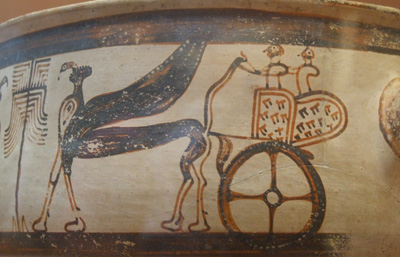
For me, two things that show that Homer was relatively accurate in describing the Mycenaeans are chariots and champions. In late Mycenaean Greece the elite would ride into battle on thin rail chariots(heres a picture): http://www.salimbeti.com/micenei/images/chariot86.jpg
They would then dismount and fight on foot, in contrast to earlier Mycenaean culture where chariots were used as heavy 'tanks' to smash into enemy lines, in the Illiad Nestor even references this, saying
"Any man whose chariot confronts an enemy’s should thrust with his spear at him from there.That’s the most effective tactic, the way men wiped out city strongholds long ago —their chests full of that style and spirit."
In Homers Greece, Chariots had fallen greatly out of use on the battlefield, combat being more focused on massed hoplite fighting than elite single combat and chariot duels.
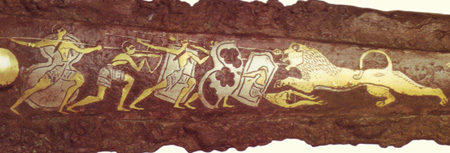
Homer references the Mycenaean tradition of single combat, look at the duels between Hector and Achilles, or Patroclus and Pyraechmes. In Mycenaean Greece, a battle was first and foremost a duel between the elites, and second a actual battle of infantry and chariots. We can see a echo of that warrior ideal in classical Thrace, where the god-king dueled in single combat, for example that fight between king Amadocus and Seuthes II mentioned by Aristotle.
Homer also mentions some military equipment that would have been anachronistic in him timeperiod. Specifically, he mentions in the Illiad a boar-tusk helmet:
"Meriones gave Odysseus a bow, a quiver and a sword, and put a cleverly made leather helmet on his head. On the inside there was a strong lining on interwoven straps, onto which a felt cap had been sewn in. The outside was cleverly adorned all around with rows of white tusks from a shiny-toothed boar, the tusks running in alternate directions in each row."
This is a iconic piece of Mycenaean equipment(here is a photo: http://en.wikipedia.org/wiki/Boar%27s_tusk_helmet#mediaviewer/File:Eberzahnhelm_Heraklion.jpg) that was not used in Homers time.
He also references Mycenaean body shields, a form of shield where it was strapped across the back and you turned to the side, allowing the shield to cover your whole body and leave both arms free, heres another photo: http://www.salimbeti.com/micenei/images/bodyshield06.jpg
It is referenced in the Iliad as Ajax's shield, being described as a "tower", a "bulwark", and in book 8, it is mentioned as being kept low to the ground and as being large enough to protect two people.
These are a few examples that hopefully show Homer got quite a bit right about Mycenaean Greece.
The short answer is: pretty much nothing except for the placenames.
There are a few different ways you can think about "being right or wrong" about the Mycenaeans, and the answer is slightly different for each of them:
Historical individuals and events. No individual mentioned in Homer is corroborated by any Bronze Age evidence, and it is at best doubtful whether there is any corroboration for any events. It is possible to maintain that the legendary destruction of Troy is corroborated by archaeological evidence of fire in Troy VIi, but since (a) there's nothing to link that to Achaian/Mycenaean/Greek agency; (b) the historical city was not actually destroyed, but continued to be inhabited continuously for another few centuries; and (c) this possible evidence of destruction is much more easily explained by the Bronze Age collapse that affected all of Greece and Anatolia and parts of Syria; taking all that into account, I'd say that the fire of Troy VIi doesn't qualify as corroboration. In addition, that layer is a suboptimal match for other aspects of the legendary tradition (Troy VIh is when the city was at its biggest and wealthiest).
Language. Homeric language is heavily traditional, but generally speaking not Mycenaean: it's from a hodge-podge of different dialects and different eras. Most of it is from the Ionic dialect at a date close to the time when the poems were composed. There are many older formulaic phrases though, and a very few can be shown to go back to the Bronze Age. A couple of items of vocabulary are used in Bronze Age senses (most famously anax "king"). There is a review of supposed Mycenaean usages in a posthumous piece by the great linguist C. J. Ruijgh in Duhoux and Morpurgo Davies (eds.), A Companion to Linear B vol. 2 (2011), pp. 253-298 (but be warned that his views are not universally shared: he routinely conflates the Arcado-Cypriot and Mycenaean dialects in his survey, and it is by no means universally accepted that this is justifiable; all, or almost all, of the supposed Mycenaeanisms that he outlines are either problematic or can be assigned instead to proto-Arcado-Cypriot).
Material culture. (1) There is one artefact of a type that no longer existed after the end of the Bronze Age (ca. 1200 BCE) described in Iliad 10, the so-called "Doloneia": a helmet covered with boars' tusks sewn into the lining. However, the leather straps used on the inner frame of the helmet sound more likely to be based on an Iron Age helmet; it's only the external decoration that can be pinned to the Bronze Age. (2) The use of chariots in battle is a well-known feature of Bronze Age warfare. However, the way they are used sounds much more like the way that mounted infantry were used in the Archaic period (i.e. contemporary with the composition of the epics). The interpretation of how chariot warfare is depicted in the Iliad remains a contested topic.
There have in the past been claims that other artefacts in Homer can be assigned to the Bronze Age, but apart from the helmet they have all now been rejected. Virtually all material culture in the Homeric epics can be safely assigned either to the 8th or 7th centuries BCE, that is to say, the century or so prior to the composition of the poems; or else assigned to false archaism achieved simply by negating elements of the material culture of that period.
So basically it comes down to: a few poetic words and phrases; and a whole bunch of place names (but not the actual historical circumstances of those places). In particular, Homeric material culture is very solidly 8th/7th century, and definitely not Mycenaean.
This question is complicated by the 'Homeric question' ('who/what is Homer?' 'Where do the 'Iliad' and 'Odyssey' come from?'). Though opinion differs, most scholars do not think a single 'Homer', composing 'the Iliad' and 'Odyssey' existed, and that 'our' Iliads and Odysseys are the product of centuries of re-telling, stemming from diverse, enigmatic origins. Consequently, 'accuracy' about the 'Mycenaean Greeks' should not be assumed.
I like Nagy's summary of what 'Homer' means (from his introduction):
... The Homer of Homer the Classic and Homer the Preclassic is more than just a hypothetical person. He is a historical concept. As a concept, Homer is a metonym for the text and the language attributed to Homer in historical times. By metonym I mean an expression of meaning by way of connecting something to something else, to be contrasted with metaphor, which I define for the moment as an expression of meaning by way of substituting something for something else.
Sources and further reading:
G. Nagy (2009), 'Homer the Preclassic'
S. Price, 'Homer and oral poetry'
M. West (2010), 'The Homeric question today' (highly recommended)