How could a culture that was basically stuck in the stone age make such huge works of art? How could they know what they were making? Were they advanced enough to make a big wooden scaffold to look down at it?
No "Aliens" examples please.
Were they advanced enough to make a big wooden scaffold to look down at it?
When people think of the Nazca, the geoglyphs are usually the only thing that comes to mind. Most people don't know about Cahuachi, the ruins of the ancient Nazca "capital" / ceremonial center next door. You can see some of the Nazca Lines from atop its forty adobe pyramids. Who needs a wooden scaffold? Assuming, of course, the lines are even intended to be viewed from above.
Hopefully, our Andean specialists can jump in and say more though.
While we're on the topic: Andean specialists, who's Helaine Silverman's The Nazca? I've been thinking about picking up a copy.
How could a culture that was basically stuck in the stone age make such huge works of art?
First, please get this idea out of your head. No one is "stuck" in any "age" because Western-style progress is not the default. Besides, even if going by the very old school "stone age -> bronze age -> whatever age" model, the Nazca would most certainly not be considered "stone age." Nazca was a centralized polity, perhaps a state, who were expert potters, built architecturally complex buildings, made very intricate and detailed textiles, etc. And although the Nazca lines are concentrated in Nazca, of course, similar lines (we call them geoglyphs) were being done up and down the coast, far from Nazca but among societies that were doing similar things to the Nazca.
Now, you don't need much to make geoglyphs. The Andean foothills along the coast of Peru are very dry and rocky (the entire coast of Peru is extremely arid desert) and there are huge boulder fields at the base of the hills. The tops of the rocks and boulders are weathered and varnished by blowing sand, and are typically dark grey or reddish-grey. But if you move the top rocks, then you get lighter-coloured unweathered rock beneath them. And that is how you make the Nazca lines. Just go along and remove the top layer of stone and you are left with a lighter coloured design.
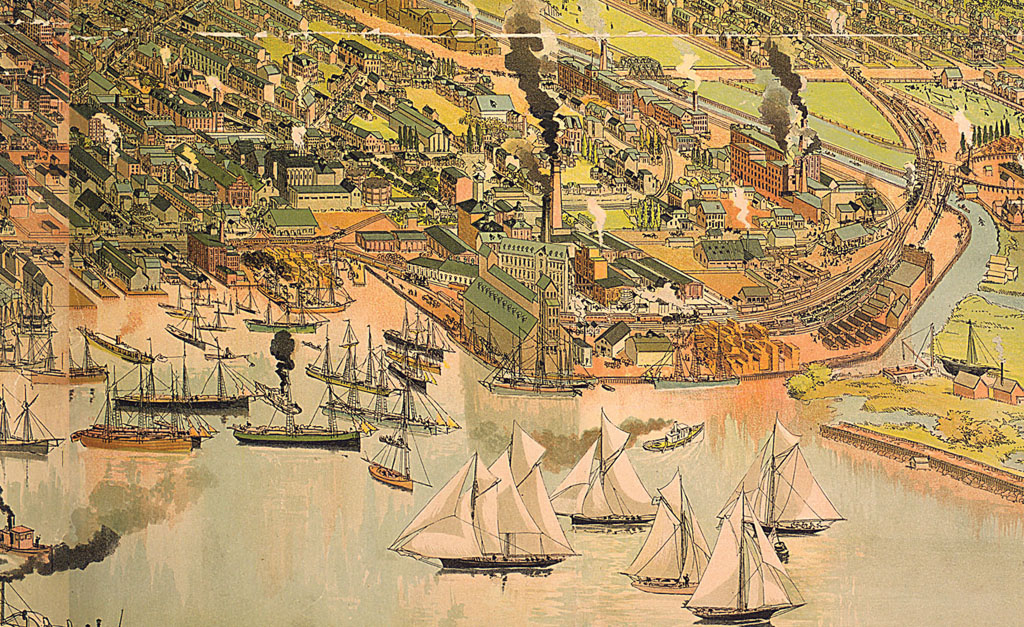
As for how to actually make the designs, it takes great artistic skill but it is not something that you need to do from high above. As /u/Reedstilt said in some cases they could stand on top of buildings, perhaps, but these rocky plains are surrounded by hills, and some Nazca lines are built on the hills themselves, so you could get a good vantage point by climbing the hill or just standing back when it was on a hill. Besides, through tricks of perspective there are ways to draw things entirely from the ground that make it look like you are flying above them, like the historic bird's eye view maps that were popular in the 1800s. And you could draw your model in a small form, figure out the calculations, and use ropes to actually make them (and anyway, most are straight lines).
As for what they were used for, the best hypothesis is that they were lines for sacred journeys, meant to be walked as a way to evoke the power of the animal or thing being depicted, which was perhaps connected to your profession, or was your amulet, or something like that. There is some connection to springs and sources of water or other important resources, but in a culture that knew hundreds or thousands of spiritually-important mountains, buildings, rocks, etc. and had extensive sacred landscapes that would be learned from birth, it is hardly necessary to have giant signals to get to places like springs. But they could have served a more magical purpose, like ensuring the spring continued to deliver water.
This is a good overview and chronology source with some pictures, and this is a freely-available scholarly source that looks like it is giving an overview of their project, but has some discussion of what the lines are and how they were built. You can look through their bibliography for more, but unless you have journal database access you probably won't be able to see most of their articles.