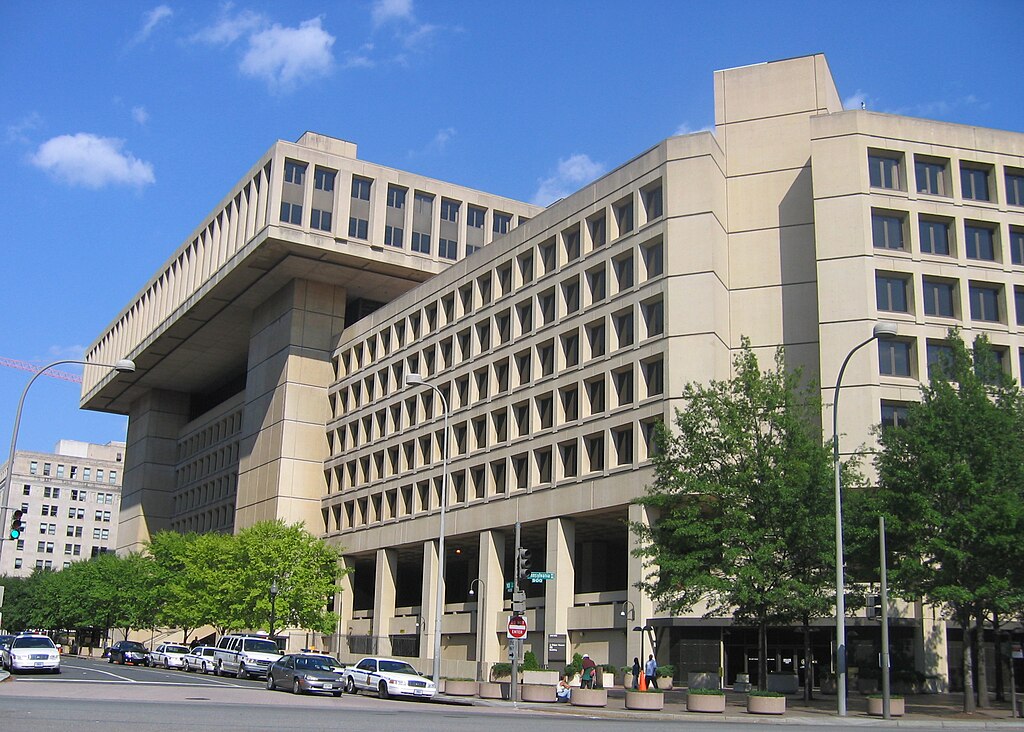
After taking a look at numerous US government-based buildings in Washington, DC, many of them seem to have a similar aesthetic as the FBI headquarters (http://upload.wikimedia.org/wikipedia/commons/thumb/f/f7/Fbi_headquarters.jpg/1024px-Fbi_headquarters.jpg). I've also seen this aesthetic in government buildings built around the same time period in Philadelphia. This Buzzfeed post (I apologize) has more examples: http://www.buzzfeed.com/bennyjohnson/the-7-most-heinously-ugly-government-buildings-in-washington
My specific questions are:
Historic and artistic trends in the mid-20th century favored Modernism and eschewed traditional historicist architecture. The buildings we today call Art Deco or Moderne dominated European and American building by the late 1920s, and government commissions were no different—except that there was still a desire to impose the "dignity" of symmetrical arrangement and classical massing. Buildings like John Russell Pope's 1941 National Gallery (now the West Building) represent the zenith of "stripped classicism."
When building began again after World War II, the same trends continued: the 1951 General Accounting Office building is a good example. But architects around the world were starting to design in fresh ways not anchored in historic examples, using new materials such as poured-in-place concrete or lightweight curtain walls of aluminum and plate glass. The horrors of the two world wars meant that societies both east and west of the Iron Curtain were looking to be modern, to free themselves from associations with empires. There was also bit of an aversion to the austere heavy-handed classicism favored by Nazi Germany and Fascist Italy.
As the Great Society built new agency buildings in Washington, the nation's greatest architects worked in the styles of the day. Some of the use of concrete celebrated the plasticity of that material in a style that became known as Brutalism (from the French term béton brut). Others used easy-to-shape concrete in a New Classicism whose sculptural columns flowed into the roofline, or a celebration of structure like Harry Weese's stations for the Washington Metro. All the architects, of course, were constrained by the program (sometimes needing to fit lots of office space on a small site) and by Washington's building height limits. The ultimate maturity of the modern movement is probably marked by I.M. Pei's 1978 East Building for the National Gallery.
Washington buildings of the 1960s may appear ugly to us today, but preservationists speak of the 40-year curse. All architecture goes through a period when it's unappreciated, but eventually we're able to look with a more discerning eye and celebrate most of it as part of history, and some of it as timeless good design.