Terminology & Chronology
Mexico typically gets left out of "North America" due to the delineation between the modern state and the US, and while this may have something to say about how culture shapes geography, it is still nonetheless a significant chunk of the continent. We also have a much stronger archaeological and historical record for that region than we do for other parts of North America.
When we are talking about the time period of the "life of Jesus," we are talking about the late "Preclassic" or "Formative" period of Mesoamerica, about 400 BCE - 200 CE. Some chronologies further subdivide this period, delineating a "Terminal" Preclassic/Formative from around 1 CE - 200 CE. There's also debate over when these cut-off points should be applied in particular areas, since we are essentially grafting a chronological framework from Ancient Greece onto a region much large and more diverse. For simplicity's sake though, just remember Late Formative = 400 BCE - 200 CE.
General Features
A common aspect of this period is that it was a sort of interstitial period in-between the widespread influence of the Mesoamerican cultura madre, the Olmecs, and the growth of more fully developed stratified, urban societies in other regions. Whether the Olmecs were truly a mother culture, or simply a prominent sister, or even had a highland "cultura padre," is not something we need to get into here. By the time period we are talking about, the evident Olmec influence on Mesoamerica had subsided. The "Epi-Olmecs" continued on in the Southern Gulf Coast, but they were not even remotely as influential as their forebearers.
We see some features of Mesoamerican life that would become commonplace in later periods. The spread of comals, for instance, points in turn to the spread of the tortilla as a common food. Although the tamale would remain the staple; tortillas being used as utensils and, once toasted, "trail food." We see the standardization of temple-pyramid styles at this point, with talud-tablero styles becoming commonplace across Central Mexico. In the burgeoning Maya polities we see the implementation of a "template" of civic centers composed of pyramid-temples, palaces, and ballcourts, linked by sacbeob (crushed stone causeways) to other cities and suburban nucleations. We further see the earliest artifacts attesting to the development of Isthmian/Epi-Olmec writing several centuries before Christ, as well as the earliest Long Count calendar dates on artifacts attesting to that system's use at least a generation ere Jesus.
I'll focus on just a few areas in detail, just to help illustrate the changes that were occurring at this time.
Basin of Mexico
Home of the Aztecs... when they arrived more than a 1000 years later! In the Early-Mid Formative, the Olmec-influenced Tlatilco, on the Western shores of Lake Texcoco, was the largest settlement and the closest to what we could properly call a city, having a population of several thousand. Again though, the earlier Olmec-influenced societies were largely in decline, with many sites outright abandoned by the Late Formative. Tlatilco stuck around for some time into the Late Formative, but was entirely eclipsed by in size and importance by Cuicuilco in the Southwest Basin and Teotihuacan in the Northeast. These two sites arose both through their exploitation of rich agricultural land, but also the integration into long-distance trade routes. Teotihuacan had the added advantage of being located near one of the premier sources of obsidian, Pachuca, which continued to be important even into the Aztec era.
Cuicuilco though, was eclipsed at some point during this period by the eruption of the Xitle volcano. Or maybe it was Popocatepetl. Both volcanoes were active at the time and determining the exact chronology is not helped by basaltic flows over archaeological sites, not to mention the urbanizing flow of modern Mexico City over those sites. Regardless of the exact timing, Cuicuilco, and many sites in the southern part of the Basin of Mexico, was abandoned. Teotihuacan, situated outside the "blast radius," experienced a massive population jump at this time, setting up it's later hegemonic influence over large parts of Mesoamerica during the Classic period.
Valley of Oaxaca
The Oaxaca/Guerrero area is one of the most widely cited as being a contemporary culture to the early Olmecs. The city of San Jose Mogote was predominant in the region during the Early-Mid Formative, but the founding of Monte Alban around 500 BCE marked the dawn of a new era. Unlike in the Basin of Mexico, the rise of Monte Alban from nothing in 500 BCE to a city of ~17K by 200 BCE, was not triggered by a volcano (maybe, can never rule out the influence of environment). Instead, the founding of Monte Alban is considered to signify a political, probably military, unification of the Valley. Monte Alban would continue to dominate Oaxaca until the late Classic, when this unity would fracture under the pressure of rival cities and the influx of Mixtecs into the valley. It is in this area that the Zapotec script, one of the earliest writing styles
Izapa
The Pacific Coast area between modern Chiapas and Guatemala tends not to get much love. It is, however, one of the most important areas in early Mesoamerica and a Olmec contemporary that survived and thrived following their decline. By the Late Formative, Izapa was the most important polity in the area, with a widespread and distinctive culture that Michael Coe has called the, "connecting link in time and space between the earlier Olmec civilization and the later Classic Maya." That's a bit hyperbolic, but we do see some of the earliest examples of Isthmian writing and use of Long Count at Izapa as well as in the Guatemalan Highlands and in the Peten.
Guatemala Highlands & Peten
The Maya region. While the Classic Maya is probably one of the most well-known Mesoamerican civilizations, their precursors were already present in Southern Mexico/Guatemala. Kaminaljuyu, in the Highlands, was at its height by the time the birth of Jesus. A city of tens of thousands (sometimes cited as ~100K), it dominated the Highlands politically, economically, and culturally. Down in the Peten Lowlands the site of El Mirador, and later Uaxactun, similarly dominated that area. These early major Maya sites are where we see the development of the architectural, iconographic, and epigraphic styles which would be further developed by the Classic Maya.
Transition
In conclusion, Libya Mesoamerica was a land of contrasts. No, wait, it'd be better to say that this was time of transition. The Formative period saw the development of populous, urbanized, stratified societies. The Late Formative, in particular, saw the development of what could more clearly be called "states" in the sense of a central polity dominating lesser settlements across a wide region. This early states, however, had variable successes as time progressed. While Monte Alban held preeminence for centuries in the Valley of Oaxaca and Teotihuacan would become one of the most influential civilizations in the history of Mesoamerica (and the Americas in general), the early Maya sites would largely be surpassed by their successors, leading to the concept of a "Preclassic Collapse."
The shallow look taken here at a few regions does not fully show the remarkable diversity and innovation of Mesoamerica at this time. We did not touch on the shaft-tombs of West Mexico (which /u/mictlantecuhtli might be better able to explain). Nor did we cover one of the longest lasting (as in, still around and kicking today) cities in Mesoamerica, Cholula, who built the early versions of what would later become the largest pyramid in the world. So there's a lot to start you digging around on your own. Here's some sources to help:
Coe & Koontz 2008 Mexico: From the Olmecs to the Aztecs
Toby-Evans 2008 Ancient Mexico & Central America: Archaeology and Culture History
Blanton et al. 1993 Ancient Mesoamerica: A Comparison of Change in Three Regions (less accessible than the other two sources)
The Hopewell Tradition was in full swing in Ohio, making major earthwork enclosures that tracked the solar and lunar calendars. The Hopewellian Exchange had a trade network that encompassed Canada, the Rocky Mountains (obsidian), and the Gulf of Mexico (lightning whelk shells).
They come to mind because the Pawnee archivist at NMAI, Tom Evans, when showing 2000-year-old Hopewell textiles described them as being from "Jesus Times."
As /u/ahalenia mentioned, during the first few centuries after the start of the Common Era, the Hopewell Tradition was widespread through the Mississippi and Ohio River valleys, but I wanted to elaborate on that topic a bit.
The Hopewell Tradition began nearly two centuries earlier and was originally based in and around the American Bottom along the Mississippi and Illinois. This marked the beginning of a period known archaeologically as the Middle Woodland. The Hopewell Tradition was an elaboration on earlier trade networks, architectural styles, ceremonial motifs, and burial customs that had been formulated in the Early Woodland (from ~1000 BCE to ~200 BCE), with some notable antecedents going back into the Archaic period.
The people who initially developed the Hopewell Tradition are known as the Havanna or Illinois Hopewell. Soon, their new traditions were spreading up, and eventually made its way up the Ohio River where it merged and mingled with the culture of the Adena. The Adena were the big-shots of the Early Woodland, recipients of much of the old trade network and active and flamboyant participants in the old ceremonial systems. While most of them appear to have taken to the new Hopewell Tradition eagerly, becoming the Scioto or Ohio Hopewell that would define and exemplify much of the tradition going forward and bring to it their own ostentatious fervor, there continued to be Adena traditionalists holding out on the eastern fringes of Hopewell space. While the Ohio Hopewell dominated the major river valleys of the state--the Great Miami, the Scioto, and the Muskingum--the Adena traditionalists held out in the Hocking River, along the Ohio north of the Muskingum's mouth, and south of the Ohio along the Kanawha River in West Virginia.
The Adena traditionalists and the Hopewell converts seem to have gotten along fairly well. The Adena Mound itself, the type site for the Adena culture, seems to have been built around 40 CE, in the midst of a region that had since become epicenter of Ohio Hopewell culture in the vicinity of what is now Chillicothe, Ohio. While the Adena Mound doesn't show up on this map of Hopewell sites in the area, it was located just a little south of the Mound City Group and Shriver Circle.
The Hopewell Tradition spread all along the Ohio and Mississippi River valleys, even reaching into the Great Lakes. The Adena traditionalists in West Virginia and eastern Ohio were the only hold-outs though. There were others, like the Baumer Culture in southern Illinois and neighboring Kentucky, that seemed to care little for all the elaborate ceremonialism and long-distance trade that was going on. But like the Adena, these comparatively austere people appear to have been left in peace by the growing Hopewellian nations surrounding them.
In fact, there's very little evidence of violence in this period, which makes the Pax Hopewelliana that spread even beyond the Hopewellian nations themselves all the more impressive. Theirs was not a religion spread by imperial conquests or a peace enforced with a sword, as far as we can tell today. The peace seems to have been maintained through common interests in trade and religion. During this time, individuals, not just goods, appear to have been able to travel great distances safely and on a relatively regular basis.
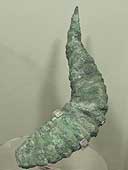
Ahalenia mentioned the Hopewell trading for obsidian, among other goods like grizzly bear teeth and claws, from the Rockies and shells (along with alligator, shark, and barracuda teeth) from the Gulf. Some of these goods appear to have arrived in their destinations with express delivery, rather than hopping from one community to the next. Obsidian from Yellowstone, which the Ohio Hopewell fashioned into large ceremonial spearpoints, is relatively common in Ohio archaeological sites but rare in the intervening space. Other curious finds in Ohio include various effigies that seem to depict bighorn sheep, such as this copper horn in the shape of a female or young male horn, which is quite suggestive that some Ohio Hopewell saw these animals for themselves and made these effigies to remember the exotic animals of the west. On a similar note, some Kansas City Hopewell seem to have encountered jaguars in the south and commemorated their encounter with artwork of their own, such as this jaguar gorget. How far south they might have traveled to find jaguars is uncertain, but its important to remember that jaguars once prowled as far north as Texas and Louisiana (where the Marksville Hopewell lived along the lower Mississippi), so the animals might have been encountered while more northerly Hopewellians went south to the Gulf coast.
The Ohio Hopewell (and others, but as the Ohio Hopewell are the ones I'm most familiar with, I'll be focus on them from here on out when I say "Hopewell"), as far as we have been able to tell, don't appear to have lived in concentrated settlements like villages, towns, or cities. Most people were living in dispersed farming hamlets surrounding the ceremonial sites, with a few specialists living in the immediate vicinity of the ceremonial sites at least part of the year. Admittedly, this echoes older erroneous ideas about the Maya which also hypothesized that Maya cities were largely vacant ceremonial location, but as yet there's no evidence for large permanent populations concentrated around these sites. We do find concetrated village sites in the post-Hopewell Late Woodland (~500 CE - ~1000 CE), during which the trade networks broke down, warfare became more common and the ceremonial sites became much smaller and less elaborate or ceased to be built at all. The dispersed Hopewellian communities are likely a sign of the generally peaceful conditions that prevailed in the Middle Woodland, allowing people to feel safe without needing pallisades or large numbers for defense.
Regardless of their reasons for living in small hamlets, the majority of Hopewell would have been making their living with hunting, gathering, and farming--similar to Native communities in the Eastern Woodlands at the time of European contact but with some significant differences. First, deer would have been hunted with atlatls, as the bow wouldn't become widespread in the region until the Late Woodland. The crops planted by all Hopewellian peoples were those of the Eastern Agricultural Complex. This included some familiar plants, like squash and sunflowers, and many unfamiliar plants like goosefoot and marshelder. The plants of the Eastern Agricultural Complex had been domesticated throughout the Archaic and became widespread staples during the Early Woodland. Maize was just starting to make its appearance in the region from the Southwest and was still a rare curiosity in the time period you're interested in. It wouldn't be until just before the start of the second millennium that it would become a staple crop throughout the eastern part of the continent. As for beans, they'd eventually make their way up from Mexico too (also probably via the Southwest) and become a regular part of the diet around the 13th Century.
The Hopewell also had an interest in astronomy and appear to have been particularly interested in rather esoteric aspects of the moon's orbit that required decades-long observations to figure out. But the primary evidence for that dates to a couple centuries after the time you're interested in, so I'll leave that and a few other topics for later.
I would like to piggy-back off this, and ask if the stories in the Book of Mormon in someway collide with the actual history (religious aspects aside)?