I've always been interested in why there was such a huge variety, and what distinct advantages lied with each sort of weapon. I.E. in what instances was an axe favored over a sword? A morning star over a sword? A sword over a mace? I know much of it had to do with mounted vs. unmounted combat. Also, you see in movies these huge swords like Scottish Claymores, and bastard swords, were these REALLY viable? They seemed 1) impossible to carry and draw, 2) totally impractical in combat due to the strength needed to swing them, and how slow they would be moved.
A lot of the variety you see comes from imaging the Middle Ages as a single period. The European Middle Ages covers hundreds of years and dozens and dozens of cultures, so you're going to see a lot of cultural variation and temporal variation.
If you look at a specific country at a specific time, you'll see much, much less variation.
Let's look at England in about 1450, around the time of the Wars of the Roses.
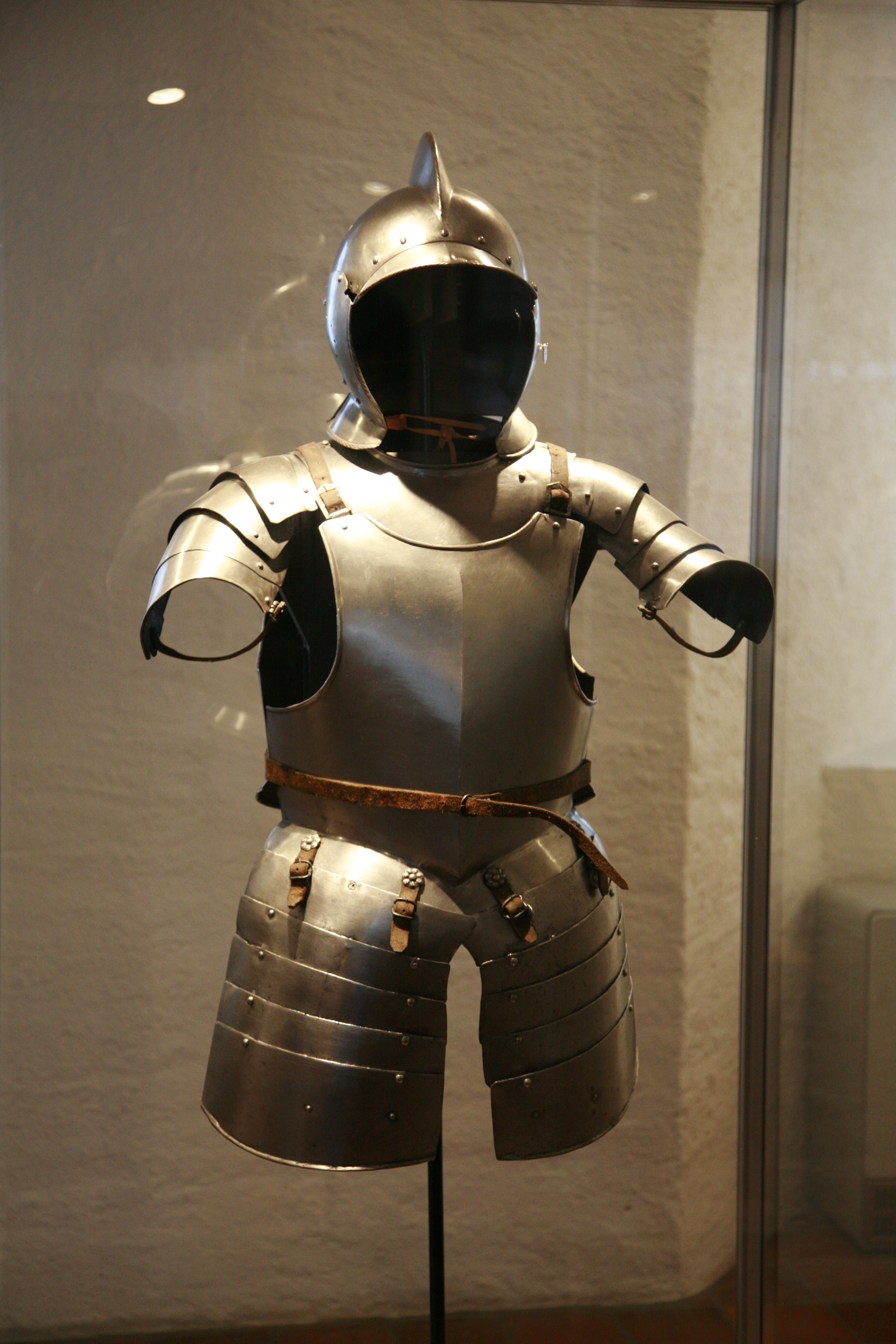
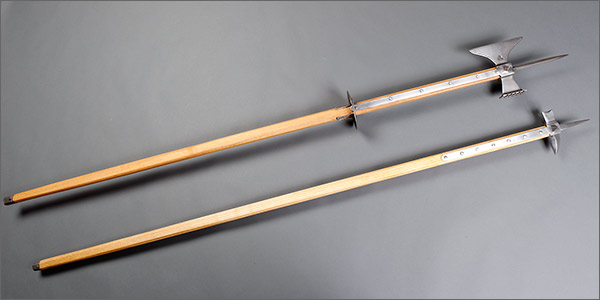
A typical kit for a man-at-arms (an armoured footman) would be mass-produced Italian or German plate harness for protection (this is slightly later German munitions-grade harness). His weapon would be a poleaxe (two variations here) or a spear. He would also carry a longsword and a dagger.
The typical weapons of that time and place would be the longsword (what you call a bastard sword - about four feet long, able to be used one- or two-handed), the shortsword (aka arming sword - same as the longsword, but only three feet long, for one-handed use), the dagger, the poleaxe, and the spear.
I.E. in what instances was an axe favored over a sword?
What they would have called an axe, we call a poleaxe, and it was favoured over a sword because it had the leverage to defeat plate armour, which was difficult to do with a sword.
What you're probably thinking of when you say axe, though, is something like this which is from 500 years before our Lancastrians and Yorkists.
The advantage of an axe like that over its contemporary swords was that it required less skill to manufacture and use. The mace exists for similar reasons - easier to manufacture, easier to use. (I'm basing my "easier to use" comment on the fact that there exist no comprehensive manuals that deal with either weapon, suggesting that if they were in use, there was not a full fighting system built around them, and they were intended to be used more simply).
A morning star over a sword? A sword over a mace?
A sword is a very versatile weapon. It is well-suited to both attack and defence, and it can also (in the case of the longsword) be used like a spear or an axe, by halfswording it. By contrast, weapons like the mace and axe have limited reach (typically only about 2 feet, compared to the 3-4 feet of a sword), and less parrying ability due to their less even weight distribution.
Also, you see in movies these huge swords like Scottish Claymores, and bastard swords, were these REALLY viable?
Yes, although I can't speak to what you saw in movies. Claymores IRL were a development of the longsword, and were about the same size, perhaps a little bigger. Say 4-5 feet.
Zweihanders were probably the largest swords ever used in battle, and were about 5-6ft in length. These were specialized weapons developed to deal with pike formations, however, and not the kind of general-purpose weapon that a longsword was. They are also more of an early Renaissance weapon than a medieval weapon, being primarily used in the 16th century. They would not be carried in a scabbard like a regular sword, but on the shoulder, like a spear (and in fact, their use has a fair bit in common with the spear).
totally impractical in combat due to the strength needed to swing them, and how slow they would be moved.
You will probably be surprised to learn that even the biggest swords weighed only a few pounds, and the tip could move incredibly fast.
A longsword (4ft) would typically weigh about 3 pounds. A zweihander maybe 4-6 pounds. Compare to a typical spear at about 4-6 pounds.
Weapons that were impractical were not used, as the user would be killed and would not contribute to the battle, so if a weapon seems impractical, it's good to ask, "what assumptions do I have that might not be true about this?". In this case, large swords did not need exceptional strength to wield (as they were not particularly heavy), nor did they move slowly.
Hopefully that answers some of your questions!
egregioustopiary is basically correct, but I'd like to expand on it briefly for you.
Blunt weapons, particularly war hammers, came into vogue towards the end of the plate armor era, when the armor was simply so good that getting around or through it was increasingly difficult. They break bones and damage the plates themselves, but were not previously used because massive organ damage and bleeding is generally preferred.
The flanged mace is a special case, as it was quite nasty against chain, but suffered from being unwieldy. Maces were more extensively used in Indian warfare than they were in European warfare, but I'm not sure why that is.
The Dane axe and similar were used mostly during the Viking Age and by viking populations, and had some armor-breaking ability against chain and helmets that swords did not have. But those axes gradually lengthened and added a back spike, becoming halberds and pollaxes.
The pollaxe and the halberd were really variations of the spear more than anything. They were nastier against plated armor, which combated spears. The spear is probably history's most ubiquitous weapon, as much as or moreso than the sword.
Swords are very general purpose tools, but very large swords are good against pole weapons. Their reach and width allows one to bat away poles, and once you're inside the reach of those weapons, their wielder is forced to rapidly switch to a sidearm. Hand and half swords were long a staple of knights - their cleaving power was maximized on horseback, and plate armor made the shield virtually obsolete.
May I add to this question? If so, did the smiths and craftsmen have universal "blueprints"/ guides (aside from apprenticeship) to make these weapons? Did the vastness of weapons stem from smiths an craftsmen botching, building onto, or experimenting with previous designs?
Silver (the author of a manual of arms) wrote down his thoughts on which weapons beat other weapons. I wrote a bit on it here: http://www.reddit.com/r/AskHistorians/comments/1juvpx/z/cbildx4
Insofar as why there's so many weapons, as the other posters have said, it's a variety across a wide range of times and places. But even within one time and place, there'd be variety as well. Why? Because people back then weren't stupid - and war tends to weed out bad ideas really quickly, anyway. So there was a constant arms race between arms and armor. Each new development in one led to the development of the other, back and forth.
So your question of mace vs. sword somewhat misses the point. It would be mace vs. plate. Or bodkin vs. chain. And so forth. If you want to know why a person would use a specific weapon, you need to look at the armor of his foes.
Does anyone remember that old History Channel show called "Conquest"? That guy seemed pretty credible and did alot of great demonstrations of the different fighting techniques and weapon usage.
Found a video: https://www.youtube.com/watch?v=zhRCNLMzUMY
Speaking for high medieval stuff, with a bit of extra information on longswords, as I mostly know about 13th century:
Whilst swords got gradually easier and easier to get during the medieval era - and most social classes that would be levied were required to own a sword in England by the time of Henry III, as his 1252 Assise of Arms says, a man with land worth between 40 and 100 shillings is required to have a sword (among other equipment), as is a man with cattle worth between 20 and 40 marks.
However, an axe would be favoured over a sword for its cheapness, the ease to repair it (if a sword breaks, it's done for, if an axe breaks, put the head on a new shaft) it's also top heavy, better for delivering a harder hit, though you can't do something like draw-cut like you can with a sword, which is one of the better ways of wounding a gambeson clad infantryman.
Morning star's are a century or two later than my knowledge, but with most of these impact weapons, the idea is simple: If a man's in armour, you can't cut through it, but you can get something heavy enough and break his bones through his armour, I believe the spikes of morning-stars evolved to do more damage to the incredibly protective plate armour.
Bastard swords, or hand-and-a-half swords, longswords and their ilk, are definitely viable, they're technique weapons, not ones you swing like an axe, but ones you lever. There's tons of brilliant treatises on these weapons from the late medieval period, and plenty of people who practice the fencing techniques in them - I'm trying to self-teach Fiore dei Liberi at the moment. The issue with these weapons is that in using a two handed technique, you lose out on having a shield, which is absolutely vital for your defense, especially when arrows are raining down. Most surviving longsword manuals are for duels and judicial combat, not movie-style fighting on a hectic battlefield. It's also important to note that fighting with these weapons, and swords and many other weapons in general, is not a matter of strength, it's primarily an issue of technique, speed and stamina.
What's important to note is that none of these weapons are primary weapons, they're secondary and sometimes even tertiary weapons. Infantrymen would use mass spear formations and knights would rely on lances more than swords. Even when a knight's lance broke, he could just ride away and collect another before returning to the battle, and he'd sooner rely on a short axe or mace than his arming sword on those rare occasions he was actually in frantic close combat.
I hope some of this helps as I've sort of just been rambling all the information I could about each weapon, and it may not be the most readable thing in the world.