As one might expect, this question has a different answer depending on which territory you're talking about. Here's a general overview:
Guam: Acquired by the United States from Spain during the Spanish-American War, administered by the U.S. Navy until World War II, ruled by Japan for four years, and then returned to U.S. control. Guam is currently an unincorporated territory of the U.S.
American Samoa: Acquired by the United States around the same time as Guam, but under different circumstances. Germany, the UK, and the US were all competing for rule over Samoa in the midst of a civil war there. The region was split between the UK and the US. American Samoa is currently governed as an unincorporated territory of the U.S.
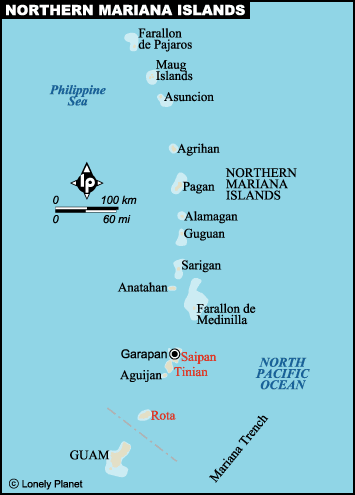
Commonwealth of the Northern Mariana Islands: Acquired by the United States after World War II, ruled as a part of the former Trust Territory of the Pacific Islands until voters chose commonwealth status during the 1970s.
Republic of Palau/Federated States of Micronesia/Republic of the Marshall Islands: These areas made up the rest of the Trust Territory of the Pacific Islands, but voters chose to become independent nations in free association with the United States.
These island groups are spread all over the Pacific. Hawai'i is the farthest east, while Guam and the Marianas are relatively close to the Philippines. Micronesia and the Marshall Island stretch across several thousand miles of ocean to the east of the Marianas. American Samoa is nowhere near any of them. It's in the South Pacific, east of Fiji.
I've read fairly widely in the literature on most of those island groups, and while I have come across scattered suggestions of incorporating parts of Micronesia within the state of Hawai'i (unfortunately I can't recall where they were), to the best of my knowledge no serious effort was ever made in that direction. The fact that Micronesians voted for independence in the 1970s would certainly have mitigated against that possibility. As would the international pressure on the United States from the United Nations and global community not to annex new territories without holding a plebiscite vote. While there were some advocates for commonwealth status in the Trust Territory, I can't think of any advocates for moving directly to statehood. I'm not aware of any suggestions of incorporating American Samoa within Hawai'i, although I suppose there may have been some from time to time. But I have to think that the absurdly large area these territories cover would have mitigated against an enlargement of the State of Hawai'i. Such a state would be a challenge to govern -- as the United States Navy found when it briefly attempted to govern Micronesia from its base in the middle of Diamond Head. Another thing to keep in mind is that Hawai'i dwarfs the population of all of these island groups, and so piggybacking on a much larger existing state wouldn't necessarily be a solid strategy for making local voices heard.
There have been advocates for making Guam the 51st state, however. Here is a site maintained by a pro-statehood group. But I can't really comment on the history of that movement or its future possibilities of success. It's important to note that in Guam, as in pre-statehood Hawai'i, there are voices on various sides of this issue. Indigenous sovereignty advocates argue for more local autonomy, while statehood advocates see full incorporation into the American nation-state as the best route toward political power. Those voices come and go as movements rise and fall and moods change, but statehood would have be a controversial proposition in any of these groups.
The short answer is that these island groups all have very different histories, and if gathering support for statehood is a challenge, combining one of these territories with an existing state would have presented an even larger challenge. Take a look at this map of the Mariana Islands and pay attention to how close Guam is to the rest of the group. Despite decades of advocacy for combining these territories -- which share a common history and culture but have been administered as separate units by the U.S. since World War II, there's been practically no progress. I hope that helps.