Greetings esteemed scholars. I was wondering if one of you fine gentlepeople knew why the Netherlands and Belgium have such a comparatively high population density and also how long that's been going on. Since when have these countries been densley populated?
The question came to mind after a recent /r/europe thread in which I noted that Denmark (excluding Greenland), being slightly bigger than the Netherlands and having much the same climate and landscape only has one-third of the Dutch population.
Belgium too is quite densely populated so I assume the two phenomenons have a cause in common.
What can you tell me about this? Where does it come from, how long has it been here?
Someone suggested it had to do with the rich soil and the good location for a trade port which made it a very wealthy and thus populous area and while that suggestion does sound very plausible, I'd like to know more on the subject, so thanks in advance!
If this breaks the current events rule, please feel free to delete it but I figured this population density rather pre-dates 1994.
Since back during the Late Middle Ages, Belgium and the Netherlands have had a relatively high population density. By which I mean, in comparison to other regions, the population density was high. The type of population density we associate with the area now only comes into play after 1800, however. More on that later.
There are a lot of factors at play here and it's hard to pin all of them down. We can for instance see that the area has been very urbanised since the late middle ages. In 1500, the area of Belgium had an urban population of 21,1 percent of the total population, while the northern Netherlands clocked in at 15,8 percent. The Belgian percentage would fluctuate around 23% until 1800, while the Northern Netherlands would even reach 30%. Compare this figure from 1500 to the average of North and Western Europe (6,6%), Central Europe (3,7%) and Mediterranean Europe (9,5%). Even the other most urbanised area of Europe, Northern Italy, only clocked in at 12,4%. This immediately raises the question - why does this area have a higher urban density than the rest of Europe? This question immediately takes us to many other factors.
For quite some time during the Middle Ages and the Early Modern Period, the Low Countries were probably the most important economic region in Europe. During the Middle Ages, Bruges (Belgium) took on the role as one of the most important trade cities and ports, which then shifted to Antwerp during the later middle ages and which would eventually shift to Amsterdam after the fall of Antwerp in 1585. Regardless, the region remained an important trade node in the European network for quite some time - to this day, even. Many of the cities started out as trade centres. Ultimately, the region was well positioned between the trade routes of the Champagne region, the British Isles, the Hansa cities and the Baltic trade. It was also the point where the cultural sphere of France and the HRE met, but spent quite some time outside of both spheres.
You mentioned agriculture and fertile soils and you're right to do so. But there's more to it. While the soil was fertile in some areas, there was one big problem: there wasn't a lot of it. This was because of geographical limitations, some areas being infertile due to encroachment from the sea (mainly the Netherlands), because of the already relatively large population and because of the inheritance practices which ended up scattering land holdings into many tiny parcels. This could've - and was, for some time - been a huge stumbling block for population growth (see: Malthus etc) and for urbanisation. But over time, the people in this area came up with ways to overcome this problem. On the one hand, they found extra land - draining marshes, reclaiming land from the very sea. On the other, they started working the land they had more efficiently and more intensely. While in other areas in the world, if you needed more food you could just use more land for agriculture and be done with it - like how Americans moved towards the west over time. This, of course, leads to a spread out population. But for the Netherlands and Belgium this wasn't an option. There wasn't any free land left. (although later on the people themselves would in great numbers join the migration wave to America) So, they had limited land, but lots of people. The solution was to squeeze every drop out of the land they had, using techniques like the three-field system etc, with heavy labour intensity. This created a solid base for population growth.
The actual population numbers and the population growth weren't necessarily high, however - not for a long time, at least. Between 1500 and 1800, the population more than doubled - going from 1,24 million in Belgium and 950k in the Netherlands to 2,9 million and 2,1 million respectively. It was around this time, however, that the population boom began. This is a pretty universal boom in most regions of Europe - the result of a drop in mortality (especially among children) as a result of disease, war and famine, and a slower drop in natality (families before this time had many children, but not many ended up seeing adulthood. When that mortality dropped, you're suddenly stuck with a whole bunch of people). By 1900, the previous figures had risen to 6,7 million and 5,1 million.
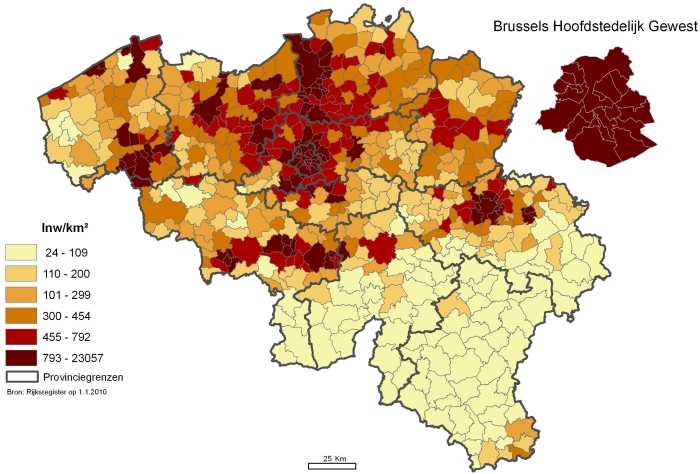
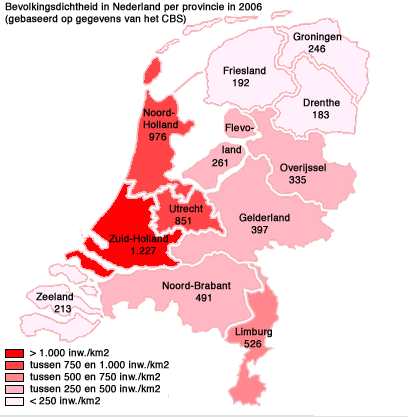
The population growth focussed on the more urbanised areas and the now heavily industrialised areas - the rural areas even saw a population decline. Here's a map of Belgium, for instance. You can see Brussels in the centre, Antwerp above it, Ghent to its side and then Bruges and Kortrijk on the left. Closer to the bottom, you can see a sort of bow, a line through Wallonia - that's the old industrial band of Liège, Charleroi, etc. But you'll notice that there are also a significant amount of areas where the population density is downright pitiful. Those are the rural areas. You can see the same in the Netherlands.
In the twentieth century the population would continue to grow rapidly - though the birth rate would drop drastically after the second demographic transition of sixties and the seventies. Belgium currently has 11 million inhabitants, the Netherlands have 16 million.
I dunno, I feel like I started rambling somewhere and forgot to actually answer your question. Well, I hope it was interesting at least.