All of the paintings by Adolf Hitler that are known to be by him seem to end in 1917. Though it is believed that Hitler made hundreds of paintings, we simply are not aware of which are his and which are not. The United State's government has many of his original paintings in storage somewhere, but does not allow them to be displayed. We do know that he personally deigned many German buildings and bunkers during his time in power, and this site features many of his known sketches and drawings.
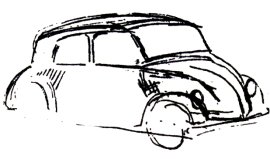
Though not exactly a piece of art, this sketch by Adolf Hitler in 1932 is what lead to the creation of the VW Beetle.
Sources:
edited for adding links.
MOD NOTE: Please stick to the topic at hand, which is "Did Hitler continue making art after he rose to power?" If you have comprehensive and informative knowledge about Hitler's artistic endeavors, please do share them. A score of people giving their one line reviews of Hitler's painting abilities is neither helpful nor the topic at hand. Such comments should be directed at /r/NaziArtReviews.
Although he simply didn't have time to paint like he did in Vienna when he tried to live off of sales of his paintings and postcards, I would argue that he did continue to "create" art, but in a more indirect role. I don't think it's a stretch to call him an art director.
Hitler spent 1908–1913 painting as a profession in Vienna. He had already been rejected as a painter. So, by that time, I don't think Hitler wanted to become a great artist with his paintings hanging in the halls of museums. I think he wanted to build the museums themselves. It seems to me that painting served merely as a means to an end, which was to study the architecture around him.
From Mein Kampf Vol. 1, Ch. 2:
...my talent for painting seemed to be excelled by my talent for drawing, especially in almost all fields of architecture. At the same time my interest in architecture as such increased steadily, and this development was accelerated after a two weeks' trip to Vienna which I took when not yet sixteen. The purpose of my trip was to study the picture gallery in the Court Museum, but I had eyes for scarcely anything but the Museum itself. From morning until late at night, I ran from one object of interest to another, but it was always the buildings which held my primary interest. For hours I could stand in front of the Opera, for hours I could gaze at the Parliament; the whole Ring Boulevard seemed to me like an enchantment out of -The Thousand-and-One-Nights.
Now I was in the fair city for the second time, waiting with burning impatience, but also with confident self-assurance, for the result of my entrance examination. I was so convinced that I would be successful that when I received my rejection, it struck me as a bolt from the blue. Yet that is what happened. When I presented myself to the rector, requesting an explanation for my non-acceptance at the Academy's school of painting, that gentleman assured me that the drawings I had submitted incontrovertibly showed my unfitness for painting, and that my ability obviously lay in the field of architecture; for me, he said, the Academy's school of painting was out of the question, the place for me was the School of Architecture. It was incomprehensible to him that I had never attended an architectural school or received any other training in architecture. Downcast, I left von Hansen's magnificent building on the Schillerplatz, for the first time in my young life at odds with myself...
In a few days I myself knew that I should some day become an architect.
When after the death of my mother I went to Vienna for the third time, to remain for many years... I wanted to become an architect, and obstacles do not exist to be surrendered to, but only to be broken...
Albert Speer attributed his own rise in power due to Hitler's love of architecture and the talks they shared about their mutual passion. Speer gave Hitler daily briefings about renovations and construction projects when Hitler was Chancellor. Hitler told him his architectural dreams for Germany, and they shared common stylistic visions with a Neoclassical foundation. So Speer was tapped to become the lead architect for Germany's massive construction and rebuilding projects. For some early projects, Hitler consulted on, and even drew sketches.
Most later projects were completed without personal oversight by Hitler, once he had three trusted architects. But he did continue to contribute ideas, visions, and sketches for select projects, such as directing Giesler on what he wanted his mausoleum to look/feel like, and giving Speer ideas and sketches for the (uncompleted) Volkshalle (these sketches were from the 1920's).
So, I'd say that Hitler did continue making art. He just did it by submitting sketches and setting policy in a general supervisory role, as a sort of visionary / art director.
Although he is known for his paintings (besides, you know, World War II), Hitler had a passion for architecture. He even once said that "If Germany had not lost [World War I], [He] would have not got involved in politics and would have been a great architect, some kind of Michelangelo"
According to Albert Speer (architect and friend of Hitler's), architecture was his favorite passion. He even modified the final plans for the operas of Cologne and Linz.
Several times, some of the works given to Speer were done from drafts made by Hitler.
Sources:
*Albert Speer, Inside the Third Reich
*Guyot & Restellini, L'art Nazi (in French)
Edit: typos