Well you can certainly argue that by the end of August/September 1918 at the wars end trench warfare was already obsolete and anything that came after that was just "piling on" so to say. Let's address some finer points about trench warfare:
This is really the most immediate thing I need to get out of the way. It's why trenches never took hold in the East or in the Middle East or in Asia or wherever else on the scale that it was done in the West. The front was far too wide and it would be impossible to man all of that.
In the West it was possible but still was limited. When Verdun happened it was the full extent of the German and French armies putting all they had in that one region with the rest just kind of as a holding force across the front. The Somme Offensive was an overwhelming majority of Britain's continental military might going into that one little spot of the front.
This is basically how trench warfare worked. You had a small screening force holding the line basically as a formality and if an offensive came or you wanted to perform an offensive you threw men from the reserve into that spot and buffed it up and then when it was over you pulled them back again.
This is the biggest problem with trenches -- it can't respond dynamically to a changing battlefield. It's a trench. It's there. It has X machine gun placements and has some supporting trenches. It can't retreat or advance or flank. It's a fortification at its core. Something you occupy, not something you "do" or use against your enemy.
Now, what made this obsolete? A lot of people (myself included, admittedly) will point toward technological advancements but really it was the doctrine that sealed the deal in 1918. Let's just get the technology out of the way though real fast:
Airplanes allowed on the field, active reconnaissance. This is something we take for granted these days as almost a given but in this time it was revolutionary. Having men in the sky observing the battle almost like we'd view of a battle map or a video game on a screen and giving real time updates to officers on the ground. Where enemy reinforcements are coming from, how much, where their men are, where weak points are, etc.
Perhaps a better title would be "armored automobiles" because the impact of these vehicles extended beyond what we'd traditionally associate with "tank" -- that is, something which destroys a fortified position or destroys other armored vehicles. Tanks gave a few other groundbreaking things, notably, safe troop transport. You can put troops inside or behind it to protect it from enemy fire and they can advance across "no mans land" and reinforce the line safely without going through the gauntlet.
Mortars had been used since as early as the 16th-17th century for sieges but the First World War was the 'coming of age' you can say of portable, squad based mortars. This was also combined with our friend the flamethrower. These in combination would allow formerly heavily fortified positions to become paper mache -- mortars would allow basically targeted and close range "artillery support" and flamethrowers would make the concrete bunkers and little underground nook and crannies become basically useless. You put a flamethrower in a trench and push the button and it's cleared.
This is a smaller one but because of the compact nature of trench fighting we also began to see development of compact weapons -- machine pistols, the precursors of what we call "submachine guns", close combat tools like trench knives.
Now this is all a bit out there, what does this all mean? Why does it matter? By themselves or even together it means absolutely nothing. Tanks were introduced in 1916 at the Somme, Flamethrowers were first used at Verdun and Airplanes were around since the beginning. The technologies by themselves did not overcome the trenches but it would be doctrine that put them to use to allow trenches to become obsolete.
Let's break this up into two phases -- the Spring Offensive and the Hundred Days Offensive, both in 1918.
The Spring Offensive
This was the sort of last ditch effort by the Germans to secure a victory. They were tired, their home front was wrecked and revolution was already occurring in the Northern cities with the Navy in open revolt as well. The army was tired and 10,000 Americans were flooding into the front...per day. They had a limited time to strike the French, secure continental Europe, and secure a peace. They would do this in two ways: driving the British into the sea and taking Paris. They would do pretty damn well through 4 months.
How did it succeed? Something called Hutlier Tactics, more commonly known as "Storm Trooper Tactics." No not star wars you nerds, experienced German infiltration troops. What Germany did was it took its best, most experienced men and trained them even more. It gave them special experimental weaponry and they would use something called 'infiltration tactics' (which would be used extensively in WWII as well) to basically sneak into and get behind the enemy lines. They would cause havoc and destroy key positions like MG nests or bunkers and basically create chaos. In this chaos and a weakened enemy trench the men would advance. Not as company-wide units marching as one but as smaller platoons and squads being covered by close range mortar support, armored cover, and man portable machine guns suppressing what else of the enemy was still looking forward and not dealing with the infiltrated troops. These strongly fortified enemy positions in the trench would now be isolated as the weak points were hit by the infiltrated troops and could be effectively surrounded and destroyed without much issue.
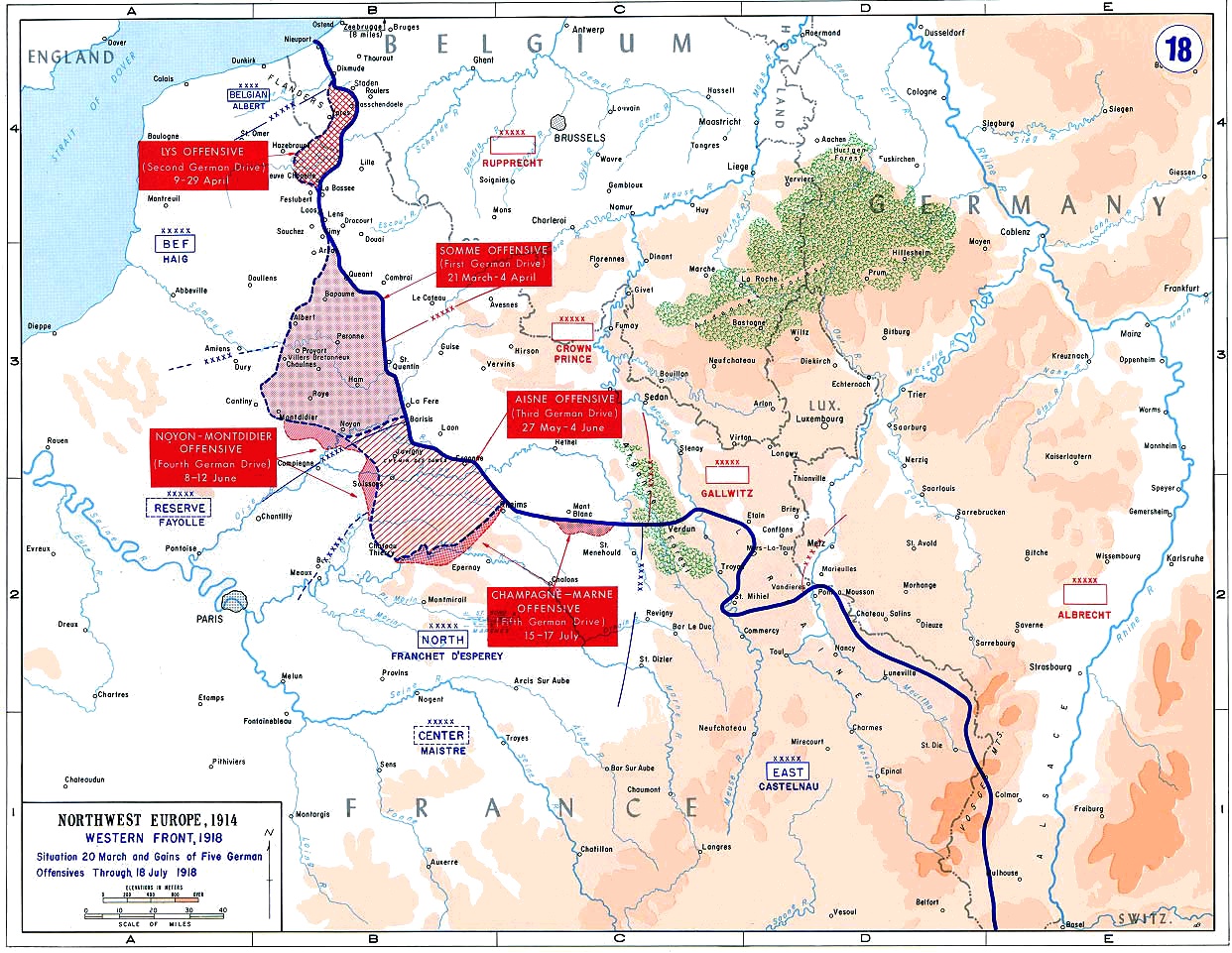
It would be massively successful as you saw from the picture above. They crushed through the line and were on the outskirts of Paris. But it failed -- why? Well, look at it. The rest of the front didn't really move all that much. What the Germans wanted was a quick knockout blow to secure the enemy capital and knock the British into the sea. What they effectively did was throw the remaining of their well trained men into the meat grinder for a bunch of strategically unimportant land. They over extended themselves and just got cut off, over extended, and killed as the rest of the army lagged behind.
The Hundred Days Offensive
What do you do when you combine Hutlier Tactics but across an entire front? Not just targeting one small area but doing it everywhere. You get the Hundred Days Offensive, in essence. Remember that one part I said in the beginning about offensives being limited basically to one area? Know how the Germans had the issue of using good tactics but just focusing in on one area and just taking too much of one spot and getting cut off? The Entente solved both of those issues. They would use those tactics and break through in an area...but then stop. They would pull those men back and leave a holding force and then attack somewhere else. Once the Germans arrived to stop that one offensive another would begin miles away hitting another weakened part of their line. Move forward, secure, retreat, repeat elsewhere.
It was literally Hutlier Tactics on a grand scale! They would constantly peck away at the entire German front, progressively driving it back and moving the entire front forward basically as a whole. Take out weak points all around the strong points and suddenly those strong points weren't so strong. Men would stay supplied, not over extend, and not get cut off. The Germans could not respond to it because they could not reasonably reinforce every single place on their front at once and could not respond to these tactics without knowing beforehand where they'd be coming from. It was at this point, once the Allies crushed through the infamous Hindenburg Line and the entire German front was collapsing on itself from constant, seemingly random offensives that the Generals proposed an armistice before their homeland was destroyed.
I'll let the WW2 historians come in to talk about light armor and advanced aviation and fully portable machine guns and NCO's and the inner workings of squad based tactics as they were expanded upon in the 20's and 30's. That's not my wheel house. However we can clearly see the foundations of a thoroughly modern method of warfare in August and September 1918. Flexibility, squad oriented assaults, combined arms tactics between artillery, air support, armor and infantry, on the field radio communication. I would certainly say that by the end of 1918 trench warfare was already dead. The nail was already set and had those first few taps. What technological changes happened in the next two decades -- sturdier tanks, tank destroyers, armored cars, sophisticated bombers and close air support, modern portable machine guns and so forth -- was just driving in the nail.
Notes:
"The Kaiser's Battle: 21 March 1918", Martin Middlebrook
"The First Day on the Somme", Martin Middlebrook
"French Strategy and Operations in the Great War", Robert Doughty
I'm going to try to make an ice sculpture with a hatchet and it's been a minute since i've read this book, but please bear with me.
Bruce Gudmundsson's book Stormtroop Tactics: Innovation in the German Army, 1914-1918 cover's this fairly extensively. During WWI a lot of new killing machines were created (machine guns, new artillery, tanks, militarized aircraft and hot air balloons, chemical warfare, mortars etc.) however, the greatest change was not WHAT we used to kill each but HOW. Initially, there was a lot of conflict in how war was supposed to be fought. Traditional thought was, in it's most simplified form, greater numbers and position ensure victory. While that will get you pretty far, it is awfully rigid. A war fought by large maneuver, using entire regiments of men as a single block on the war board, so to speak. Germany started to develop a new system where they broke their units down in to companies, platoons, and squads, much like we do currently. Instead of 400 some men looking to one man (the Lieutenant) the Germans began placing Non-Commissioned Officers (enlisted men of good merit) in command of the platoons and squads. The Lt would instruct his NCOs on the "Commanders Intent", which is basically the scheme of maneuver and battle objectives, and the NCOs would take this information to their men. This dissemination of orders and the intent of the mission allowed the entire company of men to adapt to the tempo of battle and be flexible when things didn't go as planned.
The German army also created a unit who's sole purpose was to test and develop new weapons and tactics to troublesome situations.
Wars are not won by planes, tanks, artillery, or any one piece of gear short of an atomic weapon. They are won by men.
For any current or former military member who has heard the term "small unit leadership", this is where it started.
edit: I forgot to add that this was the first time that the concept of "battles with limited objectives" were allowed at the discretion and initiative of the small unit leadership. Instead of only following the broad sweeps of the battle plan, if the opportunity for advancement, rout, or a good position were capable of being taken, it was up to the discretion of the small unit leaders. This is where the idea of fast horizontal communication amongst the platoons comes in to play. Basically, CO (commanding officer) says we have to take that hill. If the hill is taken and the NCOs see a small town ahead that looks viable for the taking it would take them little time to organize an attack.
If both sides in a battle hold their ground for extended periods of time, the construction of defensive works is inevitable. Battles therefore evolve toward sieges if they last long enough, and entrenchments follow from that.
Manoevering and military stalemate on the western front of WWI effectively dragged the conflict out long enough for the war to devolve into a grand mutual siege with extensive entrenchments. (The same conditions did not exist on other WWI fronts, and trench warfare did not take over those theatres.)
Blitzkrieg over the same ground in WWII was so fast and mobile that battles never settled down long enough for siege tactics to take over. So the simplest answer is that advances in mechanized warfare made the difference.
However, trench warfare did not become obsolete (it will still be used today, if the conditions are right). It just didn't take root on the western front in WWII because of the speed and mobility of the combatants in those particular battles. The eastern front saw many more battles that evolved toward siege-like conditions, and trench warfare was heavily used there. Here are some examples:
Elos outlines the weapons, but communication was just as important. The British developed the tank but there were occasions when it was shown to be no panacea, eg, the second day of Cambrai in 1917.
The real step forward to Blitzkreig and controlled, deep penetration operations was radio gear and the combined-arms mechanised force. The British also developed this and proved its viability in wargames as the 'Independent Force' under Percy Hobart in the mid 1930s. However, the threat to traditional arms (especially cavalry) in the British army and lack of money in the Depression led to its disbandment. What it proved was that tanks could be controlled and move and fight in a co-ordinated way throughout the battle. This had not been previously possible and once a battle started the plan usually fell apart and it was down to luck and the initiative of the troops.
It is worth noting that in the later stages of World War II fighting reverted to something closer to trench warfare than to Blitzkrieg. Fortified field positions could often stymie an armoured advance, and massive forces were needed to batter into places like Aarchen, Breslau and Koenigsburg. The fight through Normandy and Italy was slow and arduous.
The perfection of the tank, and the perfection of the strike aircraft. A WWII fighter could strafe a long line of ditches and kill everyone in the strike path. Adding a third dimension to the battlefield made trenches immovable easily located targets