Or is Islamic extremism a more recent phenomenon?
Terrorism as you're thinking is a more of a modern invention. Uprisings and rebellions would be what would have happened. Sunni's viewed the Ottoman caliphate as the top authority and continuation of Muhammed's blood line. It was pretty well accepted that what they said was truth in Islam if you were Ottoman and Sunni.
For followers of Shi'a Islam they tended to live in the Shi'a Safavid Dynasty in Persia or what is today Iran.
These two countries warred but it was more importantly land disputes and power disputes. The Ottomans in the early 16th century worrying about their native Shi'a population dispersed and relocated large populations of their Shi'a citizens, and then went to battle against the Safavids. They captured their capital decisively won those battles. The ottomans were a powerhouse in that time. Having a large, super loyal, well trained, disciplined and well armed army they easily defeated the Safavids in any major battle they fought.
Muhammed Ali of Egypt fought for the Ottomans and later turned against them in the 19th century but it was not due to religion. It was probably the largest open rebellion the Ottomans faced other than Greece successfully rebelling in that same time period.
I would argue that extremism is a modern idea with specific respect to terrorism. Most disagreements of the Ottoman's past were over power, and land rather than religious ideals.
/u/PharaohJoe is pretty much right about the majority of conflicts being political and terrorism being a mostly modern invention. However, the one conflict that seems to fit what you're asking about is the Wahhabist rebellion in what is now Saudi Arabia.
Wahhabism is named after Mohhamed Bin Abd el Wahhab, who was born around the turn of the 18th century in what is now rural Saudi Arabia (at the time a mostly empty desert with various tribal leaders, but ostensibly under Ottoman rule). In an age where Islamic jurisprudence and education was generally controlled by the Ottoman government (a Caliphate), he was sort of a self-educated Islamic scholar. He traveled in the Nejd desert around modern-day Saudi Arabia preaching his ideas, today sometimes also called Salafism (Salafis consider the term Wahhabi insulting).
The term Salafi refers to one who follows the earliest three generations of Muslims, based on a hadith where Mohammed said they were the best.
My Islamic Studies professor's notes give a "black list" for Wahhab:
The common thread here is that Wahhab thought much of what came after Mohhamed's time was heretical innovation and should be eliminated. If you're familiar with the ideas of the Taliban or ISIS, you'll probably notice some similarities.
Wahhab didn't get very far until he eventually formed an alliance with the al-Saud family in 1744. The Saudis and the Salfis conquered large parts of modern day Iraq and Saudi Arabia. This became known as the Emirate of Diriyah.
The Ottomans didn't really care (the region had little value to them in a pre-oil age) at first. Wahhab's religious ideas were quite literally stuck out in the desert and were in direct contradiction with popular Sufi and Shi'a religious practices at the time, so I doubt the Ottomans really worried about them spreading. But when the Wahhabi Saudis captured Mecca in 1803 (a serious political challenge to the Caliphate's legitimacy), the Ottomans decided send Ali Pasha from Egypt to put down the revolt, which he did easily by 1818.
The Saudis and Wahhabis retreated into the Nejd Desert and would not regain this level of power until the unification of modern day Saudi Arabia in the 20th century. Today, Wahhabism accounts for the rather severe religious practices of the modern Saudi state. The Saudis also spend a fair amount of money advocating for Wahhabi practices in other parts of the Islamic world.
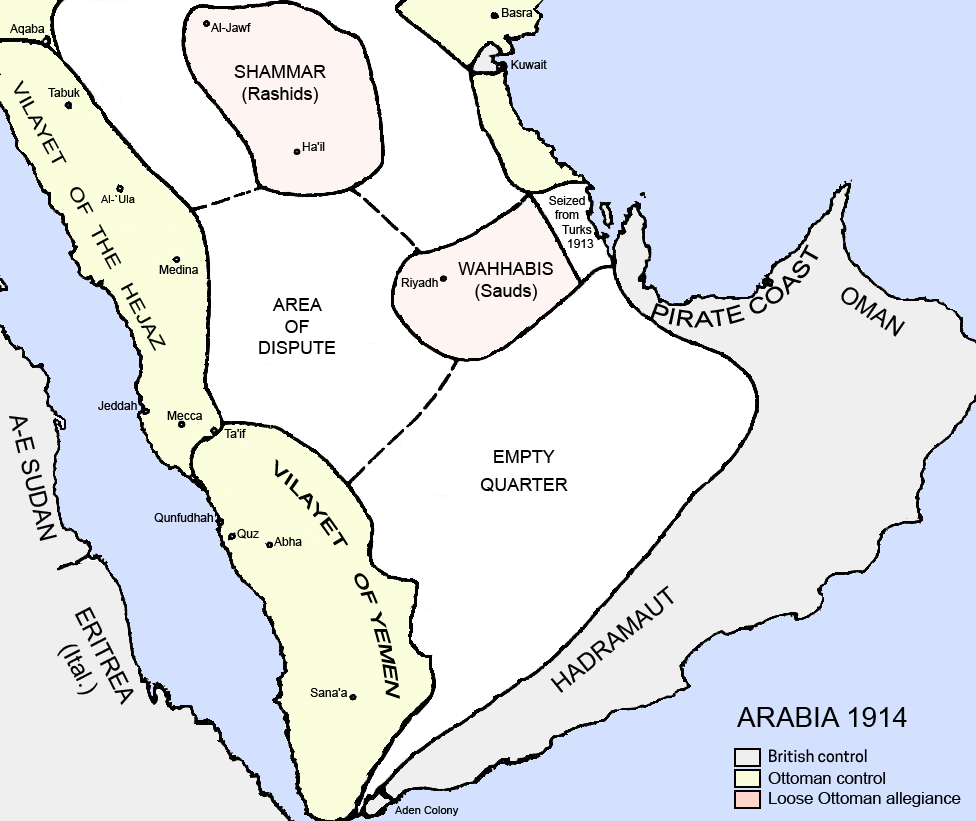
Edit: to show how loose/non-existent Ottoman control in the Nejd desert was - a map from 1914. For most of the Caliphate's history, it's rulers would have only cared about the areas labeled Vilayet of the Hejaz and Vilayet of Yemen, and only when the Saudis invaded these areas did it provoke an Ottoman response.
Like /u/PharaohJoe stated terrorism is a modern concept and did not emerge until the past couple of centuries. The Ottoman Empire never faced too much religious strife within its borders. One of the main reasons the Ottomans were able to avoid religious strife is because it claimed the Caliphate and the Ottoman administration system was tolerant of other religions and sects. This means everyone would be governed by their own courts. This resulted in a decrease in want for religious reform. But land reform was an issue in the Ottoman Empire. The want for land reform culminated in the 17th century with the Jelali Revolts that demanded reforms of the tax system. These series of revolts in the 16th and 17th century were mostly Turk based and the religion was pretty monotonous.
Other than the Jelali Reovlts, religious and ethnic rebellions did not occur on a large scale until the 19th century when most of the Balkans attained their independence from the Ottomans. Also, as /u/PharaohJoe stated, Muhammad Ali Pasha, originally an Albanian Christian, took over Egypt from its Mamluk rulers par the orders of the Ottoman sultans.
Sources:
https://openlibrary.org/books/OL2936204M/The_great_Anatolian_rebellion_1000-1020_1591-1611
and
A History of the Modern Middle East by Cleveland Burton
and
A History of Islamic Societies by Ira Lapidus
PS: If anyone wants to clear anything up go ahead, it is a bit late and I might be forgetting some things.
EDIT: Also I cannot believe I forgot this, but /u/MESICguy is right as well with the Wahhabis, but they were a later development in the Ottoman Empire and took place around the same time as the Balkan independence movements. And like he stated they lost power pretty quickly at the hands of Ali Pasha, only to rise again in the 20th century.