Are the "fair youth","dark lady" and "rival poet" thought to be real people?
They are thought to be autobiographical. However, we do not know for certain why the sonnets were written, who they were written for, or whether or not they were intended for publication. I wrote a little about this in an answer to a related question a few weeks ago. Here's the relevant portion:
It is widely presumed that Shakespeare's sonnets represent his own intimate feelings and may not have been intended for publication. If it is possible to know anything about his personality and thought process, that's where we're most likely to find it. Unfortunately they offer more questions than answers.
The first 126 sonnets are addressed to an unidentified young male (the "fair youth"). The first 17 implore the young man to find a suitable wife and marry so that his virtues might live on after him. Then, in sonnet 18 ("Shall I compare thee to a summer's day?") the sonnets begin to take on a romantic tone towards the reader and there are occasional mentions of jealousy over a rival poet in #78-86. Sonnet #20 explicitly laments that the fair youth is not a woman. These early sonnets, taken collectively, have sparked an argument among artists and historians as to whether sonnets 18-126 are evidence of a homosexual affair or if the love being expressed is entirely platonic. Suddenly, beginning in sonnet 127 the poems are being addressed to a new subject: The Dark Lady. Sonnets 127-152 are unambiguously sexual in nature. #151 is particularly risqué and bawdy and is often cited to distinguish the relationships between the Fair Youth and Dark Lady to counter claims of Shakespeare's possible bisexuality. This portion of the sonnets is frequently used to suggest that Shakespeare was unfaithful in his marriage while in London at least once. His passion for his Dark Lady is the kind of smoldering, half-guilty hunger that seems more suited to a secret lover than a distant spouse.
I could go on and on about this topic and books about this very question are an industry unto themselves. Our lack of knowledge about Shakespeare's personality tempts us to project our own personalities and the conventions of our times on him, but the only honest answer is that we don't know and are not likely to ever find out.
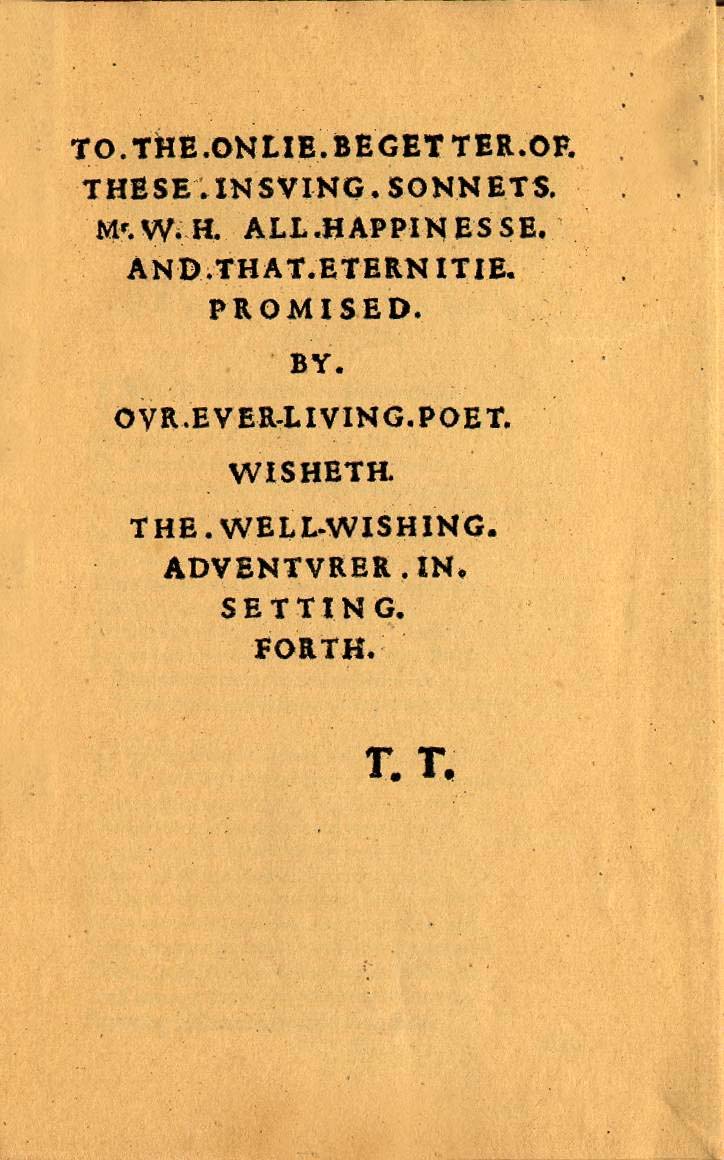
The dedication page from the sonnets original printing says they are dedicated to the mysterious "Mr. W.H.". There was much speculation throughout the 19th century as to the identity of W.H. Unfortunately they came to no conclusion and we still don't know who the intended reader (if there was one) was.
Edit: A good read on this topic is Shakespeare: The Evidence: Unlocking the Mysteries of the Man and His Work by Ian Wilson, 1999