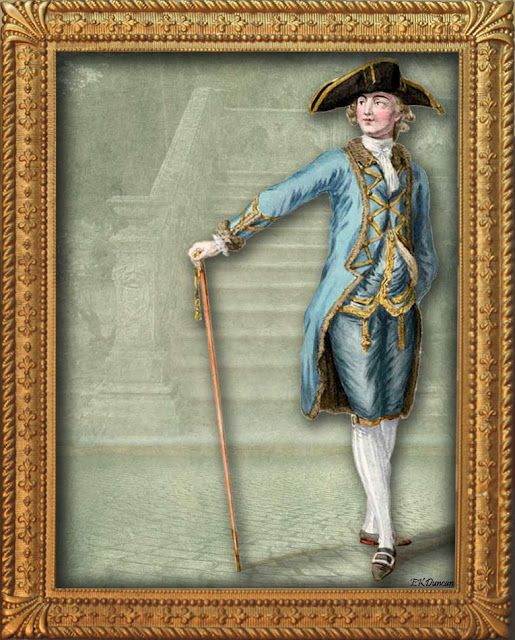
I am talking about European culture.
If you look at ~1900 European suit it looks essentially modern. Check out Wilde and Roosevelt. If you met those guys on the street they'd look fancy but acceptable.
If you look at the latter half of 19th century you get sort of modern coats. People hadn't liked ties yet and used jackets extensevely but looked mostly normal.
Then let's get another, say, 70 years back. You get this. And those hair. And this.
To me it looks like some big thing happened in the first half of 19th century that stopped men's fashion from evolving all the time, as before that you had some distinct changes all the time.
I would like to take a moment to say that in Western culture....suits like that were everyday wear. You would wear a suit to go to the grocery store. Now they are for formal occasions only. Men nowadays have buttondowns, polos, tshirts, khakis, jeans, shorts, etc. While fashion trends have stayed fairly stable with regards to suits and dress attire, casual daily clothes have certainly changed quite a bit.
Which culture are you referring to? Perhaps some examples would help your case.
The period in question also saw the invention of widespread photography in the 1830s. Note that all of your example images neatly segregate into photos for later styles, and paintings for earlier ones.
My speculation:
Photographs allow us to directly visualize what people looked like in a given period, which encourages a particular kind of imitation. We've all seen iconic photographs of Abraham Lincoln looking presidential, and movies of Cary Grant looking dapper. Photographs encourage us to connect to these older traditions in a visceral way that paintings and written descriptions do not.
Perhaps related is the phenomenon of Christmas music in the US. Many of the recordings you hear (in shopping malls etc.) date back to the 1950s, when the recording industry emerged as a major force. A recording allows us to tie back to our roots more directly than a song alone. (I.e. we connect more to Silver Bells as sung by Bing Crosby, than we do to Silver Bells as a generic song. I recognize this is a US-specific example.)
So I think there's a broad point here about the impact of high-fidelity recording on cultural evolution.